

10.9 Introduction to the Famous Scientists
747
+
V
(σ A ∗ · ∇ϕ + σ A · ∇ϕ ∗ )dV +
1
2
V
(∇ϕ ∗ · σ ∇Φ + ∇ϕ · σ ∇Φ ∗ )dV
−
V
( J ∗
s · A + J s · A ∗ )dV −
S
(H t · A ∗ + H ∗
t · A)dS
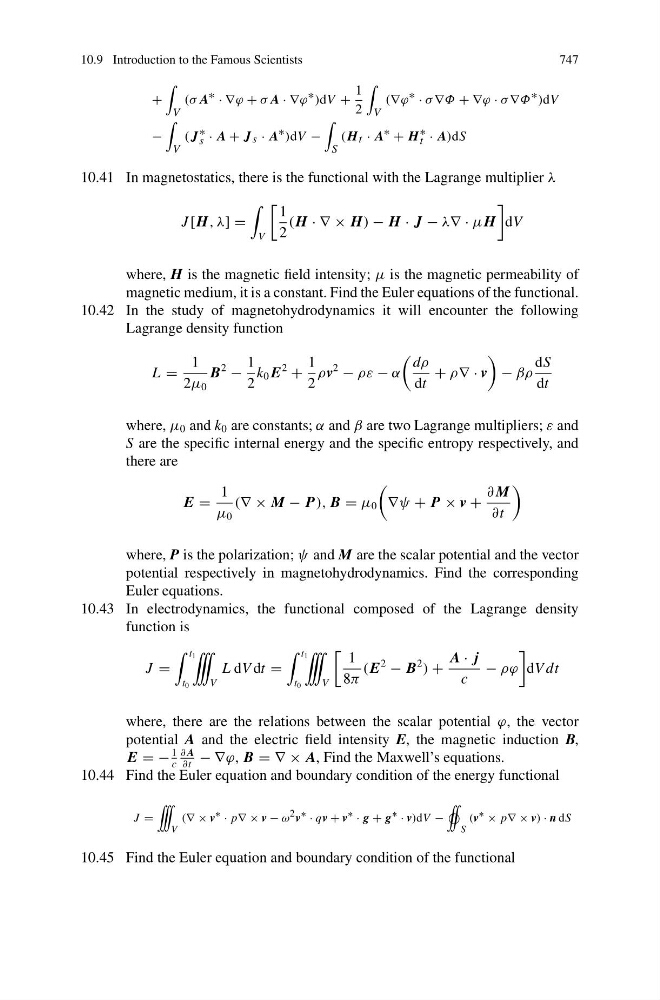
10.41 In magnetostatics, there is the functional with the Lagrange multiplier λ
J [H, λ] =
V
1
2
(H · ∇ × H) − H · J − λ∇ · μH
dV
where, H is the magnetic field intensity; μ is the magnetic permeability of
magnetic medium, it is a constant. Find the Euler equations of the functional.
10.42 In the study of magnetohydrodynamics it will encounter the following
Lagrange density function
L =
1
2μ 0
B
2
−
1
2
k 0 E
2
+
1
2
ρv
2
− ρε − α
dρ
dt
+ ρ∇ · v
− βρ
dS
dt
where, μ 0 and k 0 are constants; α and β are two Lagrange multipliers; ε and
S are the specific internal energy and the specific entropy respectively, and
there are
E =
1
μ 0
(∇ × M − P), B = μ 0
∇ψ + P × v +
∂ M
∂t
where, P is the polarization; ψ and M are the scalar potential and the vector
potential respectively in magnetohydrodynamics. Find the corresponding
Euler equations.
10.43 In electrodynamics, the functional composed of the Lagrange density
function is
J =
t 1
t 0
V
L dV dt =
t 1
t 0
V
1
8π
(E
2
− B
2
) +
A · j
c
− ρϕ
dV dt
where, there are the relations between the scalar potential ϕ, the vector
potential A and the electric field intensity E, the magnetic induction B,
E = −
1
c
∂ A
∂t
− ∇ϕ, B = ∇ × A, Find the Maxwell’s equations.
10.44 Find the Euler equation and boundary condition of the energy functional
J =
V
(∇ × v ∗ · p∇ × v − ω 2 v ∗ · qv + v ∗ · g + g ∗ · v)dV −
S
(v ∗ × p∇ × v) · n dS
10.45 Find the Euler equation and boundary condition of the functional