

728
10 Variational Problems of Functionals with Vector, Tensor …
defined on ∂ uV and ∂vV , n is an outward normal unit vector of ∂ V . Find its Euler
equations and boundary conditions.
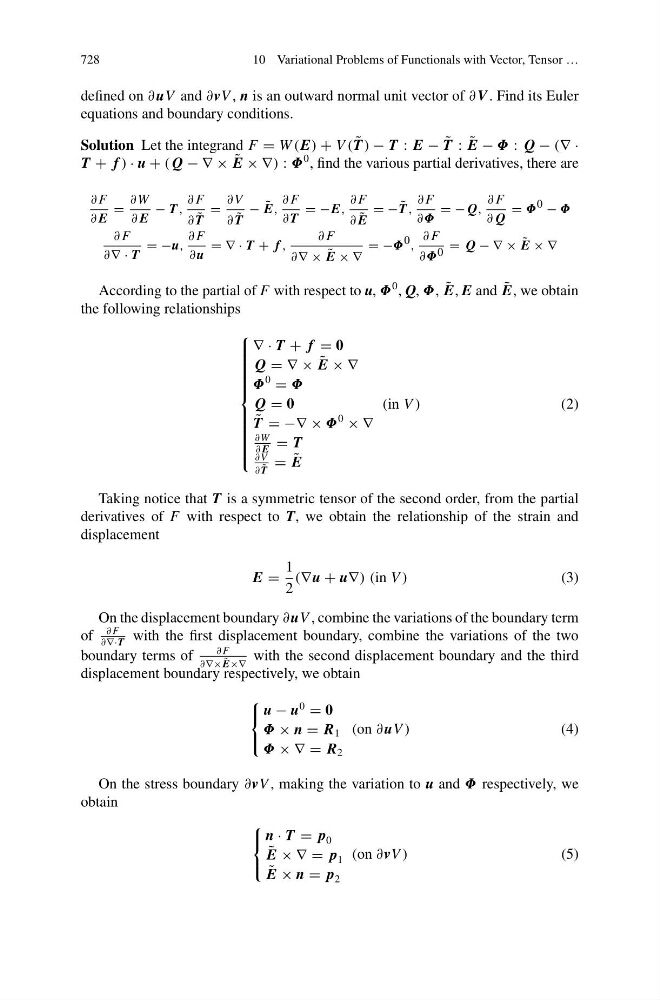
Solution Let the integrand F = W (E) + V ( ˜
T ) − T : E − ˜
T : ˜
E − Φ : Q − (∇ ·
T + f ) · u + ( Q − ∇ × ˜
E × ∇) : Φ
0 , find the various partial derivatives, there are
∂ F
∂ E
=
∂ W
∂ E
− T ,
∂ F
∂ ˜
T
=
∂ V
∂ ˜
T
− ˜
E,
∂ F
∂ T
= −E,
∂ F
∂ ˜
E
= − ˜
T ,
∂ F
∂Φ
= − Q,
∂ F
∂ Q
= Φ 0 − Φ
∂ F
∂∇ · T
= −u,
∂ F
∂ u
= ∇ · T + f ,
∂ F
∂∇ × ˜
E × ∇
= −Φ 0 ,
∂ F
∂Φ 0 = Q − ∇ × ˜
E × ∇
According to the partial of F with respect to u, Φ
0 , Q, Φ, ˜
E, E and ˜
E, we obtain
the following relationships
⎧
⎪ ⎪ ⎪ ⎪ ⎪ ⎪ ⎪ ⎪ ⎪ ⎨
⎪ ⎪ ⎪ ⎪ ⎪ ⎪ ⎪ ⎪ ⎪ ⎩
∇ · T + f = 0
Q = ∇ × ˜
E × ∇
Φ
0
= Φ
Q = 0
˜
T = −∇ × Φ
0
× ∇
∂ W
∂ E
= T
∂ V
∂ ˜
T
= ˜
E
(in V )
(2)
Taking notice that T is a symmetric tensor of the second order, from the partial
derivatives of F with respect to T, we obtain the relationship of the strain and
displacement
E =
1
2
(∇u + u∇) (in V )
(3)
On the displacement boundary ∂ uV , combine the variations of the boundary term
of
∂ F
∂∇·T
with the first displacement boundary, combine the variations of the two
boundary terms of
∂ F
∂∇× ˜
E×∇
with the second displacement boundary and the third
displacement boundary respectively, we obtain
⎧
⎨
⎩
u − u
0
= 0
Φ × n = R 1
Φ × ∇ = R 2
(on ∂ uV )
(4)
On the stress boundary ∂vV , making the variation to u and Φ respectively, we
obtain
⎧
⎨
⎩
n · T = p 0
˜
E × ∇ = p 1
˜
E × n = p 2
(on ∂vV )
(5)