

1.6 Summation Convention, Kronecker Delta and Permutation Symbols
57
Substituting Eq. (4) into Eq. (2), we obtain
ε i jk ε ist = δ js δ kt − δ ks δ jt
(5)
Quod erat demonstrandum.
Example 1.6.3 Prove Eqs. (1.6.23) and (1.6.24).
Proof Change the subscript s of ε − δ identity ε i jk ε ist = δ js δ kt − δ ks δ jt into j, there
is
ε i jk ε i jt = δ j j δ kt − δ k j δ jt = 3δ kt − δ kt = 2δ kt
Then change the subscript t of the above expression into k, there is
ε i jk ε i jk = 2δ kk = 2 × 3 = 6
Quod erat demonstrandum.
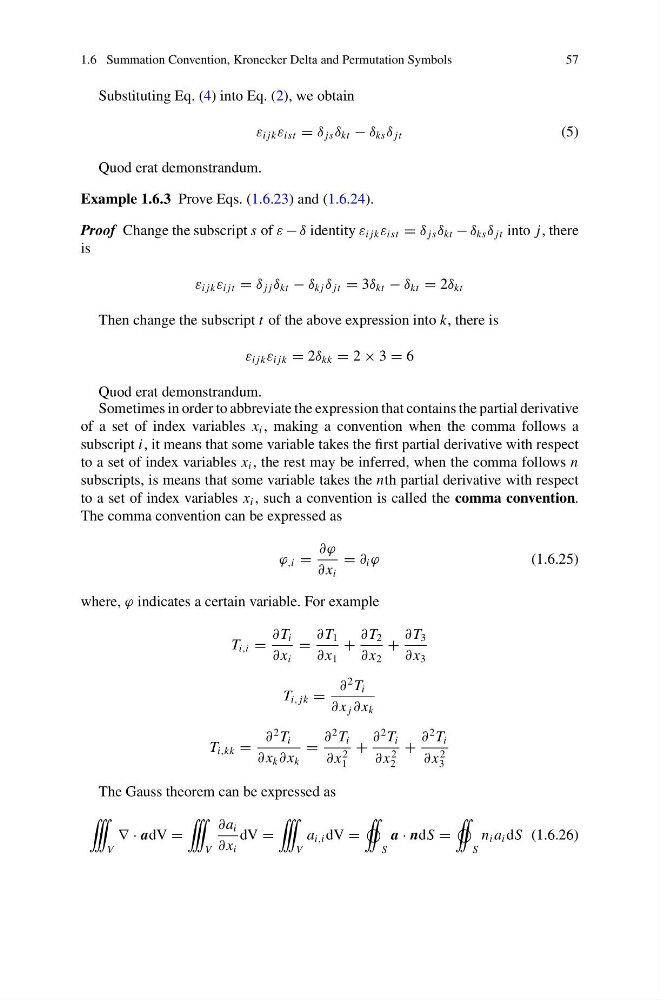
Sometimes in order to abbreviate the expression that contains the partial derivative
of a set of index variables x i , making a convention when the comma follows a
subscript i, it means that some variable takes the first partial derivative with respect
to a set of index variables x i , the rest may be inferred, when the comma follows n
subscripts, is means that some variable takes the nth partial derivative with respect
to a set of index variables x i , such a convention is called the comma convention.
The comma convention can be expressed as
ϕ ,i =
∂ϕ
∂ x i
= ∂ i ϕ
(1.6.25)
where, ϕ indicates a certain variable. For example
T i,i =
∂ T i
∂ x i
=
∂ T 1
∂ x 1
+
∂ T 2
∂ x 2
+
∂ T 3
∂ x 3
T i, jk =
∂
2 T i
∂ x j ∂ x k
T i,kk =
∂
2 T i
∂ x k ∂ x k
=
∂
2 T i
∂ x
2
1
+
∂
2 T i
∂ x
2
2
+
∂
2 T i
∂ x
2
3
The Gauss theorem can be expressed as
V
∇ · adV =
V
∂a i
∂ x i
dV =
V
a i,i dV =
S
a · ndS =
S
n i a i dS (1.6.26)
57
Substituting Eq. (4) into Eq. (2), we obtain
ε i jk ε ist = δ js δ kt − δ ks δ jt
(5)
Quod erat demonstrandum.
Example 1.6.3 Prove Eqs. (1.6.23) and (1.6.24).
Proof Change the subscript s of ε − δ identity ε i jk ε ist = δ js δ kt − δ ks δ jt into j, there
is
ε i jk ε i jt = δ j j δ kt − δ k j δ jt = 3δ kt − δ kt = 2δ kt
Then change the subscript t of the above expression into k, there is
ε i jk ε i jk = 2δ kk = 2 × 3 = 6
Quod erat demonstrandum.
Sometimes in order to abbreviate the expression that contains the partial derivative
of a set of index variables x i , making a convention when the comma follows a
subscript i, it means that some variable takes the first partial derivative with respect
to a set of index variables x i , the rest may be inferred, when the comma follows n
subscripts, is means that some variable takes the nth partial derivative with respect
to a set of index variables x i , such a convention is called the comma convention.
The comma convention can be expressed as
ϕ ,i =
∂ϕ
∂ x i
= ∂ i ϕ
(1.6.25)
where, ϕ indicates a certain variable. For example
T i,i =
∂ T i
∂ x i
=
∂ T 1
∂ x 1
+
∂ T 2
∂ x 2
+
∂ T 3
∂ x 3
T i, jk =
∂
2 T i
∂ x j ∂ x k
T i,kk =
∂
2 T i
∂ x k ∂ x k
=
∂
2 T i
∂ x
2
1
+
∂
2 T i
∂ x
2
2
+
∂
2 T i
∂ x
2
3
The Gauss theorem can be expressed as
V
∇ · adV =
V
∂a i
∂ x i
dV =
V
a i,i dV =
S
a · ndS =
S
n i a i dS (1.6.26)