

10.7 Variational Problems of Functionals with Series-Type …
723
with the rotation, the four kinds of variational problems can be boiled down to the
operation conforming to the definition of Eq. (7.4.6). In former two cases ∇× and
×∇ are both the self-adjoint operators. In latter two cases ∇× and ×∇ are both the
self-adjoint operators under the definition of Eq. (7.4.6).
Example 10.7.1 Let V be the region of the elastic body, S(S = S u + S p ) is the
boundary surface of V, n is the exterior normal unit vector on the boundary surface
S, the displacement is given on the displacement boundary S u : u| S u = u, the force
per unit area is given on the stress boundary S p : p| S p = p, e is the strain tensor, σ is
the stress tensor, f is the force per unit body, a is the reciprocal fourth-order tensor.
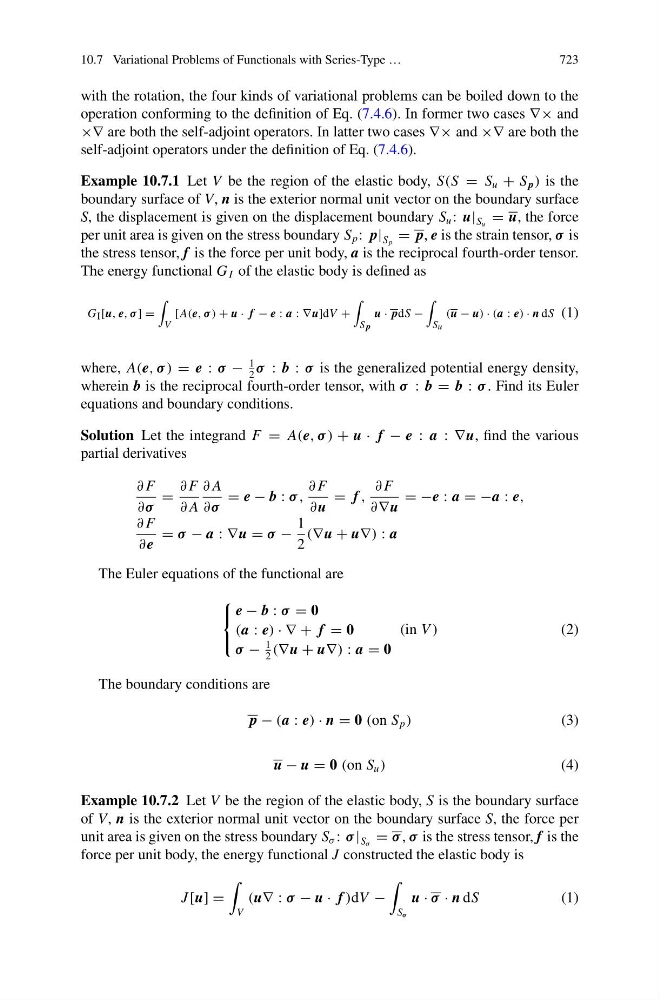
The energy functional G I of the elastic body is defined as
G I [u, e, σ ] =
V
[A(e, σ ) + u · f − e : a : ∇u]dV +
S p
u · pdS −
S u
(u − u) · (a : e) · n dS (1)
where, A(e, σ ) = e : σ −
1
2
σ : b : σ is the generalized potential energy density,
wherein b is the reciprocal fourth-order tensor, with σ : b = b : σ . Find its Euler
equations and boundary conditions.
Solution Let the integrand F = A(e, σ ) + u · f − e : a : ∇u, find the various
partial derivatives
∂ F
∂σ
=
∂ F
∂ A
∂ A
∂σ
= e − b : σ ,
∂ F
∂ u
= f ,
∂ F
∂∇u
= −e : a = −a : e,
∂ F
∂ e
= σ − a : ∇u = σ −
1
2
(∇u + u∇) : a
The Euler equations of the functional are
⎧
⎨
⎩
e − b : σ = 0
(a : e) · ∇ + f = 0
σ −
1
2
(∇u + u∇) : a = 0
(in V )
(2)
The boundary conditions are
p − (a : e) · n = 0 (on S p )
(3)
u − u = 0 (on S u )
(4)
Example 10.7.2 Let V be the region of the elastic body, S is the boundary surface
of V, n is the exterior normal unit vector on the boundary surface S, the force per
unit area is given on the stress boundary S σ : σ | S σ = σ , σ is the stress tensor, f is the
force per unit body, the energy functional J constructed the elastic body is
J [u] =
V
(u∇ : σ − u · f )dV −
S σ
u · σ · n dS
(1)