

698
10 Variational Problems of Functionals with Vector, Tensor …
−
A P
u · P 1N d A −
A u
(u − u 1 ) · F · K · ndA
(1)
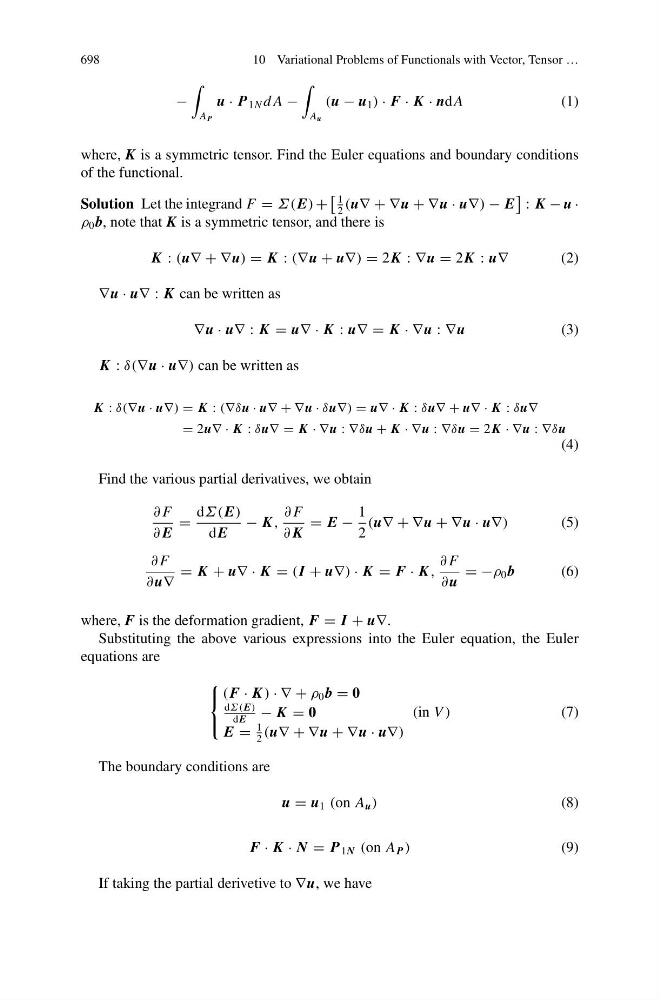
where, K is a symmetric tensor. Find the Euler equations and boundary conditions
of the functional.
Solution Let the integrand F = Σ(E) +
1
2
(u∇ + ∇u + ∇u · u∇) − E
: K − u ·
ρ 0 b, note that K is a symmetric tensor, and there is
K : (u∇ + ∇u) = K : (∇u + u∇) = 2K : ∇u = 2K : u∇
(2)
∇u · u∇ : K can be written as
∇u · u∇ : K = u∇ · K : u∇ = K · ∇u : ∇u
(3)
K : δ(∇u · u∇) can be written as
K : δ(∇u · u∇) = K : (∇δu · u∇ + ∇u · δu∇) = u∇ · K : δu∇ + u∇ · K : δu∇
= 2u∇ · K : δu∇ = K · ∇u : ∇δu + K · ∇u : ∇δu = 2K · ∇u : ∇δu
(4)
Find the various partial derivatives, we obtain
∂ F
∂ E
=
dΣ(E)
dE
− K ,
∂ F
∂ K
= E −
1
2
(u∇ + ∇u + ∇u · u∇)
(5)
∂ F
∂ u∇
= K + u∇ · K = (I + u∇) · K = F · K ,
∂ F
∂ u
= −ρ 0 b
(6)
where, F is the deformation gradient, F = I + u∇.
Substituting the above various expressions into the Euler equation, the Euler
equations are
⎧
⎨
⎩
(F · K ) · ∇ + ρ 0 b = 0
dΣ(E)
dE
− K = 0
E =
1
2
(u∇ + ∇u + ∇u · u∇)
(in V )
(7)
The boundary conditions are
u = u 1 (on A u )
(8)
F · K · N = P 1N (on A P )
(9)
If taking the partial derivetive to ∇u, we have