

696
10 Variational Problems of Functionals with Vector, Tensor …
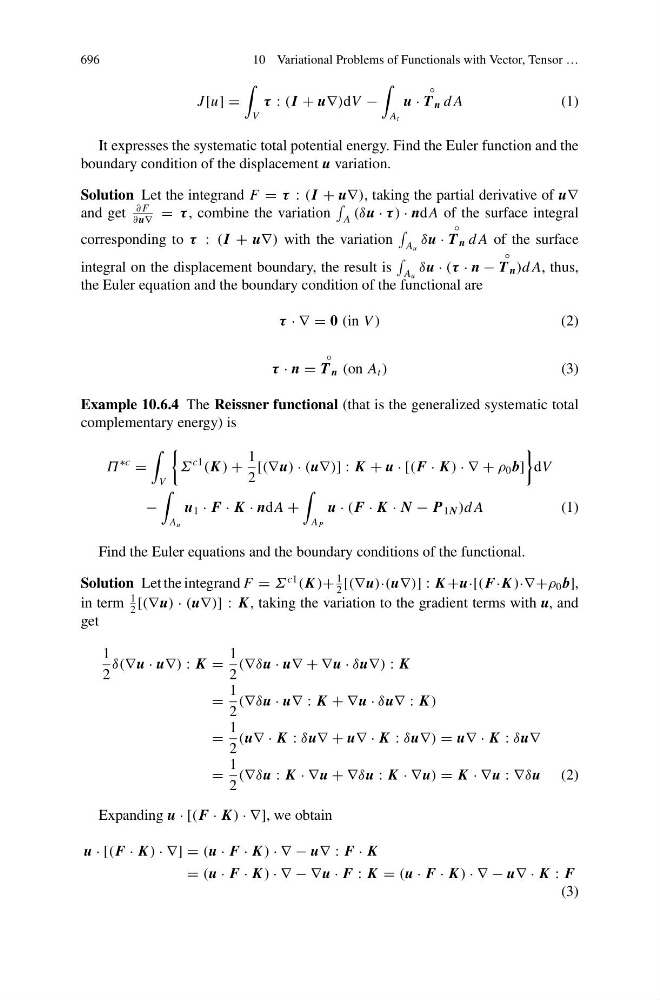
J [u] =
V
τ : (I + u∇)dV −
A t
u ·
◦
T n d A
(1)
It expresses the systematic total potential energy. Find the Euler function and the
boundary condition of the displacement u variation.
Solution Let the integrand F = τ : (I + u∇), taking the partial derivative of u∇
and get
∂ F
∂ u∇
= τ , combine the variation
A (δu · τ ) · ndA of the surface integral
corresponding to τ : (I + u∇) with the variation
A u
δu ·
◦
T n d A of the surface
integral on the displacement boundary, the result is
A u
δu · (τ · n −
◦
T n )d A, thus,
the Euler equation and the boundary condition of the functional are
τ · ∇ = 0 (in V )
(2)
τ · n =
◦
T n (on A t )
(3)
Example 10.6.4 The Reissner functional (that is the generalized systematic total
complementary energy) is
Π
∗c
=
V
Σ
c1
(K ) +
1
2
[(∇u) · (u∇)] : K + u · [(F · K ) · ∇ + ρ 0 b]
dV
−
A u
u 1 · F · K · ndA +
A P
u · (F · K · N − P 1N )d A
(1)
Find the Euler equations and the boundary conditions of the functional.
Solution Let the integrand F = Σ
c1
(K )+
1
2
[(∇u)·(u∇)] : K +u·[(F· K )·∇+ρ 0 b],
in term
1
2
[(∇u) · (u∇)] : K , taking the variation to the gradient terms with u, and
get
1
2
δ(∇u · u∇) : K =
1
2
(∇δu · u∇ + ∇u · δu∇) : K
=
1
2
(∇δu · u∇ : K + ∇u · δu∇ : K )
=
1
2
(u∇ · K : δu∇ + u∇ · K : δu∇) = u∇ · K : δu∇
=
1
2
(∇δu : K · ∇u + ∇δu : K · ∇u) = K · ∇u : ∇δu (2)
Expanding u · [(F · K ) · ∇], we obtain
u · [(F · K ) · ∇] = (u · F · K ) · ∇ − u∇ : F · K
= (u · F · K ) · ∇ − ∇u · F : K = (u · F · K ) · ∇ − u∇ · K : F
(3)