

1.6 Summation Convention, Kronecker Delta and Permutation Symbols
53
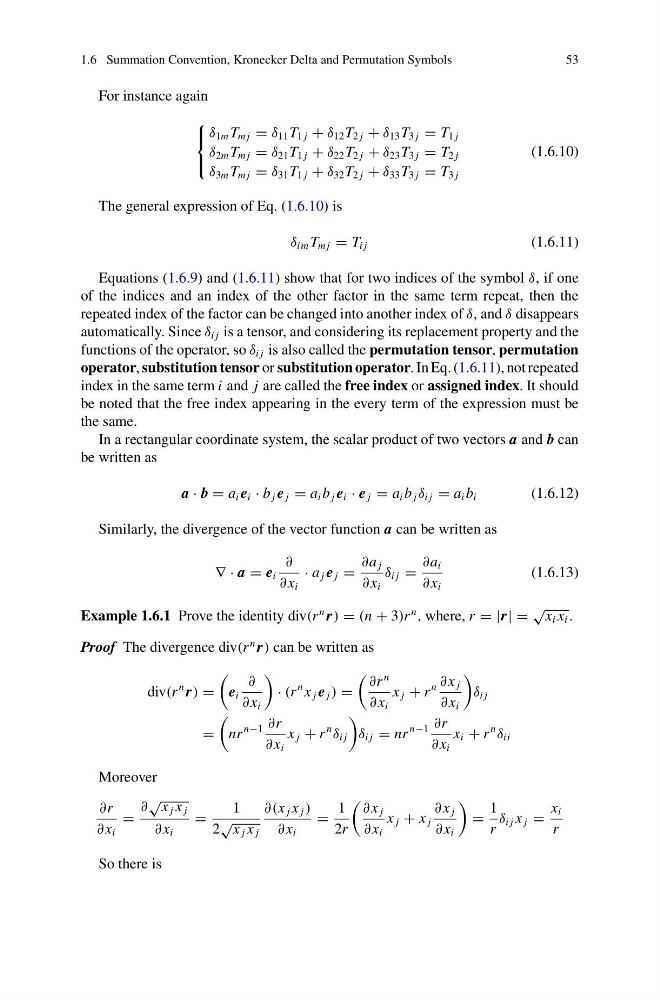
For instance again
⎧
⎨
⎩
δ 1m T m j = δ 11 T 1 j + δ 12 T 2 j + δ 13 T 3 j = T 1 j
δ 2m T m j = δ 21 T 1 j + δ 22 T 2 j + δ 23 T 3 j = T 2 j
δ 3m T m j = δ 31 T 1 j + δ 32 T 2 j + δ 33 T 3 j = T 3 j
(1.6.10)
The general expression of Eq. (1.6.10) is
δ im T m j = T i j
(1.6.11)
Equations (1.6.9) and (1.6.11) show that for two indices of the symbol δ, if one
of the indices and an index of the other factor in the same term repeat, then the
repeated index of the factor can be changed into another index of δ, and δ disappears
automatically. Since δ i j is a tensor, and considering its replacement property and the
functions of the operator, so δ i j is also called the permutation tensor, permutation
operator, substitution tensor or substitution operator. In Eq. (1.6.11), not repeated
index in the same term i and j are called the free index or assigned index. It should
be noted that the free index appearing in the every term of the expression must be
the same.
In a rectangular coordinate system, the scalar product of two vectors a and b can
be written as
a · b = a i e i · b j e j = a i b j e i · e j = a i b j δ i j = a i b i
(1.6.12)
Similarly, the divergence of the vector function a can be written as
∇ · a = e i
∂
∂ x i
· a j e j =
∂a j
∂ x i
δ i j =
∂a i
∂ x i
(1.6.13)
Example 1.6.1 Prove the identity div(r
n r) = (n + 3)r
n , where, r = |r| =
√ x i x i .
Proof The divergence div(r
n r) can be written as
div(r
n r) =
e i
∂
∂ x i
· (r
n x j e j ) =
∂r
n
∂ x i
x j + r
n ∂ x j
∂ x i
δ i j
=
nr
n−1 ∂r
∂ x i
x j + r
n
δ i j
δ i j = nr
n−1 ∂r
∂ x i
x i + r
n
δ ii
Moreover
∂r
∂ x i
=
∂
√ x j x j
∂ x i
=
1
2
√ x j x j
∂(x j x j )
∂ x i
=
1
2r
∂ x j
∂ x i
x j + x j
∂ x j
∂ x i
=
1
r
δ i j x j =
x i
r
So there is
53
For instance again
⎧
⎨
⎩
δ 1m T m j = δ 11 T 1 j + δ 12 T 2 j + δ 13 T 3 j = T 1 j
δ 2m T m j = δ 21 T 1 j + δ 22 T 2 j + δ 23 T 3 j = T 2 j
δ 3m T m j = δ 31 T 1 j + δ 32 T 2 j + δ 33 T 3 j = T 3 j
(1.6.10)
The general expression of Eq. (1.6.10) is
δ im T m j = T i j
(1.6.11)
Equations (1.6.9) and (1.6.11) show that for two indices of the symbol δ, if one
of the indices and an index of the other factor in the same term repeat, then the
repeated index of the factor can be changed into another index of δ, and δ disappears
automatically. Since δ i j is a tensor, and considering its replacement property and the
functions of the operator, so δ i j is also called the permutation tensor, permutation
operator, substitution tensor or substitution operator. In Eq. (1.6.11), not repeated
index in the same term i and j are called the free index or assigned index. It should
be noted that the free index appearing in the every term of the expression must be
the same.
In a rectangular coordinate system, the scalar product of two vectors a and b can
be written as
a · b = a i e i · b j e j = a i b j e i · e j = a i b j δ i j = a i b i
(1.6.12)
Similarly, the divergence of the vector function a can be written as
∇ · a = e i
∂
∂ x i
· a j e j =
∂a j
∂ x i
δ i j =
∂a i
∂ x i
(1.6.13)
Example 1.6.1 Prove the identity div(r
n r) = (n + 3)r
n , where, r = |r| =
√ x i x i .
Proof The divergence div(r
n r) can be written as
div(r
n r) =
e i
∂
∂ x i
· (r
n x j e j ) =
∂r
n
∂ x i
x j + r
n ∂ x j
∂ x i
δ i j
=
nr
n−1 ∂r
∂ x i
x j + r
n
δ i j
δ i j = nr
n−1 ∂r
∂ x i
x i + r
n
δ ii
Moreover
∂r
∂ x i
=
∂
√ x j x j
∂ x i
=
1
2
√ x j x j
∂(x j x j )
∂ x i
=
1
2r
∂ x j
∂ x i
x j + x j
∂ x j
∂ x i
=
1
r
δ i j x j =
x i
r
So there is