

10.5 The Euler Equations of Rotation Type Functionals
677
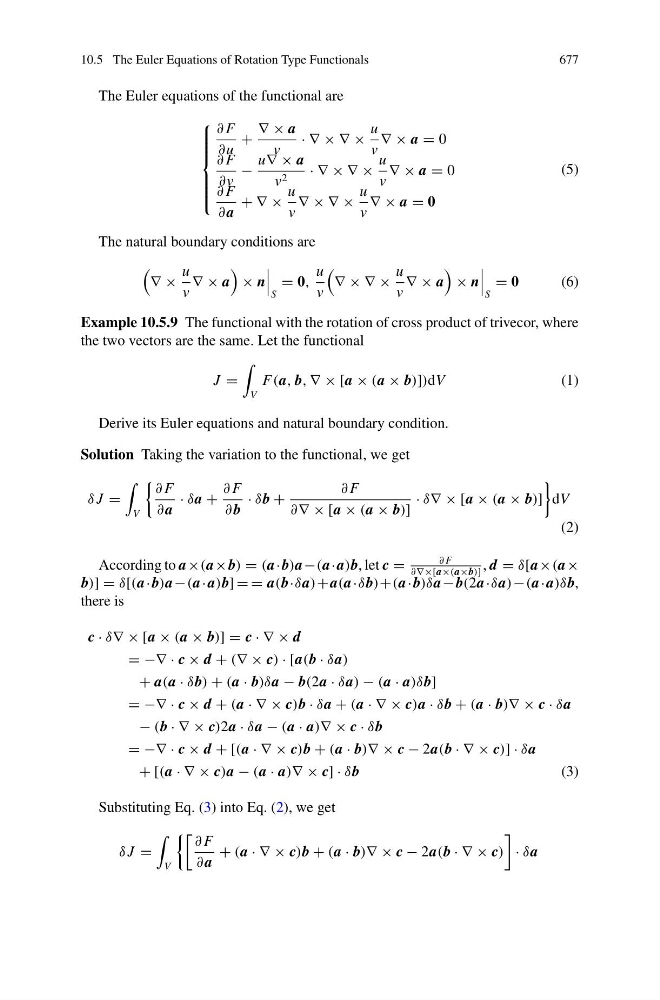
The Euler equations of the functional are
⎧
⎪ ⎪ ⎪ ⎪ ⎨
⎪ ⎪ ⎪ ⎪ ⎩
∂ F
∂u
+
∇ × a
v
· ∇ × ∇ ×
u
v
∇ × a = 0
∂ F
∂v
−
u∇ × a
v 2
· ∇ × ∇ ×
u
v
∇ × a = 0
∂ F
∂ a
+ ∇ ×
u
v
∇ × ∇ ×
u
v
∇ × a = 0
(5)
The natural boundary conditions are
∇ ×
u
v
∇ × a
× n
S
= 0,
u
v
∇ × ∇ ×
u
v
∇ × a
× n
S
= 0
(6)
Example 10.5.9 The functional with the rotation of cross product of trivecor, where
the two vectors are the same. Let the functional
J =
V
F(a, b, ∇ × [a × (a × b)])dV
(1)
Derive its Euler equations and natural boundary condition.
Solution Taking the variation to the functional, we get
δ J =
V
∂ F
∂ a
· δa +
∂ F
∂ b
· δb +
∂ F
∂∇ × [a × (a × b)]
· δ∇ × [a × (a × b)]
dV
(2)
According to a×(a×b) = (a·b)a−(a·a)b, let c =
∂ F
∂∇×[a×(a×b)]
, d = δ[a×(a×
b)] = δ[(a· b)a−(a· a)b] = = a(b·δa)+ a(a·δb)+(a· b)δa− b(2a·δa)−(a· a)δb,
there is
c · δ∇ × [a × (a × b)] = c · ∇ × d
= −∇ · c × d + (∇ × c) · [a(b · δa)
+ a(a · δb) + (a · b)δa − b(2a · δa) − (a · a)δb]
= −∇ · c × d + (a · ∇ × c)b · δa + (a · ∇ × c)a · δb + (a · b)∇ × c · δa
− (b · ∇ × c)2a · δa − (a · a)∇ × c · δb
= −∇ · c × d + [(a · ∇ × c)b + (a · b)∇ × c − 2a(b · ∇ × c)] · δa
+ [(a · ∇ × c)a − (a · a)∇ × c] · δb
(3)
Substituting Eq. (3) into Eq. (2), we get
δ J =
V
∂ F
∂ a
+ (a · ∇ × c)b + (a · b)∇ × c − 2a(b · ∇ × c)
· δa