

10.4 The Euler Equations of Divergence Type Functionals
667
δ J =
V
∂ F
∂u
+ ∇ · ∇v × ∇ϕ
δu +
∂ F
∂v
− ∇ · ∇u × ∇ϕ
δv
dV
+
V
[∇ · ϕa − ∇ · (∇v × ∇ϕ)δu + ∇ · (∇u × ∇ϕ)δv]dV
(4)
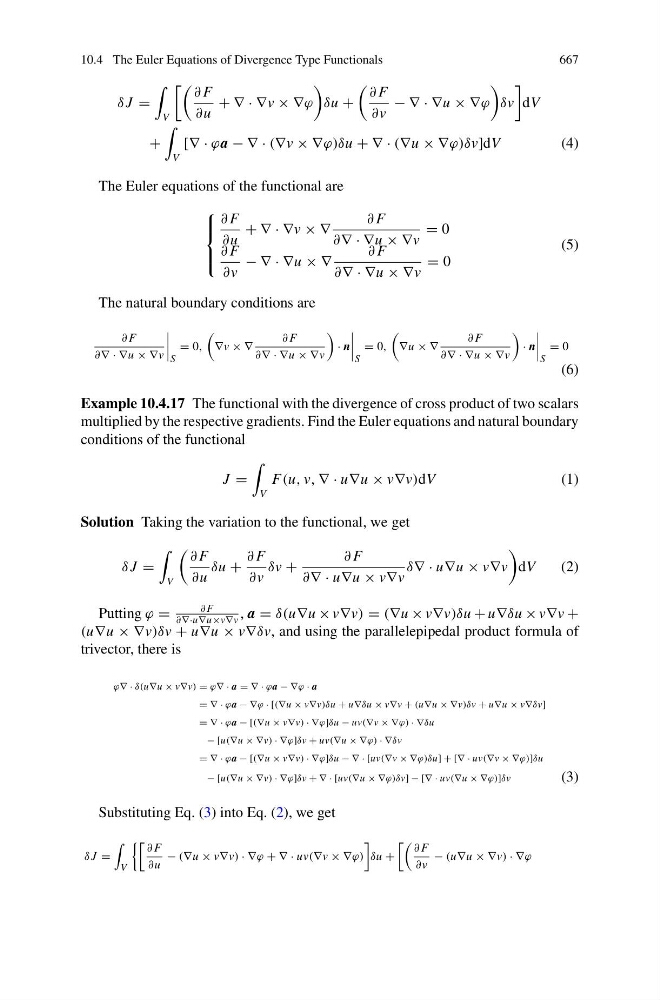
The Euler equations of the functional are
⎧
⎪ ⎨
⎪ ⎩
∂ F
∂u
+ ∇ · ∇v × ∇
∂ F
∂∇ · ∇u × ∇v
= 0
∂ F
∂v
− ∇ · ∇u × ∇
∂ F
∂∇ · ∇u × ∇v
= 0
(5)
The natural boundary conditions are
∂ F
∂∇ · ∇u × ∇v
S
= 0,
∇v × ∇
∂ F
∂∇ · ∇u × ∇v
· n
S
= 0,
∇u × ∇
∂ F
∂∇ · ∇u × ∇v
· n
S
= 0
(6)
Example 10.4.17 The functional with the divergence of cross product of two scalars
multiplied by the respective gradients. Find the Euler equations and natural boundary
conditions of the functional
J =
V
F(u, v, ∇ · u∇u × v∇v)dV
(1)
Solution Taking the variation to the functional, we get
δ J =
V
∂ F
∂u
δu +
∂ F
∂v
δv +
∂ F
∂∇ · u∇u × v∇v
δ∇ · u∇u × v∇v
dV
(2)
Putting ϕ =
∂ F
∂∇·u∇u×v∇v
, a = δ(u∇u × v∇v) = (∇u × v∇v)δu + u∇δu × v∇v +
(u∇u × ∇v)δv + u∇u × v∇δv, and using the parallelepipedal product formula of
trivector, there is
ϕ∇ · δ(u∇u × v∇v) = ϕ∇ · a = ∇ · ϕa − ∇ϕ · a
= ∇ · ϕa − ∇ϕ · [(∇u × v∇v)δu + u∇δu × v∇v + (u∇u × ∇v)δv + u∇u × v∇δv]
= ∇ · ϕa − [(∇u × v∇v) · ∇ϕ]δu − uv(∇v × ∇ϕ) · ∇δu
− [u(∇u × ∇v) · ∇ϕ]δv + uv(∇u × ∇ϕ) · ∇δv
= ∇ · ϕa − [(∇u × v∇v) · ∇ϕ]δu − ∇ · [uv(∇v × ∇ϕ)δu] + [∇ · uv(∇v × ∇ϕ)]δu
− [u(∇u × ∇v) · ∇ϕ]δv + ∇ · [uv(∇u × ∇ϕ)δv] − [∇ · uv(∇u × ∇ϕ)]δv
(3)
Substituting Eq. (3) into Eq. (2), we get
δ J =
V
∂ F
∂u
− (∇u × v∇v) · ∇ϕ + ∇ · uv(∇v × ∇ϕ)
δu +
∂ F
∂v
− (u∇u × ∇v) · ∇ϕ