

1.5 Fundamental Lemmas of the Calculus of Variations
51
b
a
f (x)η
(n)
(x)dx = 0
(1.5.19)
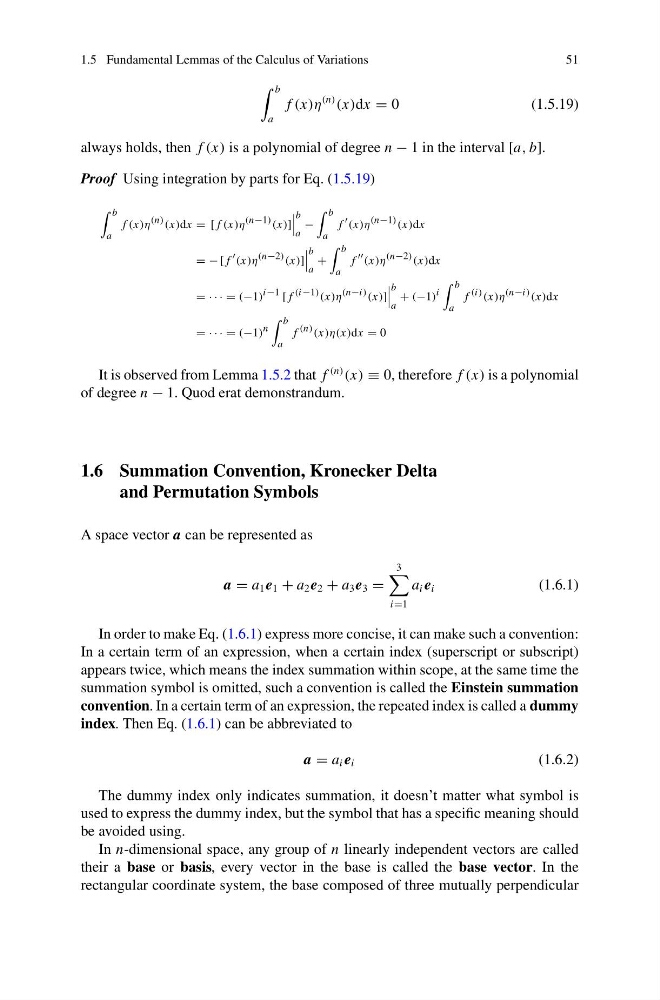
always holds, then f (x) is a polynomial of degree n − 1 in the interval [a, b].
Proof Using integration by parts for Eq. (1.5.19)
b
a
f (x)η (n) (x)dx = [ f (x)η (n−1) (x)]
b
a
−
b
a
f (x)η (n−1) (x)dx
= − [ f (x)η (n−2) (x)]
b
a
+
b
a
f (x)η (n−2) (x)dx
= · · · = (−1) i−1 [ f (i−1) (x)η (n−i) (x)]
b
a
+ (−1) i
b
a
f (i) (x)η (n−i) (x)dx
= · · · = (−1) n
b
a
f (n) (x)η(x)dx = 0
It is observed from Lemma 1.5.2 that f
(n)
(x) ≡ 0, therefore f (x) is a polynomial
of degree n − 1. Quod erat demonstrandum.
1.6 Summation Convention, Kronecker Delta
and Permutation Symbols
A space vector a can be represented as
a = a 1 e 1 + a 2 e 2 + a 3 e 3 =
3
i=1
a i e i
(1.6.1)
In order to make Eq. (1.6.1) express more concise, it can make such a convention:
In a certain term of an expression, when a certain index (superscript or subscript)
appears twice, which means the index summation within scope, at the same time the
summation symbol is omitted, such a convention is called the Einstein summation
convention. In a certain term of an expression, the repeated index is called a dummy
index. Then Eq. (1.6.1) can be abbreviated to
a = a i e i
(1.6.2)
The dummy index only indicates summation, it doesn’t matter what symbol is
used to express the dummy index, but the symbol that has a specific meaning should
be avoided using.
In n-dimensional space, any group of n linearly independent vectors are called
their a base or basis, every vector in the base is called the base vector. In the
rectangular coordinate system, the base composed of three mutually perpendicular
51
b
a
f (x)η
(n)
(x)dx = 0
(1.5.19)
always holds, then f (x) is a polynomial of degree n − 1 in the interval [a, b].
Proof Using integration by parts for Eq. (1.5.19)
b
a
f (x)η (n) (x)dx = [ f (x)η (n−1) (x)]
b
a
−
b
a
f (x)η (n−1) (x)dx
= − [ f (x)η (n−2) (x)]
b
a
+
b
a
f (x)η (n−2) (x)dx
= · · · = (−1) i−1 [ f (i−1) (x)η (n−i) (x)]
b
a
+ (−1) i
b
a
f (i) (x)η (n−i) (x)dx
= · · · = (−1) n
b
a
f (n) (x)η(x)dx = 0
It is observed from Lemma 1.5.2 that f
(n)
(x) ≡ 0, therefore f (x) is a polynomial
of degree n − 1. Quod erat demonstrandum.
1.6 Summation Convention, Kronecker Delta
and Permutation Symbols
A space vector a can be represented as
a = a 1 e 1 + a 2 e 2 + a 3 e 3 =
3
i=1
a i e i
(1.6.1)
In order to make Eq. (1.6.1) express more concise, it can make such a convention:
In a certain term of an expression, when a certain index (superscript or subscript)
appears twice, which means the index summation within scope, at the same time the
summation symbol is omitted, such a convention is called the Einstein summation
convention. In a certain term of an expression, the repeated index is called a dummy
index. Then Eq. (1.6.1) can be abbreviated to
a = a i e i
(1.6.2)
The dummy index only indicates summation, it doesn’t matter what symbol is
used to express the dummy index, but the symbol that has a specific meaning should
be avoided using.
In n-dimensional space, any group of n linearly independent vectors are called
their a base or basis, every vector in the base is called the base vector. In the
rectangular coordinate system, the base composed of three mutually perpendicular