

10.4 The Euler Equations of Divergence Type Functionals
657
δ J =
V
∂ F
∂u
δu +
∂ F
∂ a
· δa +
∂ F
∂ b
· δb +
∂ F
∂∇ · (ua × b)
δ∇ · (ua × b)
dV (2)
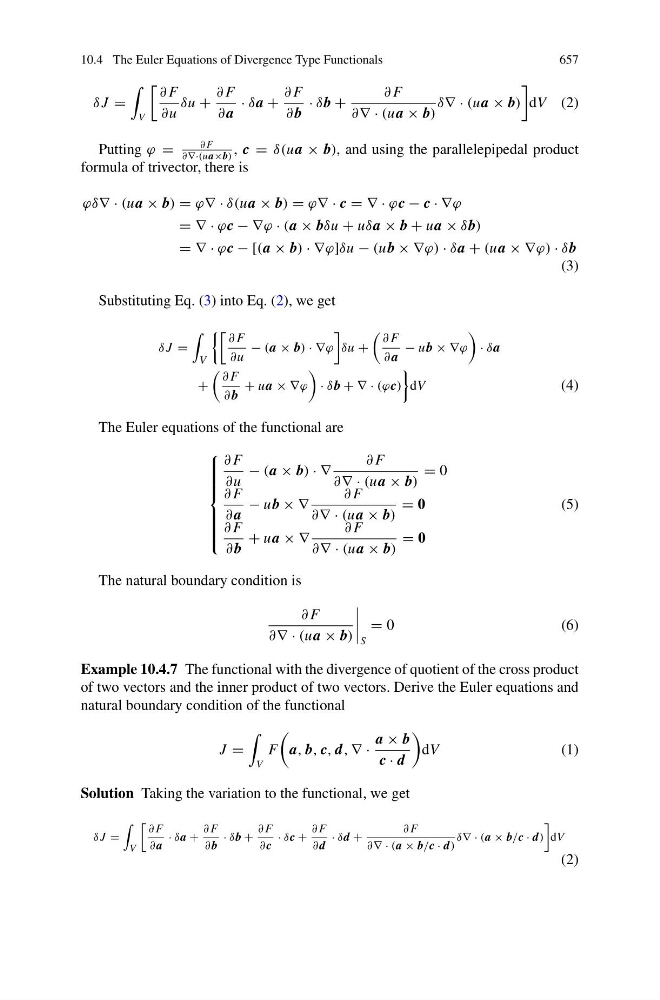
Putting ϕ =
∂ F
∂∇·(ua×b)
, c = δ(ua × b), and using the parallelepipedal product
formula of trivector, there is
ϕδ∇ · (ua × b) = ϕ∇ · δ(ua × b) = ϕ∇ · c = ∇ · ϕc − c · ∇ϕ
= ∇ · ϕc − ∇ϕ · (a × bδu + uδa × b + ua × δb)
= ∇ · ϕc − [(a × b) · ∇ϕ]δu − (ub × ∇ϕ) · δa + (ua × ∇ϕ) · δb
(3)
Substituting Eq. (3) into Eq. (2), we get
δ J =
V
∂ F
∂u
− (a × b) · ∇ϕ
δu +
∂ F
∂ a
− ub × ∇ϕ
· δa
+
∂ F
∂ b
+ ua × ∇ϕ
· δb + ∇ · (ϕc)
dV
(4)
The Euler equations of the functional are
⎧
⎪ ⎪ ⎪ ⎪ ⎪ ⎨
⎪ ⎪ ⎪ ⎪ ⎪ ⎩
∂ F
∂u
− (a × b) · ∇
∂ F
∂∇ · (ua × b)
= 0
∂ F
∂ a
− ub × ∇
∂ F
∂∇ · (ua × b)
= 0
∂ F
∂ b
+ ua × ∇
∂ F
∂∇ · (ua × b)
= 0
(5)
The natural boundary condition is
∂ F
∂∇ · (ua × b)
S
= 0
( 6 )
Example 10.4.7 The functional with the divergence of quotient of the cross product
of two vectors and the inner product of two vectors. Derive the Euler equations and
natural boundary condition of the functional
J =
V
F
a, b, c, d, ∇ ·
a × b
c · d
dV
(1)
Solution Taking the variation to the functional, we get
δ J =
V
∂ F
∂ a
· δa +
∂ F
∂ b
· δb +
∂ F
∂ c
· δc +
∂ F
∂ d
· δd +
∂ F
∂∇ · (a × b/c · d)
δ∇ · (a × b/c · d)
dV
(2)