

10.4 The Euler Equations of Divergence Type Functionals
655
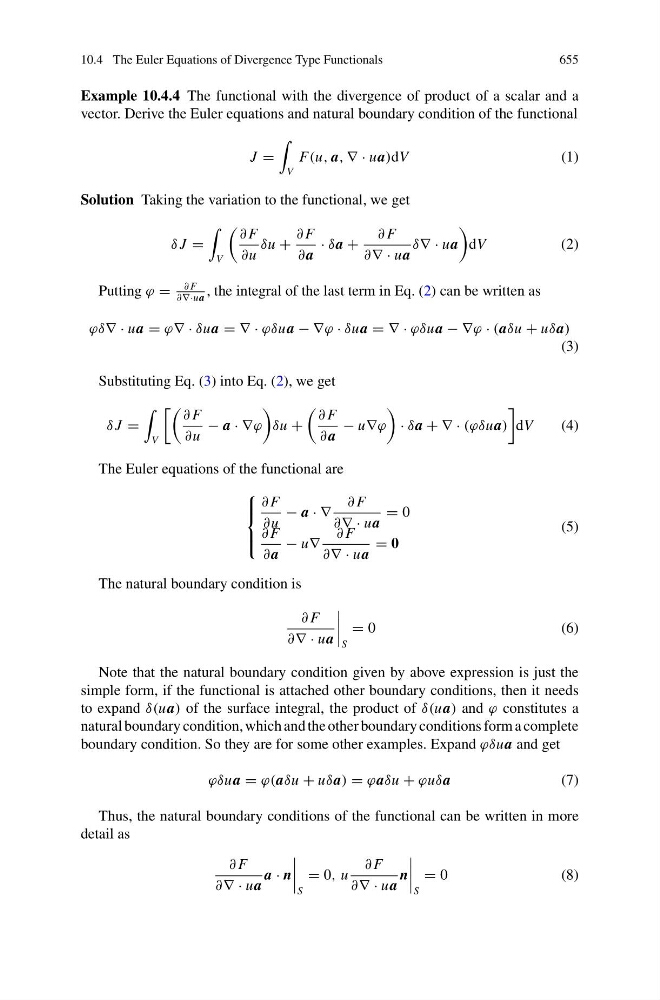
Example 10.4.4 The functional with the divergence of product of a scalar and a
vector. Derive the Euler equations and natural boundary condition of the functional
J =
V
F(u, a, ∇ · ua)dV
(1)
Solution Taking the variation to the functional, we get
δ J =
V
∂ F
∂u
δu +
∂ F
∂ a
· δa +
∂ F
∂∇ · ua
δ∇ · ua
dV
(2)
Putting ϕ =
∂ F
∂∇·ua
, the integral of the last term in Eq. (2) can be written as
ϕδ∇ · ua = ϕ∇ · δua = ∇ · ϕδua − ∇ϕ · δua = ∇ · ϕδua − ∇ϕ · (aδu + uδa)
(3)
Substituting Eq. (3) into Eq. (2), we get
δ J =
V
∂ F
∂u
− a · ∇ϕ
δu +
∂ F
∂ a
− u∇ϕ
· δa + ∇ · (ϕδua)
dV
(4)
The Euler equations of the functional are
⎧
⎪ ⎨
⎪ ⎩
∂ F
∂u
− a · ∇
∂ F
∂∇ · ua
= 0
∂ F
∂ a
− u∇
∂ F
∂∇ · ua
= 0
(5)
The natural boundary condition is
∂ F
∂∇ · ua
S
= 0
( 6 )
Note that the natural boundary condition given by above expression is just the
simple form, if the functional is attached other boundary conditions, then it needs
to expand δ(ua) of the surface integral, the product of δ(ua) and ϕ constitutes a
natural boundary condition, which and the other boundary conditions form a complete
boundary condition. So they are for some other examples. Expand ϕδua and get
ϕδua = ϕ(aδu + uδa) = ϕaδu + ϕuδa
(7)
Thus, the natural boundary conditions of the functional can be written in more
detail as
∂ F
∂∇ · ua
a · n
S
= 0, u
∂ F
∂∇ · ua
n
S
= 0
( 8 )