

10.4 The Euler Equations of Divergence Type Functionals
653
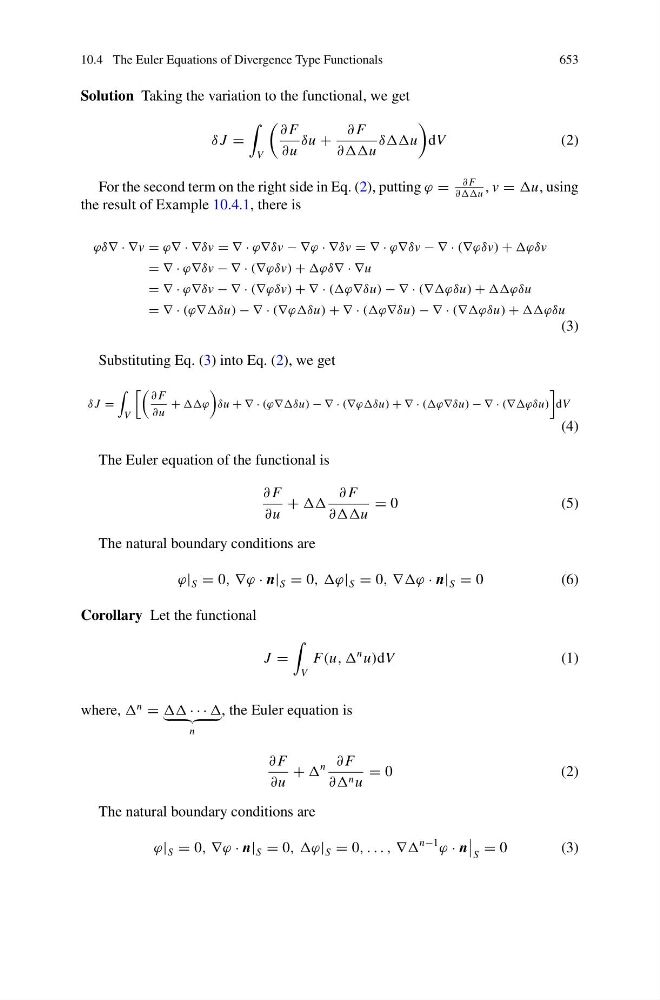
Solution Taking the variation to the functional, we get
δ J =
V
∂ F
∂u
δu +
∂ F
∂∂∂u
δδδu
dV
(2)
For the second term on the right side in Eq. (2), putting ϕ =
∂ F
∂∂∂u
, v = u, using
the result of Example 10.4.1, there is
ϕδ∇ · ∇v = ϕ∇ · ∇δv = ∇ · ϕ∇δv − ∇ϕ · ∇δv = ∇ · ϕ∇δv − ∇ · (∇ϕδv) + ϕδv
= ∇ · ϕ∇δv − ∇ · (∇ϕδv) + ϕδ∇ · ∇u
= ∇ · ϕ∇δv − ∇ · (∇ϕδv) + ∇ · ((ϕ∇δu) − ∇ · (∇ϕδu) + ϕδu
= ∇ · (ϕ∇δu) − ∇ · (∇ϕϕδu) + ∇ · ((ϕ∇δu) − ∇ · (∇ϕδu) + ϕδu
(3)
Substituting Eq. (3) into Eq. (2), we get
δ J =
V
∂ F
∂u
+ ϕ
δu + ∇ · (ϕ∇δu) − ∇ · (∇ϕϕδu) + ∇ · ((ϕ∇δu) − ∇ · (∇ϕδu)
dV
(4)
The Euler equation of the functional is
∂ F
∂u
+
∂ F
∂∂∂u
= 0
( 5 )
The natural boundary conditions are
ϕ| S = 0, ∇ϕ · n| S = 0, ,ϕ| S = 0, ∇ϕ · n| S = 0
( 6 )
Corollary Let the functional
J =
V
F(u, ,
n u)dV
(1)
where,
n
= · · ·
n
, the Euler equation is
∂ F
∂u
+
n ∂ F
∂∂ n u
= 0
( 2 )
The natural boundary conditions are
ϕ| S = 0, ∇ϕ · n| S = 0, ,ϕ| S = 0, . . . , ∇
n−1
ϕ · n
S
= 0
( 3 )