

10.3 The Euler Equations of Gradient Type Functionals
641
a · δ∇ f = a · ∇δ f = ∇ · (aδ f ) − (∇ · a)δ f = ∇ · (aδ f ) − (∇ · a)
n
i=1
f u i δu i
(3)
Substituting Eq. (3) into Eq. (2), we get
δ J =
V
n
i=1
∂ F
∂u i
−
∂ f
∂u i
∇ · a
δu i + ∇ · (aδ f )
dV
(4)
The Euler equation of the functional is
∂ F
∂u i
−
∂ f
∂u i
∇ ·
∂ F
∂∇ f
= 0
( 5 )
The natural boundary condition is
∂ F
∂∇ f
· n
S
= 0
( 6 )
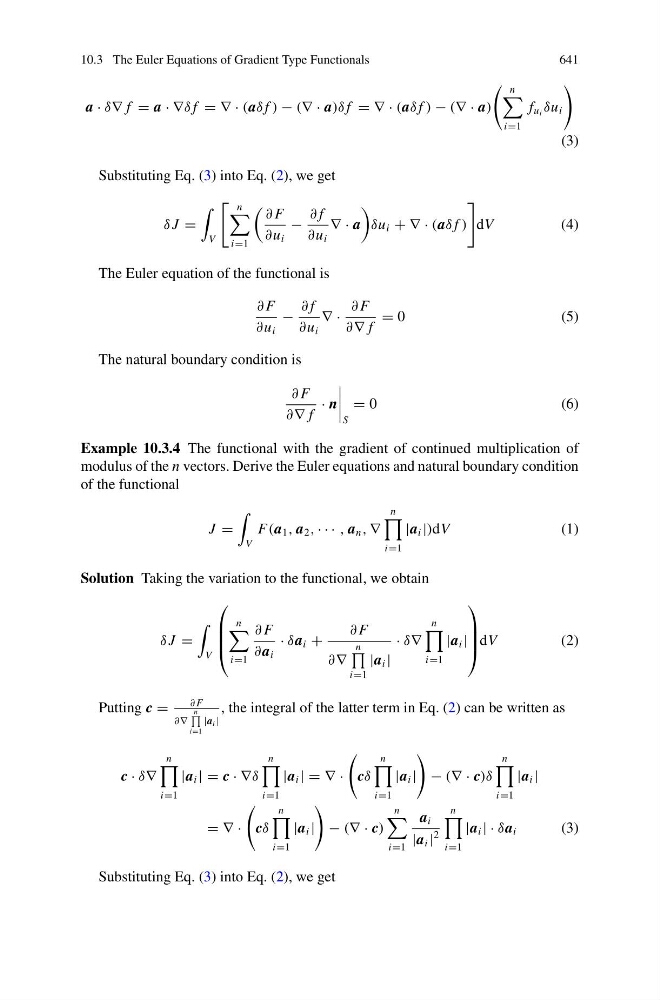
Example 10.3.4 The functional with the gradient of continued multiplication of
modulus of the n vectors. Derive the Euler equations and natural boundary condition
of the functional
J =
V
F(a 1 , a 2 , · · · , a n , ∇
n
i=1
|a i |)dV
(1)
Solution Taking the variation to the functional, we obtain
δ J =
V
⎛
⎜
⎜
⎝
n
i=1
∂ F
∂ a i
· δa i +
∂ F
∂∇
n
i=1
|a i |
· δ∇
n
i=1
|a i |
⎞
⎟
⎟
⎠ dV
(2)
Putting c =
∂ F
∂∇
n
i=1
|a i |
, the integral of the latter term in Eq. (2) can be written as
c · δ∇
n
i=1
|a i | = c · ∇δ
n
i=1
|a i | = ∇ ·
cδ
n
i=1
|a i |
− (∇ · c)δ
n
i=1
|a i |
= ∇ ·
cδ
n
i=1
|a i |
− (∇ · c)
n
i=1
a i
|a i |
2
n
i=1
|a i | · δa i
(3)
Substituting Eq. (3) into Eq. (2), we get