

628
10 Variational Problems of Functionals with Vector, Tensor …
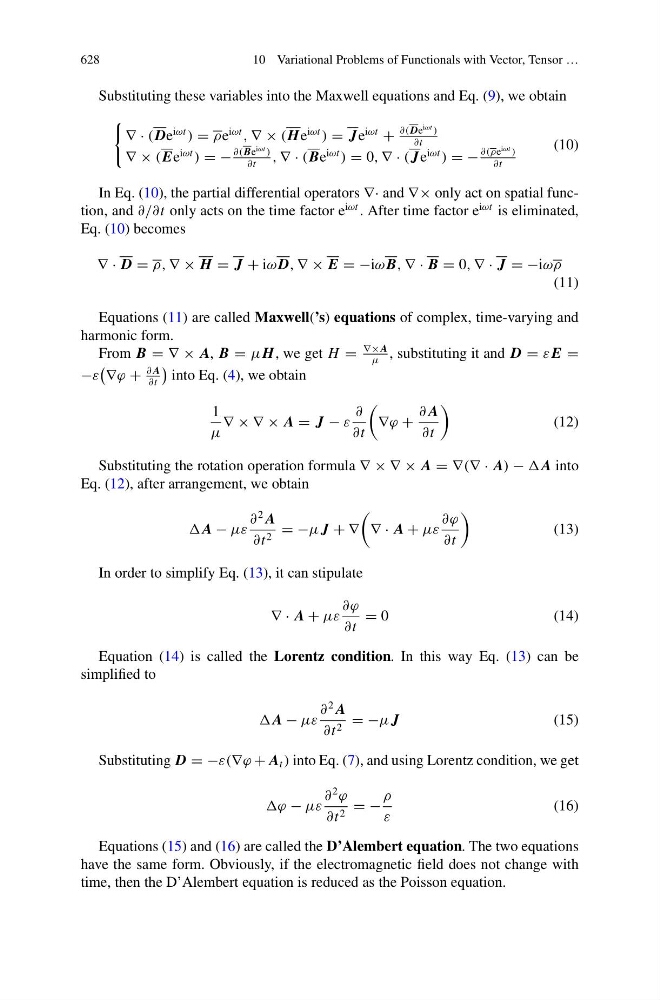
Substituting these variables into the Maxwell equations and Eq. (9), we obtain
∇ · ( De
iωt
) = ρe
iωt
, ∇ × (He
iωt
) = Je
iωt
+
∂( De
iωt )
∂t
∇ × (Ee
iωt
) = −
∂(Be
iωt )
∂t
, ∇ · (Be
iωt
) = 0, ∇ · ( Je
iωt
) = −
∂(ρe
iωt )
∂t
(10)
In Eq. (10), the partial differential operators ∇· and ∇× only act on spatial function, and ∂/∂t only acts on the time factor e
iωt . After time factor e
iωt is eliminated,
Eq. (10) becomes
∇ · D = ρ, ∇ × H = J + iω D, ∇ × E = −iω B, ∇ · B = 0, ∇ · J = −iωρ
(11)
Equations (11) are called Maxwell(’s) equations of complex, time-varying and
harmonic form.
From B = ∇ × A, B = μH, we get H =
∇× A
μ
, substituting it and D = ε E =
−ε
∇ϕ +
∂ A
∂t
into Eq. (4), we obtain
1
μ
∇ × ∇ × A = J − ε
∂
∂t
∇ϕ +
∂ A
∂t
(12)
Substituting the rotation operation formula ∇ × ∇ × A = ∇(∇ · A) − A into
Eq. (12), after arrangement, we obtain
A − με
∂
2 A
∂t 2 = −μ J + ∇
∇ · A + με
∂ϕ
∂t
(13)
In order to simplify Eq. (13), it can stipulate
∇ · A + με
∂ϕ
∂t
= 0
( 1 4 )
Equation (14) is called the Lorentz condition. In this way Eq. (13) can be
simplified to
A − με
∂
2 A
∂t 2 = −μ J
(15)
Substituting D = −ε(∇ϕ + A t ) into Eq. (7), and using Lorentz condition, we get
ϕ − με
∂
2
ϕ
∂t 2 = −
ρ
ε
(16)
Equations (15) and (16) are called the D’Alembert equation. The two equations
have the same form. Obviously, if the electromagnetic field does not change with
time, then the D’Alembert equation is reduced as the Poisson equation.