

10.2 The Euler Equations of Functionals …
621
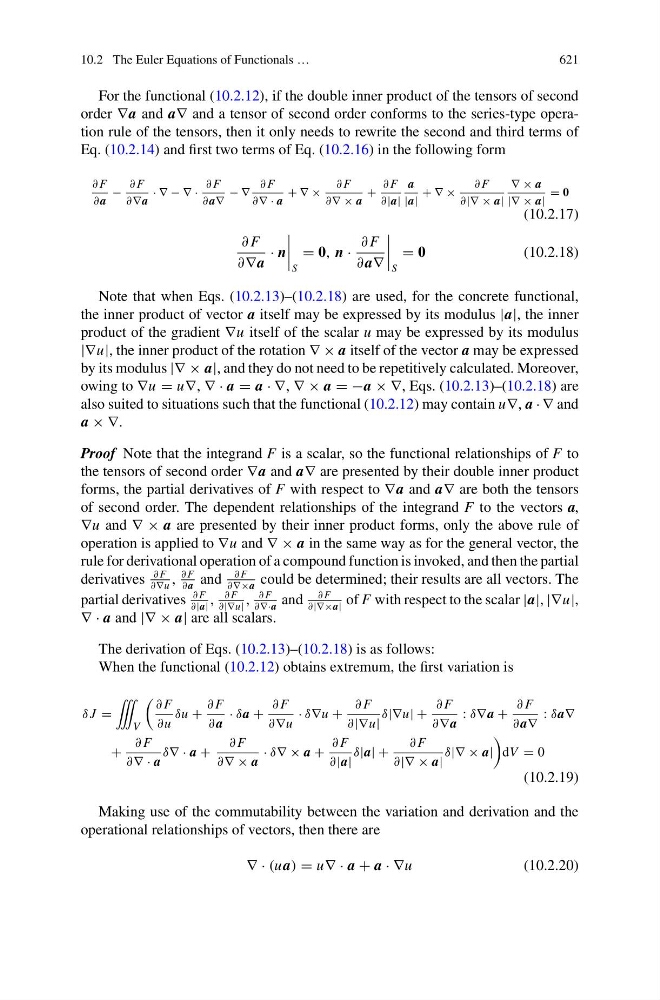
For the functional (10.2.12), if the double inner product of the tensors of second
order ∇ a and a∇ and a tensor of second order conforms to the series-type operation rule of the tensors, then it only needs to rewrite the second and third terms of
Eq. (10.2.14) and first two terms of Eq. (10.2.16) in the following form
∂ F
∂ a
−
∂ F
∂∇ a
· ∇ − ∇ ·
∂ F
∂ a∇
− ∇
∂ F
∂∇ · a
+ ∇ ×
∂ F
∂∇ × a
+
∂ F
∂|a|
a
|a|
+ ∇ ×
∂ F
∂|∇ × a|
∇ × a
|∇ × a|
= 0
(10.2.17)
∂ F
∂∇ a
· n
S
= 0, n ·
∂ F
∂ a∇
S
= 0
(10.2.18)
Note that when Eqs. (10.2.13)–(10.2.18) are used, for the concrete functional,
the inner product of vector a itself may be expressed by its modulus |a|, the inner
product of the gradient ∇u itself of the scalar u may be expressed by its modulus
|∇u|, the inner product of the rotation ∇ × a itself of the vector a may be expressed
by its modulus |∇ × a|, and they do not need to be repetitively calculated. Moreover,
owing to ∇u = u∇, ∇ · a = a · ∇, ∇ × a = −a × ∇, Eqs. (10.2.13)–(10.2.18) are
also suited to situations such that the functional (10.2.12) may contain u∇, a · ∇ and
a × ∇.
Proof Note that the integrand F is a scalar, so the functional relationships of F to
the tensors of second order ∇ a and a∇ are presented by their double inner product
forms, the partial derivatives of F with respect to ∇ a and a∇ are both the tensors
of second order. The dependent relationships of the integrand F to the vectors a,
∇u and ∇ × a are presented by their inner product forms, only the above rule of
operation is applied to ∇u and ∇ × a in the same way as for the general vector, the
rule for derivational operation of a compound function is invoked, and then the partial
derivatives
∂ F
∂∇u
,
∂ F
∂ a
and
∂ F
∂∇×a
could be determined; their results are all vectors. The
partial derivatives
∂ F
∂|a|
,
∂ F
∂|∇u|
,
∂ F
∂∇·a
and
∂ F
∂|∇×a|
of F with respect to the scalar |a|, |∇u|,
∇ · a and |∇ × a| are all scalars.
The derivation of Eqs. (10.2.13)–(10.2.18) is as follows:
When the functional (10.2.12) obtains extremum, the first variation is
δ J =
˚
V
∂ F
∂u
δu +
∂ F
∂ a
· δa +
∂ F
∂∇u
· δ∇u +
∂ F
∂|∇u|
δ|∇u| +
∂ F
∂∇ a
: δ∇ a +
∂ F
∂ a∇
: δa∇
+
∂ F
∂∇ · a
δ∇ · a +
∂ F
∂∇ × a
· δ∇ × a +
∂ F
∂|a|
δ|a| +
∂ F
∂|∇ × a|
δ|∇ × a|
dV = 0
(10.2.19)
Making use of the commutability between the variation and derivation and the
operational relationships of vectors, then there are
∇ · (ua) = u∇ · a + a · ∇u
(10.2.20)