

602
9 Variational Principles in Mechanics and Their Applications
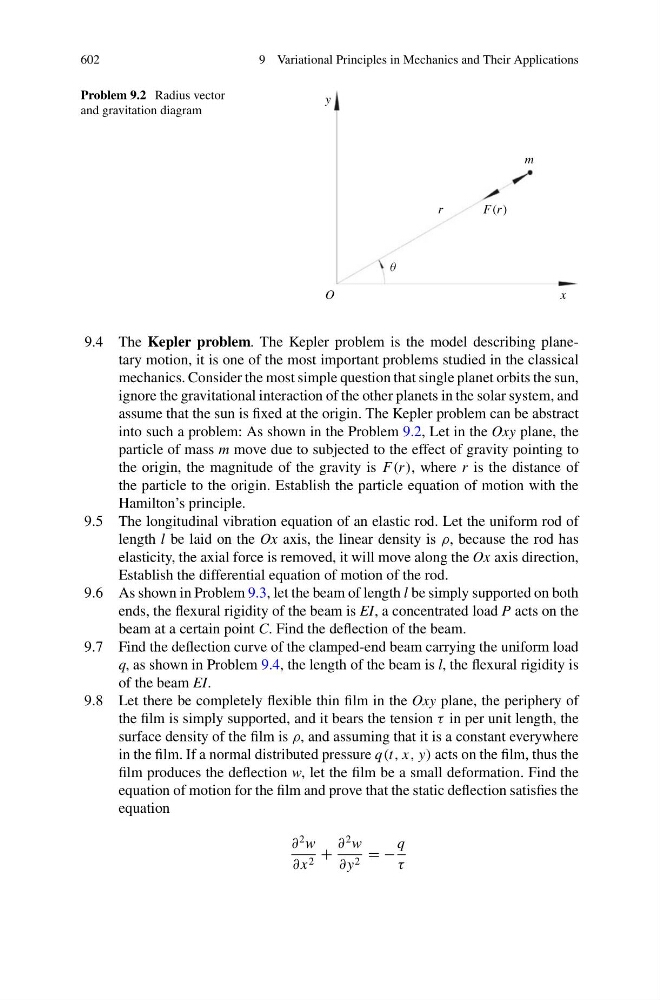
Problem 9.2 Radius vector
and gravitation diagram
O
x
y
F(r )
m
r
θ
9.4 The Kepler problem. The Kepler problem is the model describing planetary motion, it is one of the most important problems studied in the classical
mechanics. Consider the most simple question that single planet orbits the sun,
ignore the gravitational interaction of the other planets in the solar system, and
assume that the sun is fixed at the origin. The Kepler problem can be abstract
into such a problem: As shown in the Problem 9.2, Let in the Oxy plane, the
particle of mass m move due to subjected to the effect of gravity pointing to
the origin, the magnitude of the gravity is F(r ), where r is the distance of
the particle to the origin. Establish the particle equation of motion with the
Hamilton’s principle.
9.5 The longitudinal vibration equation of an elastic rod. Let the uniform rod of
length l be laid on the Ox axis, the linear density is ρ, because the rod has
elasticity, the axial force is removed, it will move along the Ox axis direction,
Establish the differential equation of motion of the rod.
9.6 As shown in Problem 9.3, let the beam of length l be simply supported on both
ends, the flexural rigidity of the beam is EI, a concentrated load P acts on the
beam at a certain point C. Find the deflection of the beam.
9.7 Find the deflection curve of the clamped-end beam carrying the uniform load
q, as shown in Problem 9.4, the length of the beam is l, the flexural rigidity is
of the beam EI.
9.8 Let there be completely flexible thin film in the Oxy plane, the periphery of
the film is simply supported, and it bears the tension τ in per unit length, the
surface density of the film is ρ, and assuming that it is a constant everywhere
in the film. If a normal distributed pressure q(t, x, y) acts on the film, thus the
film produces the deflection w, let the film be a small deformation. Find the
equation of motion for the film and prove that the static deflection satisfies the
equation
∂
2 w
∂ x 2 +
∂
2 w
∂ y 2 = −
q
τ
9 Variational Principles in Mechanics and Their Applications
Problem 9.2 Radius vector
and gravitation diagram
O
x
y
F(r )
m
r
θ
9.4 The Kepler problem. The Kepler problem is the model describing planetary motion, it is one of the most important problems studied in the classical
mechanics. Consider the most simple question that single planet orbits the sun,
ignore the gravitational interaction of the other planets in the solar system, and
assume that the sun is fixed at the origin. The Kepler problem can be abstract
into such a problem: As shown in the Problem 9.2, Let in the Oxy plane, the
particle of mass m move due to subjected to the effect of gravity pointing to
the origin, the magnitude of the gravity is F(r ), where r is the distance of
the particle to the origin. Establish the particle equation of motion with the
Hamilton’s principle.
9.5 The longitudinal vibration equation of an elastic rod. Let the uniform rod of
length l be laid on the Ox axis, the linear density is ρ, because the rod has
elasticity, the axial force is removed, it will move along the Ox axis direction,
Establish the differential equation of motion of the rod.
9.6 As shown in Problem 9.3, let the beam of length l be simply supported on both
ends, the flexural rigidity of the beam is EI, a concentrated load P acts on the
beam at a certain point C. Find the deflection of the beam.
9.7 Find the deflection curve of the clamped-end beam carrying the uniform load
q, as shown in Problem 9.4, the length of the beam is l, the flexural rigidity is
of the beam EI.
9.8 Let there be completely flexible thin film in the Oxy plane, the periphery of
the film is simply supported, and it bears the tension τ in per unit length, the
surface density of the film is ρ, and assuming that it is a constant everywhere
in the film. If a normal distributed pressure q(t, x, y) acts on the film, thus the
film produces the deflection w, let the film be a small deformation. Find the
equation of motion for the film and prove that the static deflection satisfies the
equation
∂
2 w
∂ x 2 +
∂
2 w
∂ y 2 = −
q
τ