

576
9 Variational Principles in Mechanics and Their Applications
U =
1
2
E I
l
0
y
2 dx =
1
2
E I
l
0
∞
n=1
n
2
π
2
l 2 a n sin
nπ
l
x
2
dx =
π
4 E I
4l 3
∞
n=1
n
4 a
2
n
(3)
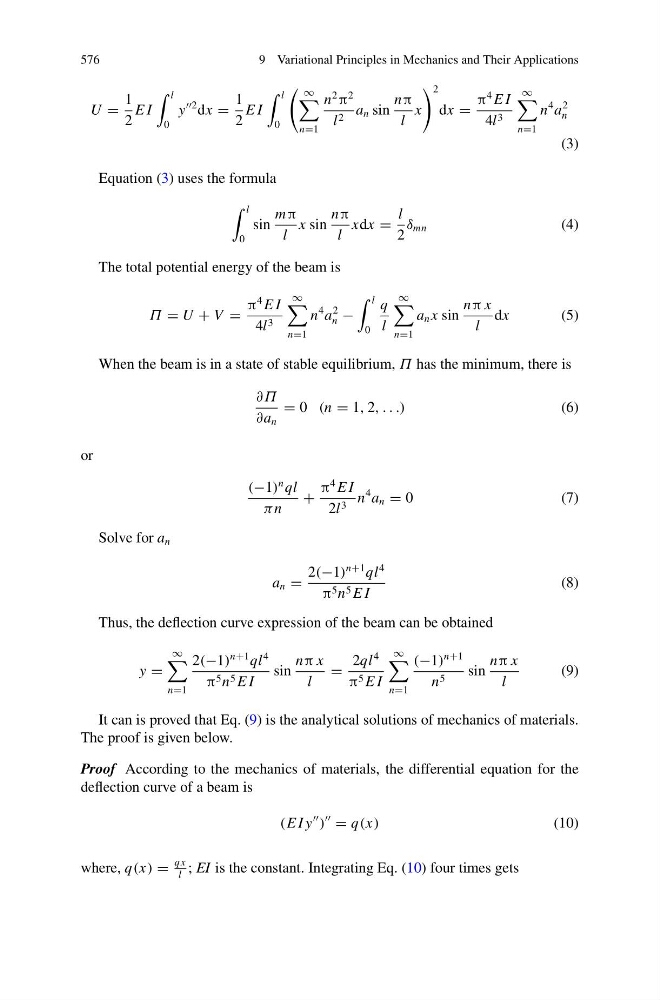
Equation (3) uses the formula
l
0
sin
mπ
l
x sin
nπ
l
xdx =
l
2
δ mn
(4)
The total potential energy of the beam is
Π = U + V =
π
4 E I
4l 3
∞
n=1
n
4 a
2
n −
l
0
q
l
∞
n=1
a n x sin
nπ x
l
dx
(5)
When the beam is in a state of stable equilibrium, Π has the minimum, there is
∂Π
∂a n
= 0 (n = 1, 2, . . .)
(6)
or
(−1)
n ql
π n
+
π
4 E I
2l 3 n
4 a n = 0
( 7 )
Solve for a n
a n =
2(−1)
n+1 ql
4
π 5 n 5 E I
(8)
Thus, the deflection curve expression of the beam can be obtained
y =
∞
n=1
2(−1)
n+1 ql
4
π 5 n 5 E I
sin
nπ x
l
=
2ql
4
π 5 E I
∞
n=1
(−1)
n+1
n 5
sin
nπ x
l
(9)
It can is proved that Eq. (9) is the analytical solutions of mechanics of materials.
The proof is given below.
Proof According to the mechanics of materials, the differential equation for the
deflection curve of a beam is
(E I y
)
= q(x)
(10)
where, q(x) =
qx
l
; EI is the constant. Integrating Eq. (10) four times gets
9 Variational Principles in Mechanics and Their Applications
U =
1
2
E I
l
0
y
2 dx =
1
2
E I
l
0
∞
n=1
n
2
π
2
l 2 a n sin
nπ
l
x
2
dx =
π
4 E I
4l 3
∞
n=1
n
4 a
2
n
(3)
Equation (3) uses the formula
l
0
sin
mπ
l
x sin
nπ
l
xdx =
l
2
δ mn
(4)
The total potential energy of the beam is
Π = U + V =
π
4 E I
4l 3
∞
n=1
n
4 a
2
n −
l
0
q
l
∞
n=1
a n x sin
nπ x
l
dx
(5)
When the beam is in a state of stable equilibrium, Π has the minimum, there is
∂Π
∂a n
= 0 (n = 1, 2, . . .)
(6)
or
(−1)
n ql
π n
+
π
4 E I
2l 3 n
4 a n = 0
( 7 )
Solve for a n
a n =
2(−1)
n+1 ql
4
π 5 n 5 E I
(8)
Thus, the deflection curve expression of the beam can be obtained
y =
∞
n=1
2(−1)
n+1 ql
4
π 5 n 5 E I
sin
nπ x
l
=
2ql
4
π 5 E I
∞
n=1
(−1)
n+1
n 5
sin
nπ x
l
(9)
It can is proved that Eq. (9) is the analytical solutions of mechanics of materials.
The proof is given below.
Proof According to the mechanics of materials, the differential equation for the
deflection curve of a beam is
(E I y
)
= q(x)
(10)
where, q(x) =
qx
l
; EI is the constant. Integrating Eq. (10) four times gets