

542
9 Variational Principles in Mechanics and Their Applications
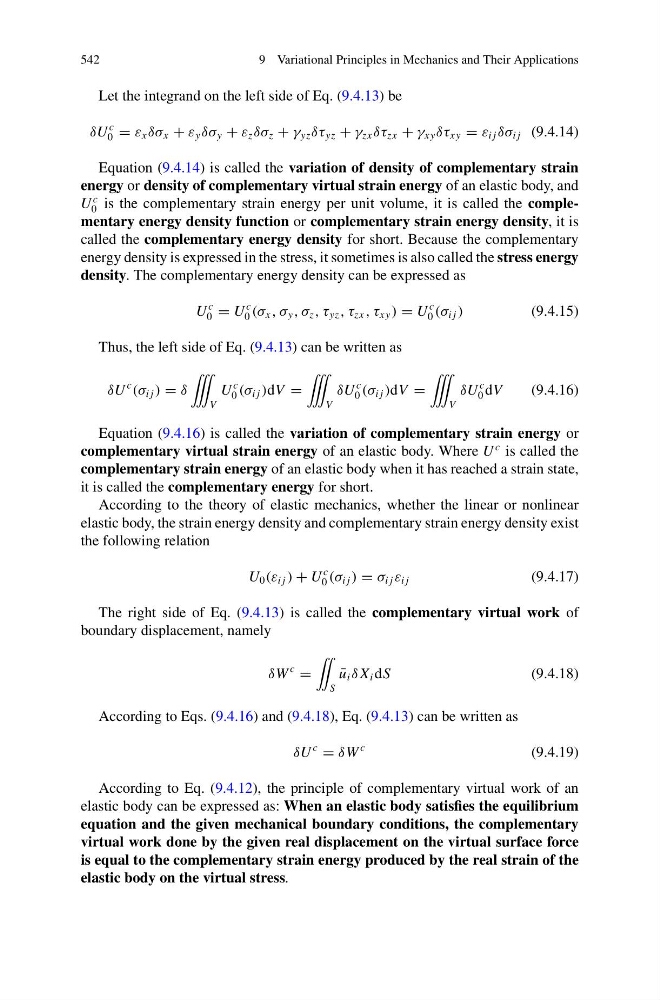
Let the integrand on the left side of Eq. (9.4.13) be
δU
c
0 = ε x δσ x + ε y δσ y + ε z δσ z + γ yz δτ yz + γ zx δτ zx + γ xy δτ xy = ε i j δσ i j (9.4.14)
Equation (9.4.14) is called the variation of density of complementary strain
energy or density of complementary virtual strain energy of an elastic body, and
U
c
0 is the complementary strain energy per unit volume, it is called the complementary energy density function or complementary strain energy density, it is
called the complementary energy density for short. Because the complementary
energy density is expressed in the stress, it sometimes is also called the stress energy
density. The complementary energy density can be expressed as
U
c
0 = U
c
0 (σ x , σ y , σ z , τ yz , τ zx , τ xy ) = U
c
0 (σ i j )
(9.4.15)
Thus, the left side of Eq. (9.4.13) can be written as
δU
c
(σ i j ) = δ
˚
V
U
c
0 (σ i j )dV =
˚
V
δU
c
0 (σ i j )dV =
˚
V
δU
c
0 dV
(9.4.16)
Equation (9.4.16) is called the variation of complementary strain energy or
complementary virtual strain energy of an elastic body. Where U
c is called the
complementary strain energy of an elastic body when it has reached a strain state,
it is called the complementary energy for short.
According to the theory of elastic mechanics, whether the linear or nonlinear
elastic body, the strain energy density and complementary strain energy density exist
the following relation
U 0 (ε i j ) + U
c
0 (σ i j ) = σ i j ε i j
(9.4.17)
The right side of Eq. (9.4.13) is called the complementary virtual work of
boundary displacement, namely
δW
c
=
¨
S
¯
u i δ X i dS
(9.4.18)
According to Eqs. (9.4.16) and (9.4.18), Eq. (9.4.13) can be written as
δU
c
= δW
c
(9.4.19)
According to Eq. (9.4.12), the principle of complementary virtual work of an
elastic body can be expressed as: When an elastic body satisfies the equilibrium
equation and the given mechanical boundary conditions, the complementary
virtual work done by the given real displacement on the virtual surface force
is equal to the complementary strain energy produced by the real strain of the
elastic body on the virtual stress.
9 Variational Principles in Mechanics and Their Applications
Let the integrand on the left side of Eq. (9.4.13) be
δU
c
0 = ε x δσ x + ε y δσ y + ε z δσ z + γ yz δτ yz + γ zx δτ zx + γ xy δτ xy = ε i j δσ i j (9.4.14)
Equation (9.4.14) is called the variation of density of complementary strain
energy or density of complementary virtual strain energy of an elastic body, and
U
c
0 is the complementary strain energy per unit volume, it is called the complementary energy density function or complementary strain energy density, it is
called the complementary energy density for short. Because the complementary
energy density is expressed in the stress, it sometimes is also called the stress energy
density. The complementary energy density can be expressed as
U
c
0 = U
c
0 (σ x , σ y , σ z , τ yz , τ zx , τ xy ) = U
c
0 (σ i j )
(9.4.15)
Thus, the left side of Eq. (9.4.13) can be written as
δU
c
(σ i j ) = δ
˚
V
U
c
0 (σ i j )dV =
˚
V
δU
c
0 (σ i j )dV =
˚
V
δU
c
0 dV
(9.4.16)
Equation (9.4.16) is called the variation of complementary strain energy or
complementary virtual strain energy of an elastic body. Where U
c is called the
complementary strain energy of an elastic body when it has reached a strain state,
it is called the complementary energy for short.
According to the theory of elastic mechanics, whether the linear or nonlinear
elastic body, the strain energy density and complementary strain energy density exist
the following relation
U 0 (ε i j ) + U
c
0 (σ i j ) = σ i j ε i j
(9.4.17)
The right side of Eq. (9.4.13) is called the complementary virtual work of
boundary displacement, namely
δW
c
=
¨
S
¯
u i δ X i dS
(9.4.18)
According to Eqs. (9.4.16) and (9.4.18), Eq. (9.4.13) can be written as
δU
c
= δW
c
(9.4.19)
According to Eq. (9.4.12), the principle of complementary virtual work of an
elastic body can be expressed as: When an elastic body satisfies the equilibrium
equation and the given mechanical boundary conditions, the complementary
virtual work done by the given real displacement on the virtual surface force
is equal to the complementary strain energy produced by the real strain of the
elastic body on the virtual stress.