

9.2 Principle of Virtual Displacement
531
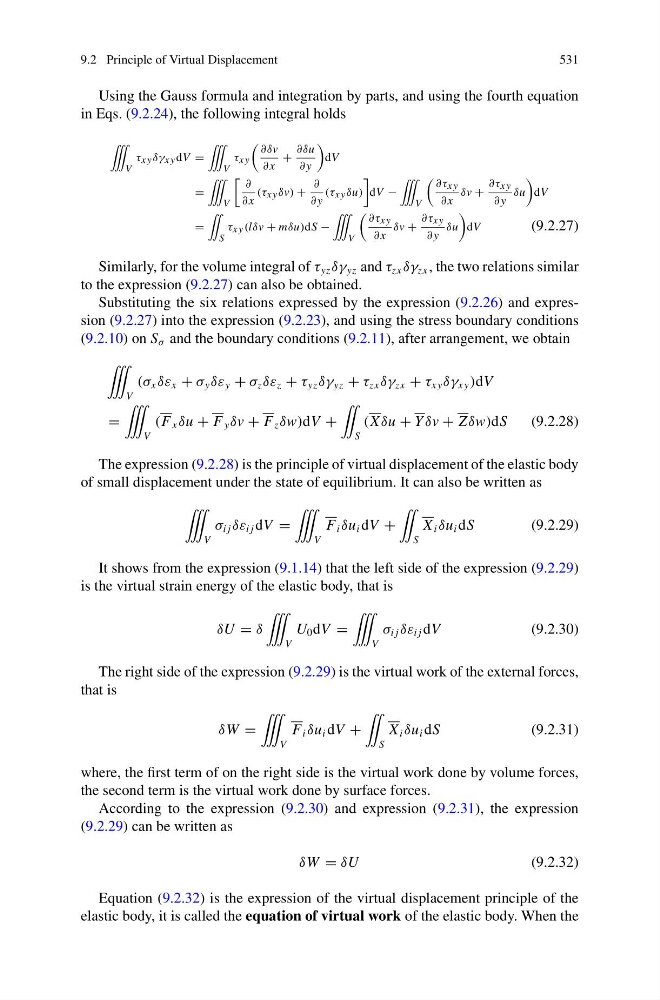
Using the Gauss formula and integration by parts, and using the fourth equation
in Eqs. (9.2.24), the following integral holds
˚
V
τ xy δγ xy dV =
˚
V
τ xy
∂δv
∂ x
+
∂δu
∂ y
dV
=
˚
V
∂
∂ x
(τ xy δv) +
∂
∂ y
(τ xy δu)
dV −
˚
V
∂τ xy
∂ x
δv +
∂τ xy
∂ y
δu
dV
=
¨
S
τ xy (lδv + mδu)dS −
˚
V
∂τ xy
∂ x
δv +
∂τ xy
∂ y
δu
dV
(9.2.27)
Similarly, for the volume integral of τ yz δγ yz and τ zx δγ zx , the two relations similar
to the expression (9.2.27) can also be obtained.
Substituting the six relations expressed by the expression (9.2.26) and expression (9.2.27) into the expression (9.2.23), and using the stress boundary conditions
(9.2.10) on S σ and the boundary conditions (9.2.11), after arrangement, we obtain
˚
V
(σ x δε x + σ y δε y + σ z δε z + τ yz δγ yz + τ zx δγ zx + τ xy δγ xy )dV
=
˚
V
(F x δu + F y δv + F z δw)dV +
¨
S
(X δu + Y δv + Z δw)dS
(9.2.28)
The expression (9.2.28) is the principle of virtual displacement of the elastic body
of small displacement under the state of equilibrium. It can also be written as
˚
V
σ i j δε i j dV =
˚
V
F i δu i dV +
¨
S
X i δu i dS
(9.2.29)
It shows from the expression (9.1.14) that the left side of the expression (9.2.29)
is the virtual strain energy of the elastic body, that is
δU = δ
˚
V
U 0 dV =
˚
V
σ i j δε i j dV
(9.2.30)
The right side of the expression (9.2.29) is the virtual work of the external forces,
that is
δW =
˚
V
F i δu i dV +
¨
S
X i δu i dS
(9.2.31)
where, the first term of on the right side is the virtual work done by volume forces,
the second term is the virtual work done by surface forces.
According to the expression (9.2.30) and expression (9.2.31), the expression
(9.2.29) can be written as
δW = δU
(9.2.32)
Equation (9.2.32) is the expression of the virtual displacement principle of the
elastic body, it is called the equation of virtual work of the elastic body. When the
531
Using the Gauss formula and integration by parts, and using the fourth equation
in Eqs. (9.2.24), the following integral holds
˚
V
τ xy δγ xy dV =
˚
V
τ xy
∂δv
∂ x
+
∂δu
∂ y
dV
=
˚
V
∂
∂ x
(τ xy δv) +
∂
∂ y
(τ xy δu)
dV −
˚
V
∂τ xy
∂ x
δv +
∂τ xy
∂ y
δu
dV
=
¨
S
τ xy (lδv + mδu)dS −
˚
V
∂τ xy
∂ x
δv +
∂τ xy
∂ y
δu
dV
(9.2.27)
Similarly, for the volume integral of τ yz δγ yz and τ zx δγ zx , the two relations similar
to the expression (9.2.27) can also be obtained.
Substituting the six relations expressed by the expression (9.2.26) and expression (9.2.27) into the expression (9.2.23), and using the stress boundary conditions
(9.2.10) on S σ and the boundary conditions (9.2.11), after arrangement, we obtain
˚
V
(σ x δε x + σ y δε y + σ z δε z + τ yz δγ yz + τ zx δγ zx + τ xy δγ xy )dV
=
˚
V
(F x δu + F y δv + F z δw)dV +
¨
S
(X δu + Y δv + Z δw)dS
(9.2.28)
The expression (9.2.28) is the principle of virtual displacement of the elastic body
of small displacement under the state of equilibrium. It can also be written as
˚
V
σ i j δε i j dV =
˚
V
F i δu i dV +
¨
S
X i δu i dS
(9.2.29)
It shows from the expression (9.1.14) that the left side of the expression (9.2.29)
is the virtual strain energy of the elastic body, that is
δU = δ
˚
V
U 0 dV =
˚
V
σ i j δε i j dV
(9.2.30)
The right side of the expression (9.2.29) is the virtual work of the external forces,
that is
δW =
˚
V
F i δu i dV +
¨
S
X i δu i dS
(9.2.31)
where, the first term of on the right side is the virtual work done by volume forces,
the second term is the virtual work done by surface forces.
According to the expression (9.2.30) and expression (9.2.31), the expression
(9.2.29) can be written as
δW = δU
(9.2.32)
Equation (9.2.32) is the expression of the virtual displacement principle of the
elastic body, it is called the equation of virtual work of the elastic body. When the