

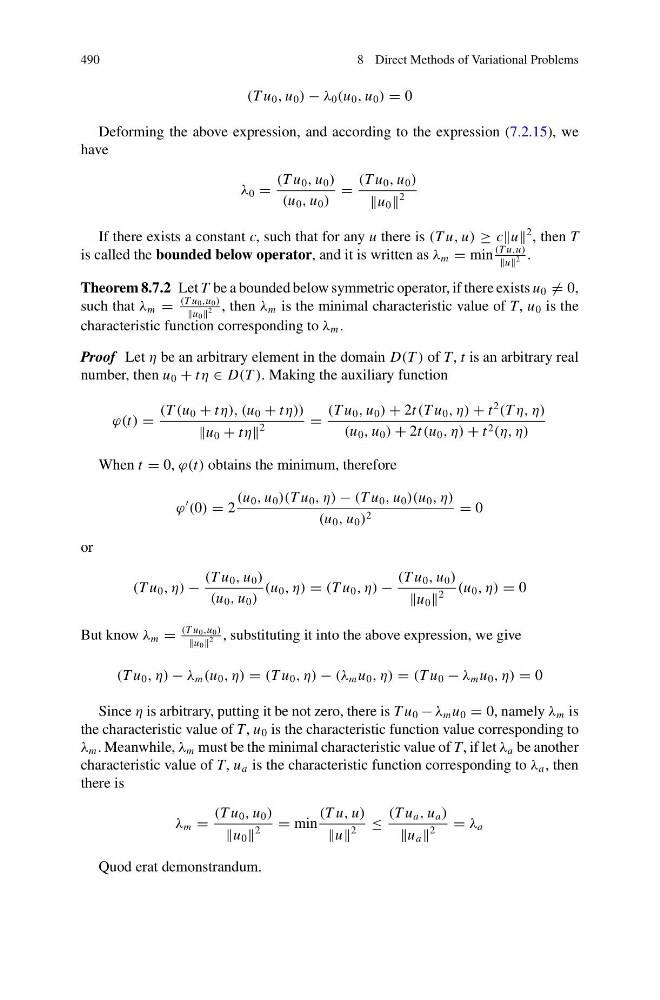
490
8 Direct Methods of Variational Problems
(T u 0 , u 0 ) − λ 0 (u 0 , u 0 ) = 0
Deforming the above expression, and according to the expression (7.2.15), we
have
λ 0 =
(T u 0 , u 0 )
(u 0 , u 0 )
=
(T u 0 , u 0 )
u 0
2
If there exists a constant c, such that for any u there is (T u, u) ≥ cu
2 , then T
is called the bounded below operator, and it is written as λ m = min
(T u,u)
u
2 .
Theorem 8.7.2 Let T be a bounded below symmetric operator, if there exists u 0 = 0,
such that λ m =
(T u 0 ,u 0 )
u 0
2 , then λ m is the minimal characteristic value of T, u 0 is the
characteristic function corresponding to λ m .
Proof Let η be an arbitrary element in the domain D(T ) of T, t is an arbitrary real
number, then u 0 + tη ∈ D(T ). Making the auxiliary function
ϕ(t) =
(T (u 0 + tη), (u 0 + tη))
u 0 + tη
2
=
(T u 0 , u 0 ) + 2t (T u 0 , η) + t
2
(T η, η)
(u 0 , u 0 ) + 2t (u 0 , η) + t 2 (η, η)
When t = 0, ϕ(t) obtains the minimum, therefore
ϕ
(0) = 2
(u 0 , u 0 )(T u 0 , η) − (T u 0 , u 0 )(u 0 , η)
(u 0 , u 0 ) 2
= 0
or
(T u 0 , η) −
(T u 0 , u 0 )
(u 0 , u 0 )
(u 0 , η) = (T u 0 , η) −
(T u 0 , u 0 )
u 0
2
(u 0 , η) = 0
But know λ m =
(T u 0 ,u 0 )
u 0
2 , substituting it into the above expression, we give
(T u 0 , η) − λ m (u 0 , η) = (T u 0 , η) − (λ m u 0 , η) = (T u 0 − λ m u 0 , η) = 0
Since η is arbitrary, putting it be not zero, there is T u 0 − λ m u 0 = 0, namely λ m is
the characteristic value of T, u 0 is the characteristic function value corresponding to
λ m . Meanwhile, λ m must be the minimal characteristic value of T, if let λ a be another
characteristic value of T, u a is the characteristic function corresponding to λ a , then
there is
λ m =
(T u 0 , u 0 )
u 0
2
= min
(T u, u)
u
2
≤
(T u a , u a )
u a
2
= λ a
Quod erat demonstrandum.
8 Direct Methods of Variational Problems
(T u 0 , u 0 ) − λ 0 (u 0 , u 0 ) = 0
Deforming the above expression, and according to the expression (7.2.15), we
have
λ 0 =
(T u 0 , u 0 )
(u 0 , u 0 )
=
(T u 0 , u 0 )
u 0
2
If there exists a constant c, such that for any u there is (T u, u) ≥ cu
2 , then T
is called the bounded below operator, and it is written as λ m = min
(T u,u)
u
2 .
Theorem 8.7.2 Let T be a bounded below symmetric operator, if there exists u 0 = 0,
such that λ m =
(T u 0 ,u 0 )
u 0
2 , then λ m is the minimal characteristic value of T, u 0 is the
characteristic function corresponding to λ m .
Proof Let η be an arbitrary element in the domain D(T ) of T, t is an arbitrary real
number, then u 0 + tη ∈ D(T ). Making the auxiliary function
ϕ(t) =
(T (u 0 + tη), (u 0 + tη))
u 0 + tη
2
=
(T u 0 , u 0 ) + 2t (T u 0 , η) + t
2
(T η, η)
(u 0 , u 0 ) + 2t (u 0 , η) + t 2 (η, η)
When t = 0, ϕ(t) obtains the minimum, therefore
ϕ
(0) = 2
(u 0 , u 0 )(T u 0 , η) − (T u 0 , u 0 )(u 0 , η)
(u 0 , u 0 ) 2
= 0
or
(T u 0 , η) −
(T u 0 , u 0 )
(u 0 , u 0 )
(u 0 , η) = (T u 0 , η) −
(T u 0 , u 0 )
u 0
2
(u 0 , η) = 0
But know λ m =
(T u 0 ,u 0 )
u 0
2 , substituting it into the above expression, we give
(T u 0 , η) − λ m (u 0 , η) = (T u 0 , η) − (λ m u 0 , η) = (T u 0 − λ m u 0 , η) = 0
Since η is arbitrary, putting it be not zero, there is T u 0 − λ m u 0 = 0, namely λ m is
the characteristic value of T, u 0 is the characteristic function value corresponding to
λ m . Meanwhile, λ m must be the minimal characteristic value of T, if let λ a be another
characteristic value of T, u a is the characteristic function corresponding to λ a , then
there is
λ m =
(T u 0 , u 0 )
u 0
2
= min
(T u, u)
u
2
≤
(T u a , u a )
u a
2
= λ a
Quod erat demonstrandum.