

1.3 Fundamentals of the Theory of Field
33
∇ × (ϕa) = ∇ × (ϕ c a) + ∇ × (ϕa c )
On the right-handed side of the above expression, taking the functions with the
subscript c as constants for the time being, after the operation to remove the subscript,
namely
∇ × (ϕa) = ϕ c ∇ × a + ∇ϕ × a c = ϕ∇ × a + ∇ϕ × a
Quod erat demonstrandum.
Example 1.3.6 Verify ∇ · (a × b) = b · (∇ × a) − a · (∇ × b).
Proof According to the rule of differentiation, there is
∇ · (a × b) = ∇ · (a × b c ) + ∇ · (a c × b)
Moreover according to the following properties of rotation position of the trivector
mixed product
a · b × c = c · a × b = b · c × a
Therefore, there is
∇ · (a × b c ) = b c · (∇ × a) = b · (∇ × a)
∇ · (a c × b) = −∇ · (b × a c ) = −a c · (∇ × b) = −a · (∇ × b)
Adding the above two expressions, we obtain
∇ · (a × b) = ∇ · (a × b c ) + ∇ · (a c × b) = b · (∇ × a) − a · (∇ × b)
Quod erat demonstrandum.
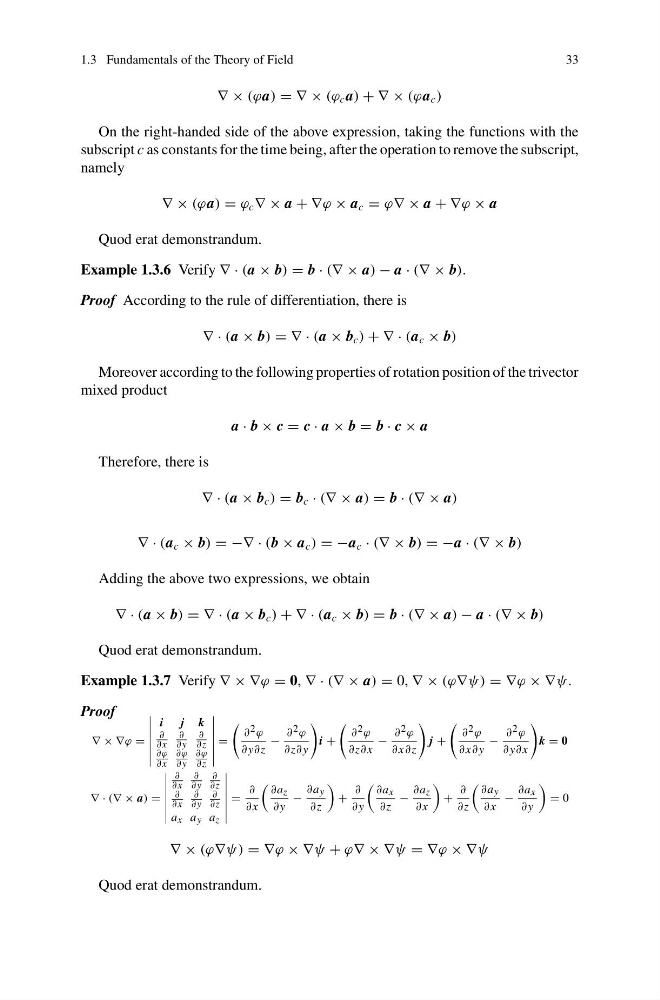
Example 1.3.7 Verify ∇ × ∇ϕ = 0, ∇ · (∇ × a) = 0, ∇ × (ϕ∇ψ) = ∇ϕ × ∇ψ.
Proof
∇ × ∇ϕ =
i j k
∂
∂ x
∂
∂ y
∂
∂z
∂ϕ
∂ x
∂ϕ
∂ y
∂ϕ
∂z
=
∂ 2 ϕ
∂ y∂z
−
∂ 2 ϕ
∂z∂ y
i +
∂ 2 ϕ
∂z∂ x
−
∂ 2 ϕ
∂ x∂z
j +
∂ 2 ϕ
∂ x∂ y
−
∂ 2 ϕ
∂ y∂ x
k = 0
∇ · (∇ × a) =
∂
∂ x
∂
∂ y
∂
∂z
∂
∂ x
∂
∂ y
∂
∂z
a x a y a z
=
∂
∂ x
∂a z
∂ y
−
∂a y
∂z
+
∂
∂ y
∂a x
∂z
−
∂a z
∂ x
+
∂
∂z
∂a y
∂ x
−
∂a x
∂ y
= 0
∇ × (ϕ∇ψ) = ∇ϕ × ∇ψ + ϕ∇ × ∇ψ = ∇ϕ × ∇ψ
Quod erat demonstrandum.
33
∇ × (ϕa) = ∇ × (ϕ c a) + ∇ × (ϕa c )
On the right-handed side of the above expression, taking the functions with the
subscript c as constants for the time being, after the operation to remove the subscript,
namely
∇ × (ϕa) = ϕ c ∇ × a + ∇ϕ × a c = ϕ∇ × a + ∇ϕ × a
Quod erat demonstrandum.
Example 1.3.6 Verify ∇ · (a × b) = b · (∇ × a) − a · (∇ × b).
Proof According to the rule of differentiation, there is
∇ · (a × b) = ∇ · (a × b c ) + ∇ · (a c × b)
Moreover according to the following properties of rotation position of the trivector
mixed product
a · b × c = c · a × b = b · c × a
Therefore, there is
∇ · (a × b c ) = b c · (∇ × a) = b · (∇ × a)
∇ · (a c × b) = −∇ · (b × a c ) = −a c · (∇ × b) = −a · (∇ × b)
Adding the above two expressions, we obtain
∇ · (a × b) = ∇ · (a × b c ) + ∇ · (a c × b) = b · (∇ × a) − a · (∇ × b)
Quod erat demonstrandum.
Example 1.3.7 Verify ∇ × ∇ϕ = 0, ∇ · (∇ × a) = 0, ∇ × (ϕ∇ψ) = ∇ϕ × ∇ψ.
Proof
∇ × ∇ϕ =
i j k
∂
∂ x
∂
∂ y
∂
∂z
∂ϕ
∂ x
∂ϕ
∂ y
∂ϕ
∂z
=
∂ 2 ϕ
∂ y∂z
−
∂ 2 ϕ
∂z∂ y
i +
∂ 2 ϕ
∂z∂ x
−
∂ 2 ϕ
∂ x∂z
j +
∂ 2 ϕ
∂ x∂ y
−
∂ 2 ϕ
∂ y∂ x
k = 0
∇ · (∇ × a) =
∂
∂ x
∂
∂ y
∂
∂z
∂
∂ x
∂
∂ y
∂
∂z
a x a y a z
=
∂
∂ x
∂a z
∂ y
−
∂a y
∂z
+
∂
∂ y
∂a x
∂z
−
∂a z
∂ x
+
∂
∂z
∂a y
∂ x
−
∂a x
∂ y
= 0
∇ × (ϕ∇ψ) = ∇ϕ × ∇ψ + ϕ∇ × ∇ψ = ∇ϕ × ∇ψ
Quod erat demonstrandum.