

454
8 Direct Methods of Variational Problems
8.1 Minimizing (Maximizing) Sequence
If looking for the function that makes a functional arrive at extremum from all
the admissible functions satisfying the boundary conditions and certain continuity
conditions, then the extremal function must satisfy the Euler equation and is the
solution of the variational problem given. If it is not looking for the function that
makes a functional arrive at extremum from all the admissible functions, but looking
for the function that makes a functional arrive at extremum just from a finite number
of allowable functions, which reduces the seeking range of admissible functions,
such that the found extremum, such as a minimum, must be greater than the true
minimum, only in the best case, namely the minimum is just within the seeking
range of admissible functions, both can be equal, but this kind of case appears rarely.
If the seeking range admissible function is extended step by step, then the minimum
obtained every time reduces gradually, and gradually approach the true minimum. In
theory, only the seeking range of admissible functions extended to all the admissible
functions that satisfy the boundary conditions and certain continuity conditions, the
functional can achieve a true extremum.
Except obtaining analytical solutions by the Euler equations, actually the seeking
rang of admissible functions can seldom be extended to all the admissible functions.
If in a series of admissible functions which both satisfy the boundary conditions
and satisfy certain continuity conditions, the seeking range are extended gradually,
it also can gradually approach the true extremum. If the extremum is a minimum,
then it tends to minimum from the larger side, namely it provides the upper limit of
minimum limit. If the extremum is a maximum, then it tends to minimum from the
smaller side, namely it provides the lower limit of maximum.
Let there be a series of functions that both satisfy the boundary conditions and
satisfy the certain continuity conditions ϕ 0 (x), ϕ 1 (x), …, ϕ n (x), …. These functions
are used to constitute a series of admissible functions as the various order approximate
functions of extremum function
⎧
⎪ ⎪ ⎪ ⎪ ⎪ ⎪ ⎪ ⎪ ⎨
⎪ ⎪ ⎪ ⎪ ⎪ ⎪ ⎪ ⎪ ⎩
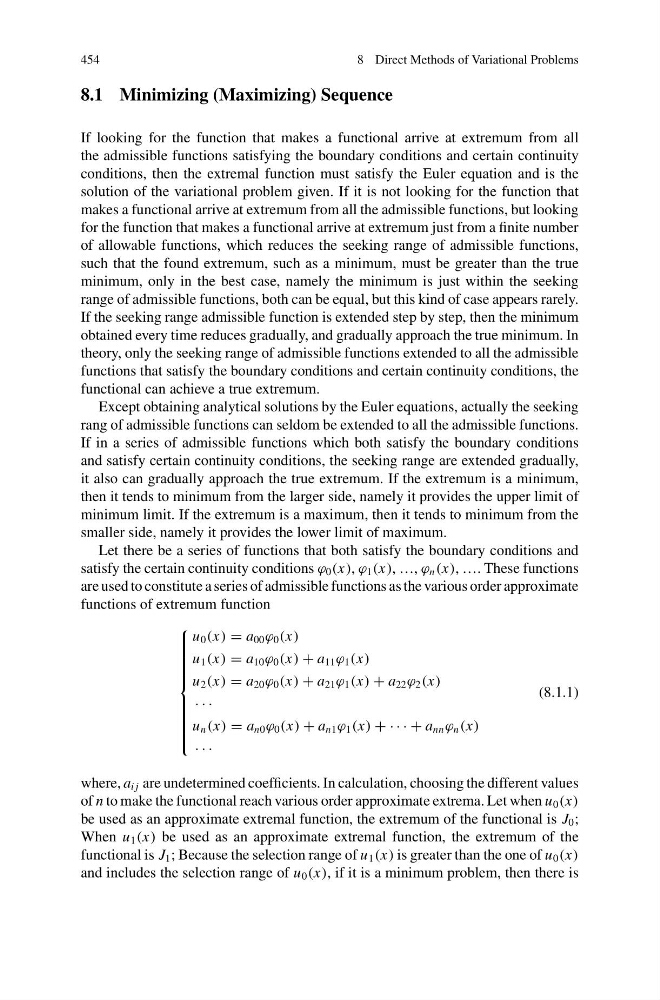
u 0 (x) = a 00 ϕ 0 (x)
u 1 (x) = a 10 ϕ 0 (x) + a 11 ϕ 1 (x)
u 2 (x) = a 20 ϕ 0 (x) + a 21 ϕ 1 (x) + a 22 ϕ 2 (x)
· · ·
u n (x) = a n0 ϕ 0 (x) + a n1 ϕ 1 (x) + · · · + a nn ϕ n (x)
· · ·
(8.1.1)
where, a i j are undetermined coefficients. In calculation, choosing the different values
of n to make the functional reach various order approximate extrema. Let when u 0 (x)
be used as an approximate extremal function, the extremum of the functional is J 0 ;
When u 1 (x) be used as an approximate extremal function, the extremum of the
functional is J 1 ; Because the selection range of u 1 (x) is greater than the one of u 0 (x)
and includes the selection range of u 0 (x), if it is a minimum problem, then there is
8 Direct Methods of Variational Problems
8.1 Minimizing (Maximizing) Sequence
If looking for the function that makes a functional arrive at extremum from all
the admissible functions satisfying the boundary conditions and certain continuity
conditions, then the extremal function must satisfy the Euler equation and is the
solution of the variational problem given. If it is not looking for the function that
makes a functional arrive at extremum from all the admissible functions, but looking
for the function that makes a functional arrive at extremum just from a finite number
of allowable functions, which reduces the seeking range of admissible functions,
such that the found extremum, such as a minimum, must be greater than the true
minimum, only in the best case, namely the minimum is just within the seeking
range of admissible functions, both can be equal, but this kind of case appears rarely.
If the seeking range admissible function is extended step by step, then the minimum
obtained every time reduces gradually, and gradually approach the true minimum. In
theory, only the seeking range of admissible functions extended to all the admissible
functions that satisfy the boundary conditions and certain continuity conditions, the
functional can achieve a true extremum.
Except obtaining analytical solutions by the Euler equations, actually the seeking
rang of admissible functions can seldom be extended to all the admissible functions.
If in a series of admissible functions which both satisfy the boundary conditions
and satisfy certain continuity conditions, the seeking range are extended gradually,
it also can gradually approach the true extremum. If the extremum is a minimum,
then it tends to minimum from the larger side, namely it provides the upper limit of
minimum limit. If the extremum is a maximum, then it tends to minimum from the
smaller side, namely it provides the lower limit of maximum.
Let there be a series of functions that both satisfy the boundary conditions and
satisfy the certain continuity conditions ϕ 0 (x), ϕ 1 (x), …, ϕ n (x), …. These functions
are used to constitute a series of admissible functions as the various order approximate
functions of extremum function
⎧
⎪ ⎪ ⎪ ⎪ ⎪ ⎪ ⎪ ⎪ ⎨
⎪ ⎪ ⎪ ⎪ ⎪ ⎪ ⎪ ⎪ ⎩
u 0 (x) = a 00 ϕ 0 (x)
u 1 (x) = a 10 ϕ 0 (x) + a 11 ϕ 1 (x)
u 2 (x) = a 20 ϕ 0 (x) + a 21 ϕ 1 (x) + a 22 ϕ 2 (x)
· · ·
u n (x) = a n0 ϕ 0 (x) + a n1 ϕ 1 (x) + · · · + a nn ϕ n (x)
· · ·
(8.1.1)
where, a i j are undetermined coefficients. In calculation, choosing the different values
of n to make the functional reach various order approximate extrema. Let when u 0 (x)
be used as an approximate extremal function, the extremum of the functional is J 0 ;
When u 1 (x) be used as an approximate extremal function, the extremum of the
functional is J 1 ; Because the selection range of u 1 (x) is greater than the one of u 0 (x)
and includes the selection range of u 0 (x), if it is a minimum problem, then there is