

7.8 Variational Problems of Equivalence with Boundary Value Problem …
431
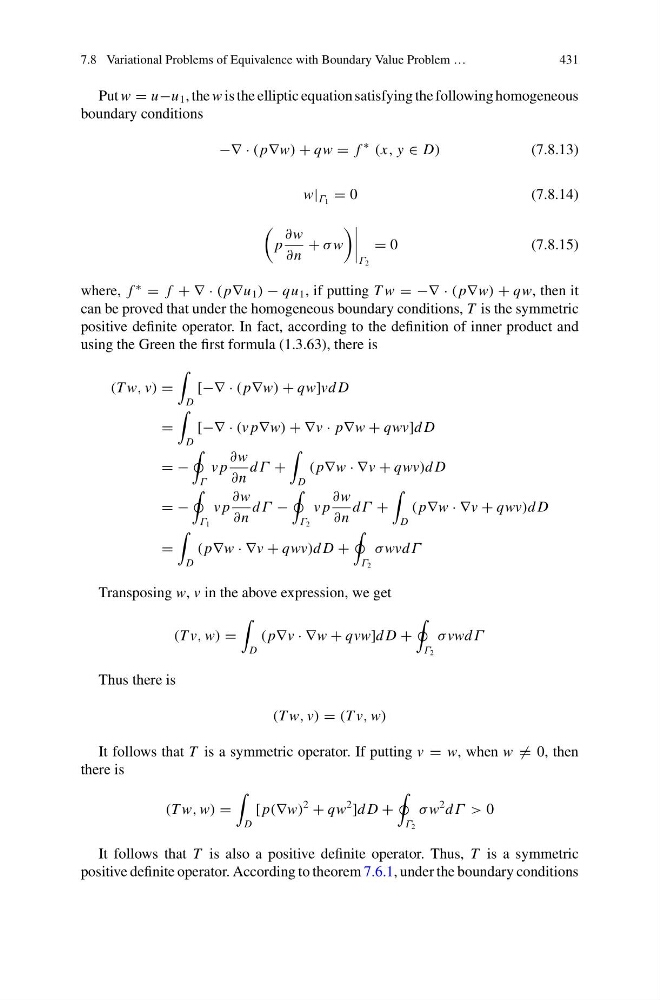
Put w = u−u 1 , the w is the elliptic equation satisfying the following homogeneous
boundary conditions
−∇ · ( p∇w) + qw = f
∗
(x, y ∈ D)
(7.8.13)
w| Γ 1 = 0
(7.8.14)
p
∂w
∂n
+ σ w
Γ 2
= 0
(7.8.15)
where, f
∗
= f + ∇ · ( p∇u 1 ) − qu 1 , if putting T w = −∇ · ( p∇w) + qw, then it
can be proved that under the homogeneous boundary conditions, T is the symmetric
positive definite operator. In fact, according to the definition of inner product and
using the Green the first formula (1.3.63), there is
(T w, v) =
D
[−∇ · ( p∇w) + qw]vd D
=
D
[−∇ · (v p∇w) + ∇v · p∇w + qwv]d D
= −
Γ
v p
∂w
∂n
dΓ +
D
( p∇w · ∇v + qwv)d D
= −
Γ 1
v p
∂w
∂n
dΓ −
Γ 2
v p
∂w
∂n
dΓ +
D
( p∇w · ∇v + qwv)d D
=
D
( p∇w · ∇v + qwv)d D +
Γ 2
σ wvdΓ
Transposing w, v in the above expression, we get
(T v, w) =
D
( p∇v · ∇w + qvw]d D +
Γ 2
σ vwdΓ
Thus there is
(T w, v) = (T v, w)
It follows that T is a symmetric operator. If putting v = w, when w = 0, then
there is
(T w, w) =
D
[ p(∇w)
2
+ qw
2
]d D +
Γ 2
σ w
2 dΓ > 0
It follows that T is also a positive definite operator. Thus, T is a symmetric
positive definite operator. According to theorem 7.6.1, under the boundary conditions
431
Put w = u−u 1 , the w is the elliptic equation satisfying the following homogeneous
boundary conditions
−∇ · ( p∇w) + qw = f
∗
(x, y ∈ D)
(7.8.13)
w| Γ 1 = 0
(7.8.14)
p
∂w
∂n
+ σ w
Γ 2
= 0
(7.8.15)
where, f
∗
= f + ∇ · ( p∇u 1 ) − qu 1 , if putting T w = −∇ · ( p∇w) + qw, then it
can be proved that under the homogeneous boundary conditions, T is the symmetric
positive definite operator. In fact, according to the definition of inner product and
using the Green the first formula (1.3.63), there is
(T w, v) =
D
[−∇ · ( p∇w) + qw]vd D
=
D
[−∇ · (v p∇w) + ∇v · p∇w + qwv]d D
= −
Γ
v p
∂w
∂n
dΓ +
D
( p∇w · ∇v + qwv)d D
= −
Γ 1
v p
∂w
∂n
dΓ −
Γ 2
v p
∂w
∂n
dΓ +
D
( p∇w · ∇v + qwv)d D
=
D
( p∇w · ∇v + qwv)d D +
Γ 2
σ wvdΓ
Transposing w, v in the above expression, we get
(T v, w) =
D
( p∇v · ∇w + qvw]d D +
Γ 2
σ vwdΓ
Thus there is
(T w, v) = (T v, w)
It follows that T is a symmetric operator. If putting v = w, when w = 0, then
there is
(T w, w) =
D
[ p(∇w)
2
+ qw
2
]d D +
Γ 2
σ w
2 dΓ > 0
It follows that T is also a positive definite operator. Thus, T is a symmetric
positive definite operator. According to theorem 7.6.1, under the boundary conditions