

422
7 Variational Principles
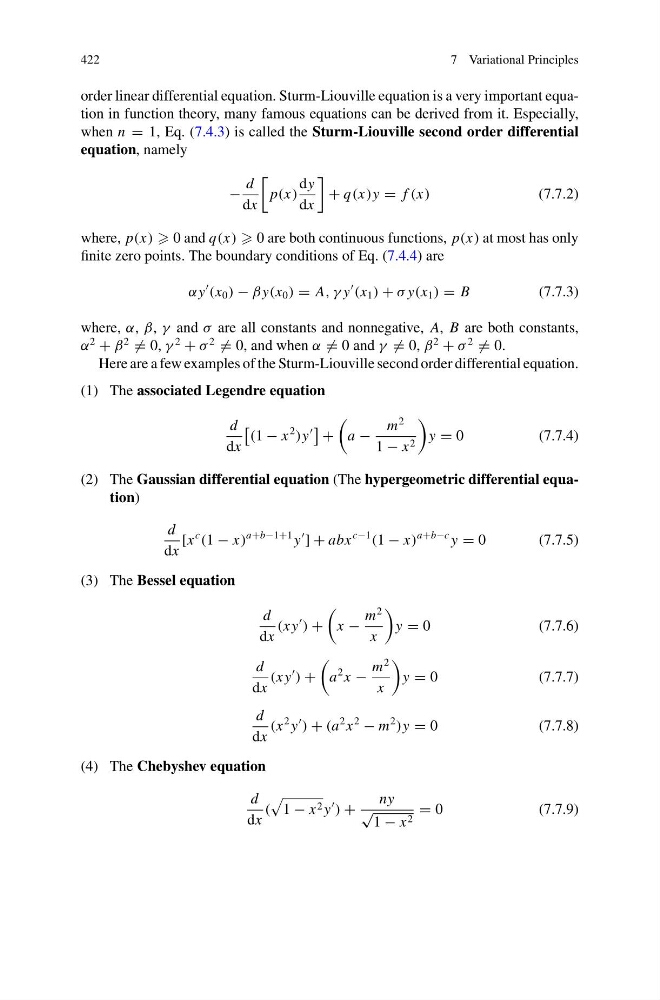
order linear differential equation. Sturm-Liouville equation is a very important equation in function theory, many famous equations can be derived from it. Especially,
when n = 1, Eq. (7.4.3) is called the Sturm-Liouville second order differential
equation, namely
−
d
dx
p(x)
dy
dx
+ q(x)y = f (x)
(7.7.2)
where, p(x) 0 and q(x) 0 are both continuous functions, p(x) at most has only
finite zero points. The boundary conditions of Eq. (7.4.4) are
αy
(x 0 ) − βy(x 0 ) = A, γ y
(x 1 ) + σ y(x 1 ) = B
(7.7.3)
where, α, β, γ and σ are all constants and nonnegative, A, B are both constants,
α
2
+ β
2
= 0, γ
2
+ σ
2
= 0, and when α = 0 and γ = 0, β
2
+ σ
2
= 0.
Here are a few examples of the Sturm-Liouville second order differential equation.
(1) The associated Legendre equation
d
dx
(1 − x
2
)y
+
a −
m
2
1 − x 2
y = 0
(7.7.4)
(2) The Gaussian differential equation (The hypergeometric differential equation)
d
dx
[x
c
(1 − x)
a+b−1+1 y
] + abx
c−1
(1 − x)
a+b−c y = 0
(7.7.5)
(3) The Bessel equation
d
dx
(x y
) +
x −
m
2
x
y = 0
(7.7.6)
d
dx
(x y
) +
a
2 x −
m
2
x
y = 0
(7.7.7)
d
dx
(x
2 y
) + (a
2 x
2
− m
2
)y = 0
(7.7.8)
(4) The Chebyshev equation
d
dx
(
1 − x 2 y
) +
ny
√
1 − x 2
= 0
(7.7.9)
7 Variational Principles
order linear differential equation. Sturm-Liouville equation is a very important equation in function theory, many famous equations can be derived from it. Especially,
when n = 1, Eq. (7.4.3) is called the Sturm-Liouville second order differential
equation, namely
−
d
dx
p(x)
dy
dx
+ q(x)y = f (x)
(7.7.2)
where, p(x) 0 and q(x) 0 are both continuous functions, p(x) at most has only
finite zero points. The boundary conditions of Eq. (7.4.4) are
αy
(x 0 ) − βy(x 0 ) = A, γ y
(x 1 ) + σ y(x 1 ) = B
(7.7.3)
where, α, β, γ and σ are all constants and nonnegative, A, B are both constants,
α
2
+ β
2
= 0, γ
2
+ σ
2
= 0, and when α = 0 and γ = 0, β
2
+ σ
2
= 0.
Here are a few examples of the Sturm-Liouville second order differential equation.
(1) The associated Legendre equation
d
dx
(1 − x
2
)y
+
a −
m
2
1 − x 2
y = 0
(7.7.4)
(2) The Gaussian differential equation (The hypergeometric differential equation)
d
dx
[x
c
(1 − x)
a+b−1+1 y
] + abx
c−1
(1 − x)
a+b−c y = 0
(7.7.5)
(3) The Bessel equation
d
dx
(x y
) +
x −
m
2
x
y = 0
(7.7.6)
d
dx
(x y
) +
a
2 x −
m
2
x
y = 0
(7.7.7)
d
dx
(x
2 y
) + (a
2 x
2
− m
2
)y = 0
(7.7.8)
(4) The Chebyshev equation
d
dx
(
1 − x 2 y
) +
ny
√
1 − x 2
= 0
(7.7.9)