

7.6 Variational Principles of Operator Equations
419
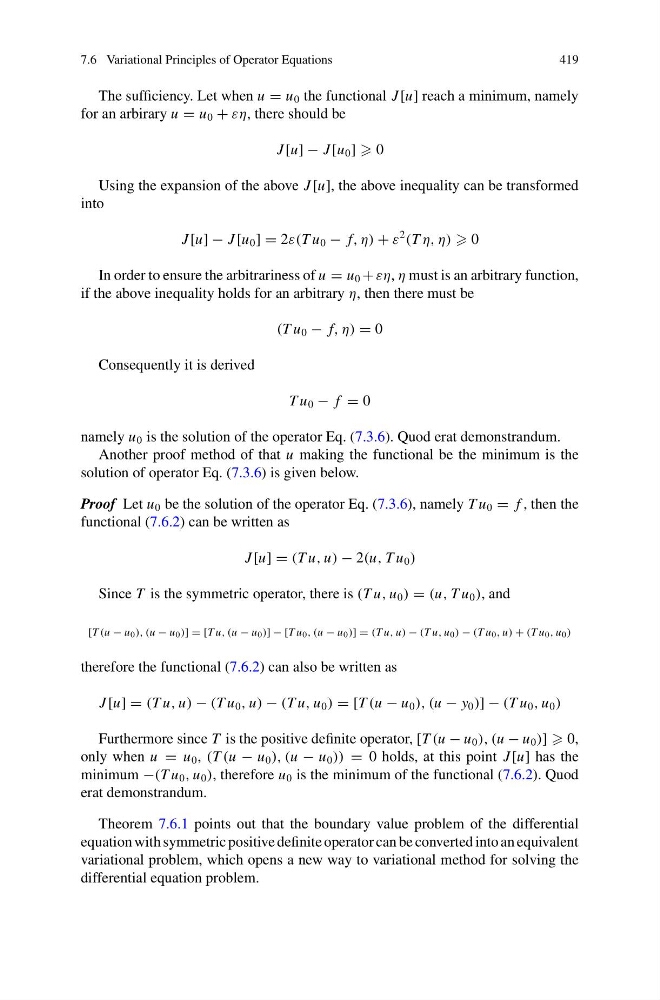
The sufficiency. Let when u = u 0 the functional J [u] reach a minimum, namely
for an arbirary u = u 0 + εη, there should be
J [u] − J [u 0 ] 0
Using the expansion of the above J [u], the above inequality can be transformed
into
J [u] − J [u 0 ] = 2ε(T u 0 − f, η) + ε
2
(T η, η) 0
In order to ensure the arbitrariness of u = u 0 + εη, η must is an arbitrary function,
if the above inequality holds for an arbitrary η, then there must be
(T u 0 − f, η) = 0
Consequently it is derived
T u 0 − f = 0
namely u 0 is the solution of the operator Eq. (7.3.6). Quod erat demonstrandum.
Another proof method of that u making the functional be the minimum is the
solution of operator Eq. (7.3.6) is given below.
Proof Let u 0 be the solution of the operator Eq. (7.3.6), namely T u 0 = f , then the
functional (7.6.2) can be written as
J [u] = (T u, u) − 2(u, T u 0 )
Since T is the symmetric operator, there is (T u, u 0 ) = (u, T u 0 ), and
[T (u − u 0 ), (u − u 0 )] = [T u, (u − u 0 )] − [T u 0 , (u − u 0 )] = (T u, u) − (T u, u 0 ) − (T u 0 , u) + (T u 0 , u 0 )
therefore the functional (7.6.2) can also be written as
J [u] = (T u, u) − (T u 0 , u) − (T u, u 0 ) = [T (u − u 0 ), (u − y 0 )] − (T u 0 , u 0 )
Furthermore since T is the positive definite operator, [T (u − u 0 ), (u − u 0 )] 0,
only when u = u 0 , (T (u − u 0 ), (u − u 0 )) = 0 holds, at this point J [u] has the
minimum −(T u 0 , u 0 ), therefore u 0 is the minimum of the functional (7.6.2). Quod
erat demonstrandum.
Theorem 7.6.1 points out that the boundary value problem of the differential
equation with symmetric positive definite operator can be converted into an equivalent
variational problem, which opens a new way to variational method for solving the
differential equation problem.
419
The sufficiency. Let when u = u 0 the functional J [u] reach a minimum, namely
for an arbirary u = u 0 + εη, there should be
J [u] − J [u 0 ] 0
Using the expansion of the above J [u], the above inequality can be transformed
into
J [u] − J [u 0 ] = 2ε(T u 0 − f, η) + ε
2
(T η, η) 0
In order to ensure the arbitrariness of u = u 0 + εη, η must is an arbitrary function,
if the above inequality holds for an arbitrary η, then there must be
(T u 0 − f, η) = 0
Consequently it is derived
T u 0 − f = 0
namely u 0 is the solution of the operator Eq. (7.3.6). Quod erat demonstrandum.
Another proof method of that u making the functional be the minimum is the
solution of operator Eq. (7.3.6) is given below.
Proof Let u 0 be the solution of the operator Eq. (7.3.6), namely T u 0 = f , then the
functional (7.6.2) can be written as
J [u] = (T u, u) − 2(u, T u 0 )
Since T is the symmetric operator, there is (T u, u 0 ) = (u, T u 0 ), and
[T (u − u 0 ), (u − u 0 )] = [T u, (u − u 0 )] − [T u 0 , (u − u 0 )] = (T u, u) − (T u, u 0 ) − (T u 0 , u) + (T u 0 , u 0 )
therefore the functional (7.6.2) can also be written as
J [u] = (T u, u) − (T u 0 , u) − (T u, u 0 ) = [T (u − u 0 ), (u − y 0 )] − (T u 0 , u 0 )
Furthermore since T is the positive definite operator, [T (u − u 0 ), (u − u 0 )] 0,
only when u = u 0 , (T (u − u 0 ), (u − u 0 )) = 0 holds, at this point J [u] has the
minimum −(T u 0 , u 0 ), therefore u 0 is the minimum of the functional (7.6.2). Quod
erat demonstrandum.
Theorem 7.6.1 points out that the boundary value problem of the differential
equation with symmetric positive definite operator can be converted into an equivalent
variational problem, which opens a new way to variational method for solving the
differential equation problem.