

7.4 Operators and Functionals
407
x
x
δ
=
x
x
δ = δ,
T
x
x
δ
=
T xδ
x
< 1
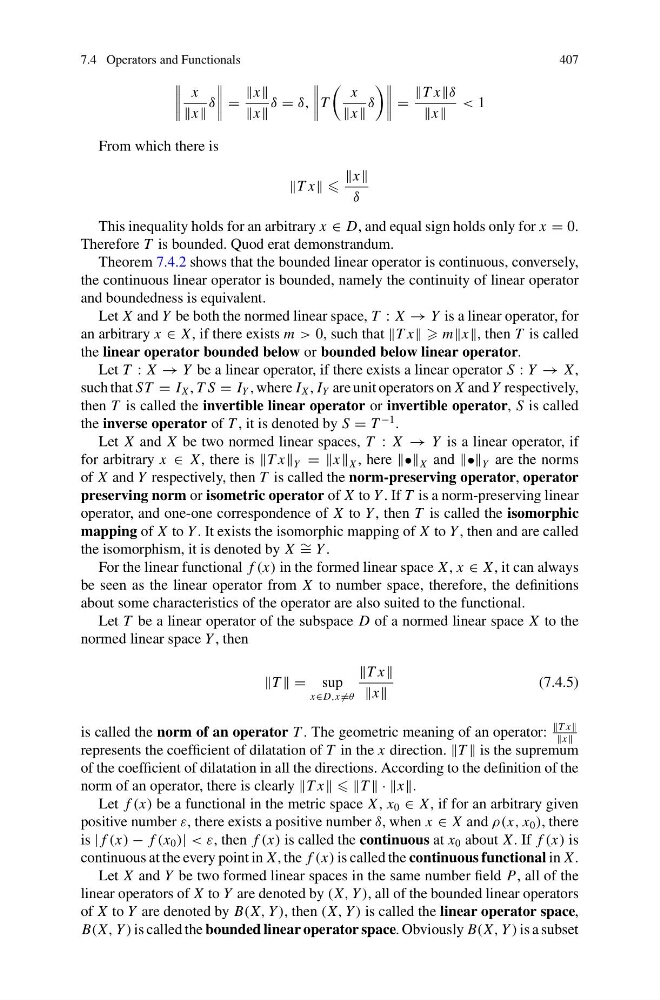
From which there is
T x
x
δ
This inequality holds for an arbitrary x ∈ D, and equal sign holds only for x = 0.
Therefore T is bounded. Quod erat demonstrandum.
Theorem 7.4.2 shows that the bounded linear operator is continuous, conversely,
the continuous linear operator is bounded, namely the continuity of linear operator
and boundedness is equivalent.
Let X and Y be both the normed linear space, T : X → Y is a linear operator, for
an arbitrary x ∈ X , if there exists m > 0, such that T x mx, then T is called
the linear operator bounded below or bounded below linear operator.
Let T : X → Y be a linear operator, if there exists a linear operator S : Y → X ,
such that ST = I X , T S = I Y , where I X , I Y are unit operators on X and Y respectively,
then T is called the invertible linear operator or invertible operator, S is called
the inverse operator of T , it is denoted by S = T
−1 .
Let X and X be two normed linear spaces, T : X → Y is a linear operator, if
for arbitrary x ∈ X , there is T x Y = x X , here • X and • Y are the norms
of X and Y respectively, then T is called the norm-preserving operator, operator
preserving norm or isometric operator of X to Y . If T is a norm-preserving linear
operator, and one-one correspondence of X to Y , then T is called the isomorphic
mapping of X to Y . It exists the isomorphic mapping of X to Y , then and are called
the isomorphism, it is denoted by X ∼ = Y .
For the linear functional f (x) in the formed linear space X , x ∈ X , it can always
be seen as the linear operator from X to number space, therefore, the definitions
about some characteristics of the operator are also suited to the functional.
Let T be a linear operator of the subspace D of a normed linear space X to the
normed linear space Y , then
T = sup
x∈D,x =θ
T x
x
(7.4.5)
is called the norm of an operator T . The geometric meaning of an operator:
T x
x
represents the coefficient of dilatation of T in the x direction. T is the supremum
of the coefficient of dilatation in all the directions. According to the definition of the
norm of an operator, there is clearly T x T · x.
Let f (x) be a functional in the metric space X , x 0 ∈ X , if for an arbitrary given
positive number ε, there exists a positive number δ, when x ∈ X and ρ(x, x 0 ), there
is | f (x) − f (x 0 )| < ε, then f (x) is called the continuous at x 0 about X . If f (x) is
continuous at the every point in X , the f (x) is called the continuous functional in X .
Let X and Y be two formed linear spaces in the same number field P, all of the
linear operators of X to Y are denoted by (X, Y ), all of the bounded linear operators
of X to Y are denoted by B(X, Y ), then (X, Y ) is called the linear operator space,
B(X, Y ) is called the bounded linear operator space. Obviously B(X, Y ) is a subset
407
x
x
δ
=
x
x
δ = δ,
T
x
x
δ
=
T xδ
x
< 1
From which there is
T x
x
δ
This inequality holds for an arbitrary x ∈ D, and equal sign holds only for x = 0.
Therefore T is bounded. Quod erat demonstrandum.
Theorem 7.4.2 shows that the bounded linear operator is continuous, conversely,
the continuous linear operator is bounded, namely the continuity of linear operator
and boundedness is equivalent.
Let X and Y be both the normed linear space, T : X → Y is a linear operator, for
an arbitrary x ∈ X , if there exists m > 0, such that T x mx, then T is called
the linear operator bounded below or bounded below linear operator.
Let T : X → Y be a linear operator, if there exists a linear operator S : Y → X ,
such that ST = I X , T S = I Y , where I X , I Y are unit operators on X and Y respectively,
then T is called the invertible linear operator or invertible operator, S is called
the inverse operator of T , it is denoted by S = T
−1 .
Let X and X be two normed linear spaces, T : X → Y is a linear operator, if
for arbitrary x ∈ X , there is T x Y = x X , here • X and • Y are the norms
of X and Y respectively, then T is called the norm-preserving operator, operator
preserving norm or isometric operator of X to Y . If T is a norm-preserving linear
operator, and one-one correspondence of X to Y , then T is called the isomorphic
mapping of X to Y . It exists the isomorphic mapping of X to Y , then and are called
the isomorphism, it is denoted by X ∼ = Y .
For the linear functional f (x) in the formed linear space X , x ∈ X , it can always
be seen as the linear operator from X to number space, therefore, the definitions
about some characteristics of the operator are also suited to the functional.
Let T be a linear operator of the subspace D of a normed linear space X to the
normed linear space Y , then
T = sup
x∈D,x =θ
T x
x
(7.4.5)
is called the norm of an operator T . The geometric meaning of an operator:
T x
x
represents the coefficient of dilatation of T in the x direction. T is the supremum
of the coefficient of dilatation in all the directions. According to the definition of the
norm of an operator, there is clearly T x T · x.
Let f (x) be a functional in the metric space X , x 0 ∈ X , if for an arbitrary given
positive number ε, there exists a positive number δ, when x ∈ X and ρ(x, x 0 ), there
is | f (x) − f (x 0 )| < ε, then f (x) is called the continuous at x 0 about X . If f (x) is
continuous at the every point in X , the f (x) is called the continuous functional in X .
Let X and Y be two formed linear spaces in the same number field P, all of the
linear operators of X to Y are denoted by (X, Y ), all of the bounded linear operators
of X to Y are denoted by B(X, Y ), then (X, Y ) is called the linear operator space,
B(X, Y ) is called the bounded linear operator space. Obviously B(X, Y ) is a subset