

7.3 Normal Orthogonal System and Fourier Series
403
n
i=1
¯
α i (x, e i ) +
n
i=1
α i (x, e i ) =
n
i=1
¯
α i α i +
n
i=1
α i ¯
α i = 2
n
i=1
α i ¯
α i
= 2
n
i=1
|α i |
2
= 2
n
i=1
|(x, e i )|
2
(7.3.9)
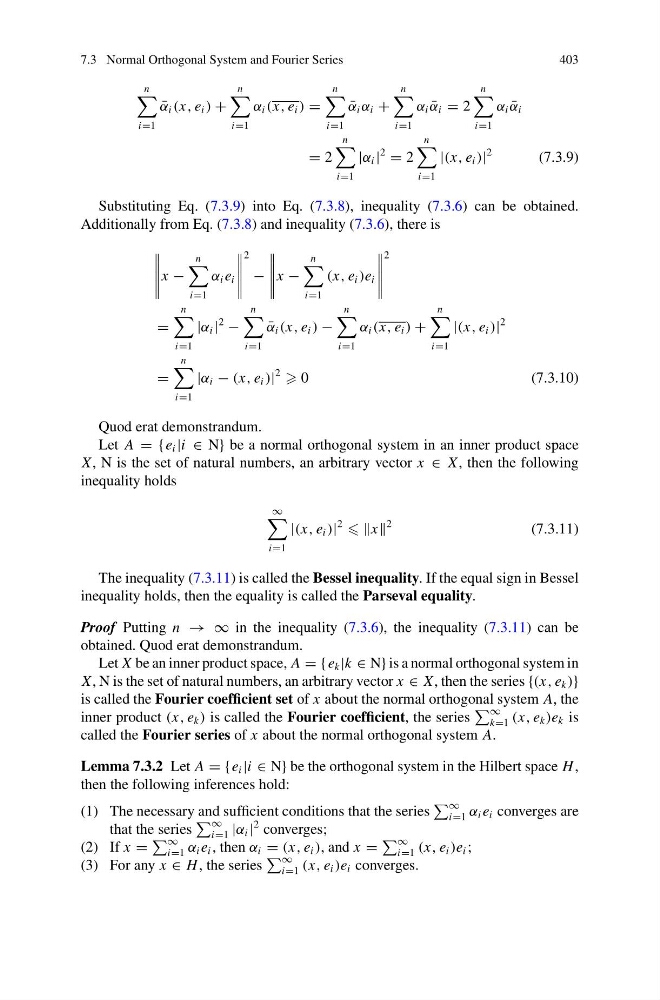
Substituting Eq. (7.3.9) into Eq. (7.3.8), inequality (7.3.6) can be obtained.
Additionally from Eq. (7.3.8) and inequality (7.3.6), there is
x −
n
i=1
α i e i
2
−
x −
n
i=1
(x, e i )e i
2
=
n
i=1
|α i |
2
−
n
i=1
¯
α i (x, e i ) −
n
i=1
α i (x, e i ) +
n
i=1
|(x, e i )|
2
=
n
i=1
|α i − (x, e i )|
2
0
(7.3.10)
Quod erat demonstrandum.
Let A = {e i |i ∈ N} be a normal orthogonal system in an inner product space
X , N is the set of natural numbers, an arbitrary vector x ∈ X , then the following
inequality holds
∞
i=1
|(x, e i )|
2
x
2
(7.3.11)
The inequality (7.3.11) is called the Bessel inequality. If the equal sign in Bessel
inequality holds, then the equality is called the Parseval equality.
Proof Putting n → ∞ in the inequality (7.3.6), the inequality (7.3.11) can be
obtained. Quod erat demonstrandum.
Let X be an inner product space, A = {e k |k ∈ N} is a normal orthogonal system in
X , N is the set of natural numbers, an arbitrary vector x ∈ X , then the series {(x, e k )}
is called the Fourier coefficient set of x about the normal orthogonal system A, the
inner product (x, e k ) is called the Fourier coefficient, the series
∞
k=1 (x, e k )e k is
called the Fourier series of x about the normal orthogonal system A.
Lemma 7.3.2 Let A = {e i |i ∈ N} be the orthogonal system in the Hilbert space H ,
then the following inferences hold:
(1) The necessary and sufficient conditions that the series
∞
i=1 α i e i converges are
that the series
∞
i=1 |α i |
2 converges;
(2) If x =
∞
i=1 α i e i , then α i = (x, e i ), and x =
∞
i=1 (x, e i )e i ;
(3) For any x ∈ H , the series
∞
i=1 (x, e i )e i converges.
403
n
i=1
¯
α i (x, e i ) +
n
i=1
α i (x, e i ) =
n
i=1
¯
α i α i +
n
i=1
α i ¯
α i = 2
n
i=1
α i ¯
α i
= 2
n
i=1
|α i |
2
= 2
n
i=1
|(x, e i )|
2
(7.3.9)
Substituting Eq. (7.3.9) into Eq. (7.3.8), inequality (7.3.6) can be obtained.
Additionally from Eq. (7.3.8) and inequality (7.3.6), there is
x −
n
i=1
α i e i
2
−
x −
n
i=1
(x, e i )e i
2
=
n
i=1
|α i |
2
−
n
i=1
¯
α i (x, e i ) −
n
i=1
α i (x, e i ) +
n
i=1
|(x, e i )|
2
=
n
i=1
|α i − (x, e i )|
2
0
(7.3.10)
Quod erat demonstrandum.
Let A = {e i |i ∈ N} be a normal orthogonal system in an inner product space
X , N is the set of natural numbers, an arbitrary vector x ∈ X , then the following
inequality holds
∞
i=1
|(x, e i )|
2
x
2
(7.3.11)
The inequality (7.3.11) is called the Bessel inequality. If the equal sign in Bessel
inequality holds, then the equality is called the Parseval equality.
Proof Putting n → ∞ in the inequality (7.3.6), the inequality (7.3.11) can be
obtained. Quod erat demonstrandum.
Let X be an inner product space, A = {e k |k ∈ N} is a normal orthogonal system in
X , N is the set of natural numbers, an arbitrary vector x ∈ X , then the series {(x, e k )}
is called the Fourier coefficient set of x about the normal orthogonal system A, the
inner product (x, e k ) is called the Fourier coefficient, the series
∞
k=1 (x, e k )e k is
called the Fourier series of x about the normal orthogonal system A.
Lemma 7.3.2 Let A = {e i |i ∈ N} be the orthogonal system in the Hilbert space H ,
then the following inferences hold:
(1) The necessary and sufficient conditions that the series
∞
i=1 α i e i converges are
that the series
∞
i=1 |α i |
2 converges;
(2) If x =
∞
i=1 α i e i , then α i = (x, e i ), and x =
∞
i=1 (x, e i )e i ;
(3) For any x ∈ H , the series
∞
i=1 (x, e i )e i converges.