

7.2 Sets and Spaces
395
space. The complex inner product space and real inner product space are both called
the inner product space for short, it is denoted by (X, (·, ·)).
Note that the property (1) of the inner product, when P is a complex number
field, for all x = (x 1 , x 2 , · · · , x n ), y = (y 1 , y 2 , · · · , y n ) ∈ C
n , where C
n is ndimensional complex vector, at the moment the definition of the inner product is
(x, y) = x 1 ¯
y 1 + x 2 ¯
y 2 + · · · + x n ¯
y n , here ¯
y i is the conjugate complex number of y i ,
it follows that (x, y) = (y, x) is not true, but it is deduced
(x, y) = x 1 ¯
y 1 + x 2 ¯
y 2 + · · · + x n ¯
y n
= ¯
y 1 x 1 + ¯
y 2 x 2 + · · · + ¯
y n x n
= (y 1 ¯
x 1 + y 2 ¯
x 2 + · · · + y n ¯
x n ) = (y, x)
Let X be a inner product space, x, y, z ∈ X , α, β ∈ P, then by axioms of the
inner product, to give
(αx + βy, z) = (αx, z) + (βy, z) = α(x, z) + β(y, z)
(x, αy) = (αy, x) = α(y, x) = α(x, y)
(x, αy + βz) = α(x, y) + β(x, z)
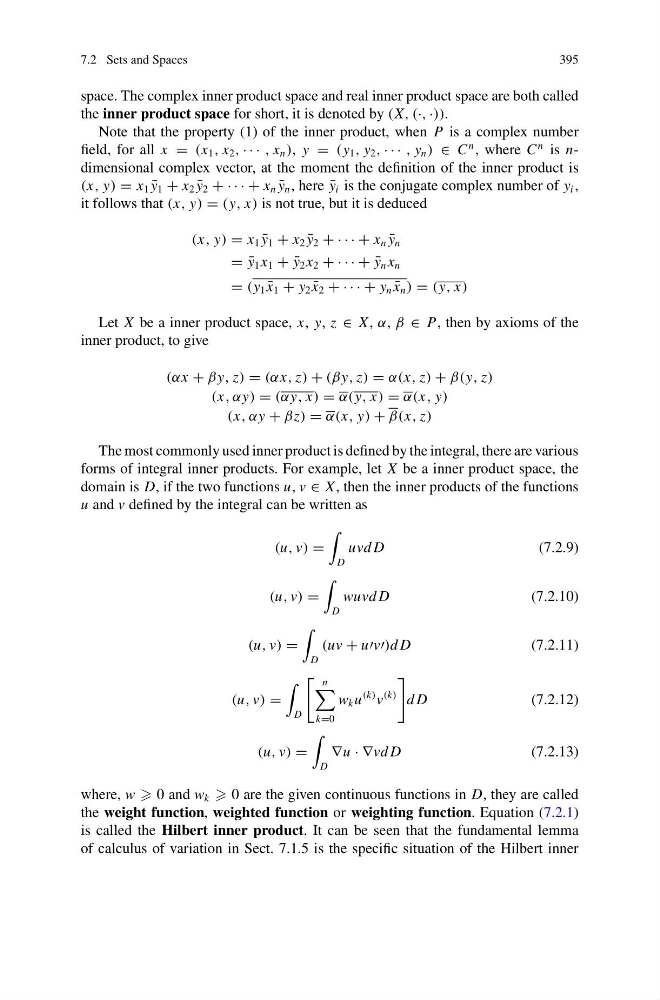
The most commonly used inner product is defined by the integral, there are various
forms of integral inner products. For example, let X be a inner product space, the
domain is D, if the two functions u, v ∈ X , then the inner products of the functions
u and v defined by the integral can be written as
(u, v) =
D
uvd D
(7.2.9)
(u, v) =
D
wuvd D
(7.2.10)
(u, v) =
D
(uv + uv)d D
(7.2.11)
(u, v) =
D
n
k=0
w k u
(k) v
(k)
d D
(7.2.12)
(u, v) =
D
∇u · ∇vd D
(7.2.13)
where, w 0 and w k 0 are the given continuous functions in D, they are called
the weight function, weighted function or weighting function. Equation (7.2.1)
is called the Hilbert inner product. It can be seen that the fundamental lemma
of calculus of variation in Sect. 7.1.5 is the specific situation of the Hilbert inner
395
space. The complex inner product space and real inner product space are both called
the inner product space for short, it is denoted by (X, (·, ·)).
Note that the property (1) of the inner product, when P is a complex number
field, for all x = (x 1 , x 2 , · · · , x n ), y = (y 1 , y 2 , · · · , y n ) ∈ C
n , where C
n is ndimensional complex vector, at the moment the definition of the inner product is
(x, y) = x 1 ¯
y 1 + x 2 ¯
y 2 + · · · + x n ¯
y n , here ¯
y i is the conjugate complex number of y i ,
it follows that (x, y) = (y, x) is not true, but it is deduced
(x, y) = x 1 ¯
y 1 + x 2 ¯
y 2 + · · · + x n ¯
y n
= ¯
y 1 x 1 + ¯
y 2 x 2 + · · · + ¯
y n x n
= (y 1 ¯
x 1 + y 2 ¯
x 2 + · · · + y n ¯
x n ) = (y, x)
Let X be a inner product space, x, y, z ∈ X , α, β ∈ P, then by axioms of the
inner product, to give
(αx + βy, z) = (αx, z) + (βy, z) = α(x, z) + β(y, z)
(x, αy) = (αy, x) = α(y, x) = α(x, y)
(x, αy + βz) = α(x, y) + β(x, z)
The most commonly used inner product is defined by the integral, there are various
forms of integral inner products. For example, let X be a inner product space, the
domain is D, if the two functions u, v ∈ X , then the inner products of the functions
u and v defined by the integral can be written as
(u, v) =
D
uvd D
(7.2.9)
(u, v) =
D
wuvd D
(7.2.10)
(u, v) =
D
(uv + uv)d D
(7.2.11)
(u, v) =
D
n
k=0
w k u
(k) v
(k)
d D
(7.2.12)
(u, v) =
D
∇u · ∇vd D
(7.2.13)
where, w 0 and w k 0 are the given continuous functions in D, they are called
the weight function, weighted function or weighting function. Equation (7.2.1)
is called the Hilbert inner product. It can be seen that the fundamental lemma
of calculus of variation in Sect. 7.1.5 is the specific situation of the Hilbert inner