

382
6 Variational Problems in Parametric Forms
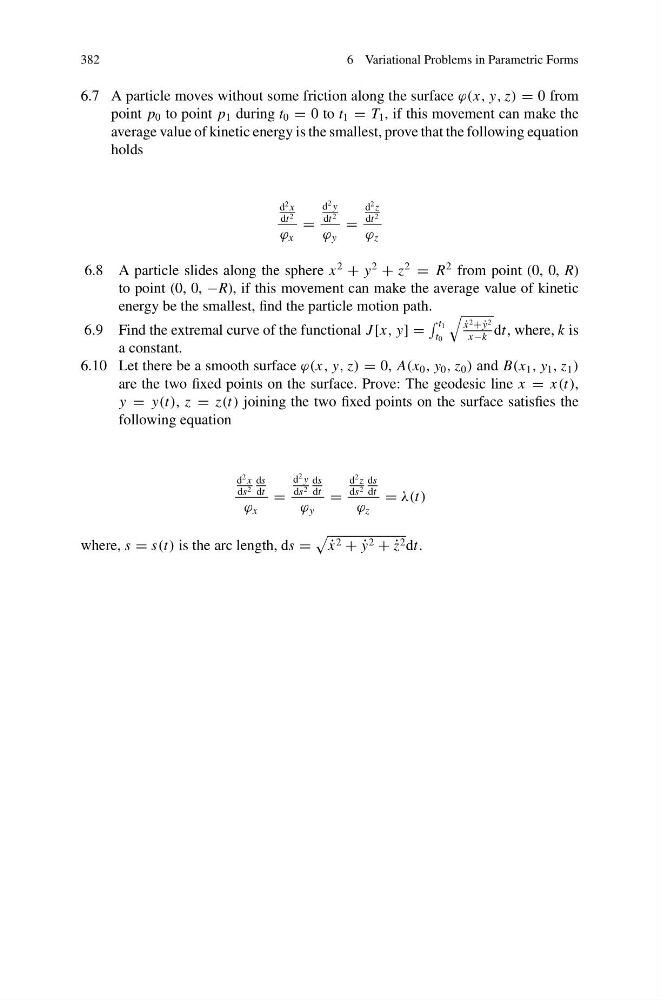
6.7 A particle moves without some friction along the surface ϕ(x, y, z) = 0 from
point p 0 to point p 1 during t 0 = 0 to t 1 = T 1 , if this movement can make the
average value of kinetic energy is the smallest, prove that the following equation
holds
d
2 x
dt 2
ϕ x
=
d
2 y
dt 2
ϕ y
=
d
2 z
dt 2
ϕ z
6.8 A particle slides along the sphere x
2
+ y
2
+ z
2
= R
2 from point (0, 0, R)
to point (0, 0, −R), if this movement can make the average value of kinetic
energy be the smallest, find the particle motion path.
6.9 Find the extremal curve of the functional J [x, y] =
t 1
t 0
˙
x 2 + ˙
y 2
x−k
dt, where, k is
a constant.
6.10 Let there be a smooth surface ϕ(x, y, z) = 0, A(x 0 , y 0 , z 0 ) and B(x 1 , y 1 , z 1 )
are the two fixed points on the surface. Prove: The geodesic line x = x(t),
y = y(t), z = z(t) joining the two fixed points on the surface satisfies the
following equation
d
2 x
ds 2
ds
dt
ϕ x
=
d
2 y
ds 2
ds
dt
ϕ y
=
d
2 z
ds 2
ds
dt
ϕ z
= λ(t)
where, s = s(t) is the arc length, ds =
˙
x 2 + ˙
y 2 + ˙
z 2 dt.
6 Variational Problems in Parametric Forms
6.7 A particle moves without some friction along the surface ϕ(x, y, z) = 0 from
point p 0 to point p 1 during t 0 = 0 to t 1 = T 1 , if this movement can make the
average value of kinetic energy is the smallest, prove that the following equation
holds
d
2 x
dt 2
ϕ x
=
d
2 y
dt 2
ϕ y
=
d
2 z
dt 2
ϕ z
6.8 A particle slides along the sphere x
2
+ y
2
+ z
2
= R
2 from point (0, 0, R)
to point (0, 0, −R), if this movement can make the average value of kinetic
energy be the smallest, find the particle motion path.
6.9 Find the extremal curve of the functional J [x, y] =
t 1
t 0
˙
x 2 + ˙
y 2
x−k
dt, where, k is
a constant.
6.10 Let there be a smooth surface ϕ(x, y, z) = 0, A(x 0 , y 0 , z 0 ) and B(x 1 , y 1 , z 1 )
are the two fixed points on the surface. Prove: The geodesic line x = x(t),
y = y(t), z = z(t) joining the two fixed points on the surface satisfies the
following equation
d
2 x
ds 2
ds
dt
ϕ x
=
d
2 y
ds 2
ds
dt
ϕ y
=
d
2 z
ds 2
ds
dt
ϕ z
= λ(t)
where, s = s(t) is the arc length, ds =
˙
x 2 + ˙
y 2 + ˙
z 2 dt.