

366
6 Variational Problems in Parametric Forms
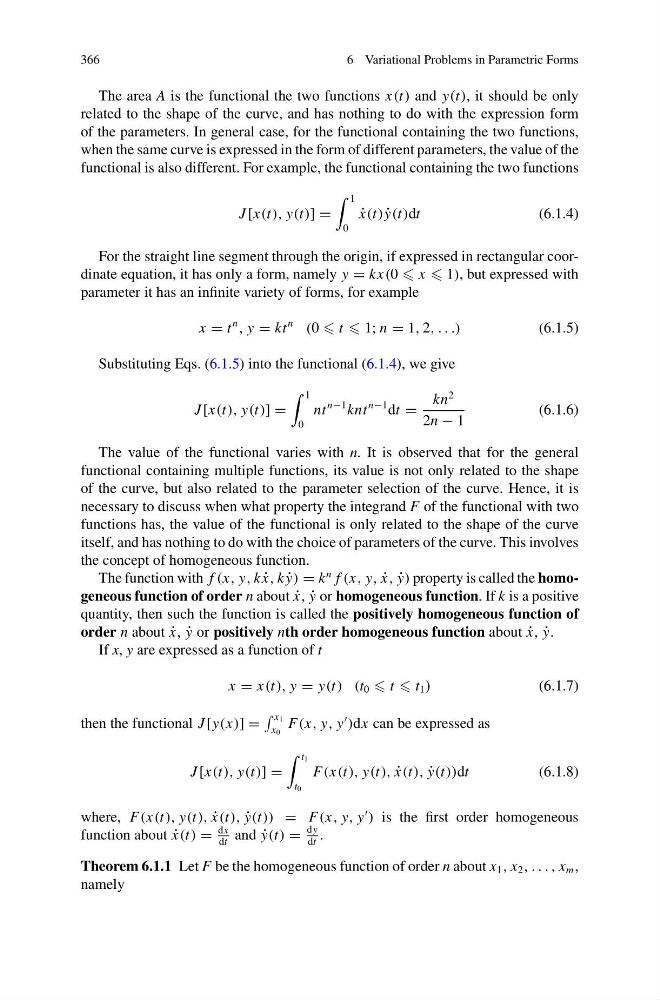
The area A is the functional the two functions x(t) and y(t), it should be only
related to the shape of the curve, and has nothing to do with the expression form
of the parameters. In general case, for the functional containing the two functions,
when the same curve is expressed in the form of different parameters, the value of the
functional is also different. For example, the functional containing the two functions
J [x(t), y(t)] =
1
0
˙
x(t) ˙
y(t)dt
(6.1.4)
For the straight line segment through the origin, if expressed in rectangular coordinate equation, it has only a form, namely y = kx(0 x 1), but expressed with
parameter it has an infinite variety of forms, for example
x = t
n
, y = kt
n
(0 t 1; n = 1, 2, . . .)
(6.1.5)
Substituting Eqs. (6.1.5) into the functional (6.1.4), we give
J [x(t), y(t)] =
1
0
nt
n−1 knt
n−1 dt =
kn
2
2n − 1
(6.1.6)
The value of the functional varies with n. It is observed that for the general
functional containing multiple functions, its value is not only related to the shape
of the curve, but also related to the parameter selection of the curve. Hence, it is
necessary to discuss when what property the integrand F of the functional with two
functions has, the value of the functional is only related to the shape of the curve
itself, and has nothing to do with the choice of parameters of the curve. This involves
the concept of homogeneous function.
The function with f (x, y, k ˙
x, k ˙
y) = k
n f (x, y, ˙
x, ˙
y) property is called the homogeneous function of order n about ˙
x, ˙
y or homogeneous function. If k is a positive
quantity, then such the function is called the positively homogeneous function of
order n about ˙
x, ˙
y or positively nth order homogeneous function about ˙
x, ˙
y.
If x, y are expressed as a function of t
x = x(t), y = y(t) (t 0 t t 1 )
(6.1.7)
then the functional J [y(x)] =
x 1
x 0
F(x, y, y
)dx can be expressed as
J [x(t), y(t)] =
t 1
t 0
F(x(t), y(t), ˙
x(t), ˙
y(t))dt
(6.1.8)
where, F(x(t), y(t), ˙
x(t), ˙
y(t)) = F(x, y, y
) is the first order homogeneous
function about ˙
x(t) =
dx
dt
and ˙
y(t) =
dy
dt
.
Theorem 6.1.1 Let F be the homogeneous function of order n about x 1 , x 2 , . . . , x m ,
namely
6 Variational Problems in Parametric Forms
The area A is the functional the two functions x(t) and y(t), it should be only
related to the shape of the curve, and has nothing to do with the expression form
of the parameters. In general case, for the functional containing the two functions,
when the same curve is expressed in the form of different parameters, the value of the
functional is also different. For example, the functional containing the two functions
J [x(t), y(t)] =
1
0
˙
x(t) ˙
y(t)dt
(6.1.4)
For the straight line segment through the origin, if expressed in rectangular coordinate equation, it has only a form, namely y = kx(0 x 1), but expressed with
parameter it has an infinite variety of forms, for example
x = t
n
, y = kt
n
(0 t 1; n = 1, 2, . . .)
(6.1.5)
Substituting Eqs. (6.1.5) into the functional (6.1.4), we give
J [x(t), y(t)] =
1
0
nt
n−1 knt
n−1 dt =
kn
2
2n − 1
(6.1.6)
The value of the functional varies with n. It is observed that for the general
functional containing multiple functions, its value is not only related to the shape
of the curve, but also related to the parameter selection of the curve. Hence, it is
necessary to discuss when what property the integrand F of the functional with two
functions has, the value of the functional is only related to the shape of the curve
itself, and has nothing to do with the choice of parameters of the curve. This involves
the concept of homogeneous function.
The function with f (x, y, k ˙
x, k ˙
y) = k
n f (x, y, ˙
x, ˙
y) property is called the homogeneous function of order n about ˙
x, ˙
y or homogeneous function. If k is a positive
quantity, then such the function is called the positively homogeneous function of
order n about ˙
x, ˙
y or positively nth order homogeneous function about ˙
x, ˙
y.
If x, y are expressed as a function of t
x = x(t), y = y(t) (t 0 t t 1 )
(6.1.7)
then the functional J [y(x)] =
x 1
x 0
F(x, y, y
)dx can be expressed as
J [x(t), y(t)] =
t 1
t 0
F(x(t), y(t), ˙
x(t), ˙
y(t))dt
(6.1.8)
where, F(x(t), y(t), ˙
x(t), ˙
y(t)) = F(x, y, y
) is the first order homogeneous
function about ˙
x(t) =
dx
dt
and ˙
y(t) =
dy
dt
.
Theorem 6.1.1 Let F be the homogeneous function of order n about x 1 , x 2 , . . . , x m ,
namely