

1.3 Fundamentals of the Theory of Field
21
large, there must be an infinitesimal ε, such that
|ε 1 | < ε, |ε 2 | < ε, . . . , |ε n | < ε
When n → ∞, there is
lim
n→∞
ε = 0
Hence
n
k=1
ε k V k
≤
n
k=1
εεV k = ε
n
k=1
V k = εV
Since the product of an infinitesimal and a bounded function is still an
infinitesimal, so the limit of the above expression vanishes, thus
V
div adV =
S
a · dS
Quod erat demonstrandum.
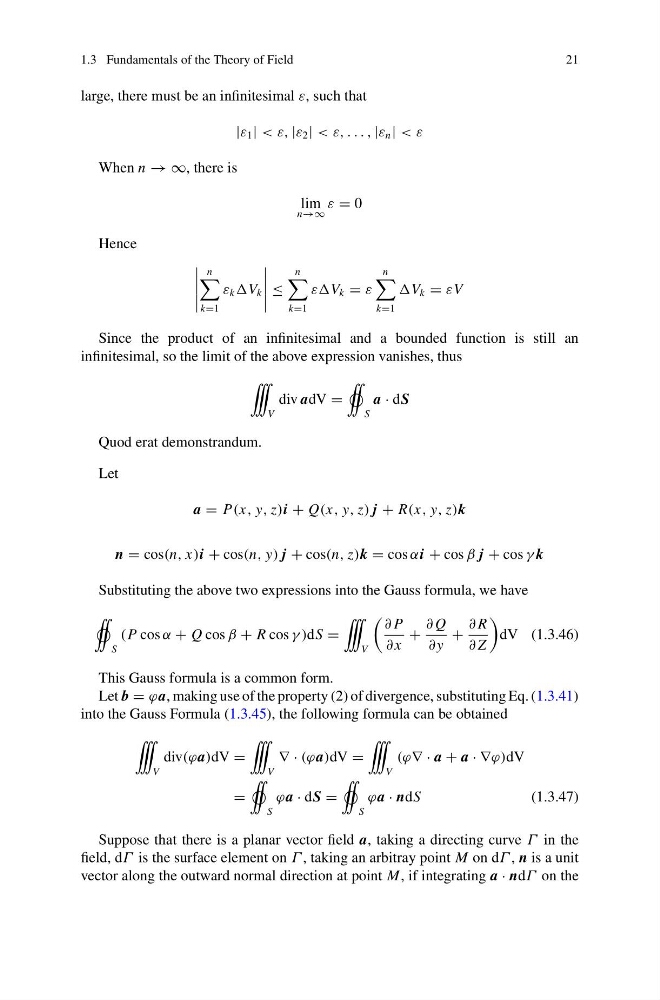
Let
a = P(x, y, z)i + Q(x, y, z) j + R(x, y, z)k
n = cos(n, x)i + cos(n, y) j + cos(n, z)k = cos αi + cos β j + cos γ k
Substituting the above two expressions into the Gauss formula, we have
S
(P cos α + Q cos β + R cos γ )dS =
V
∂ P
∂ x
+
∂ Q
∂ y
+
∂ R
∂ Z
dV (1.3.46)
This Gauss formula is a common form.
Let b = ϕa, making use of the property (2) of divergence, substituting Eq. (1.3.41)
into the Gauss Formula (1.3.45), the following formula can be obtained
V
div(ϕa)dV =
V
∇ · (ϕa)dV =
V
(ϕ∇ · a + a · ∇ϕ)dV
=
S
ϕa · dS =
S
ϕa · ndS
(1.3.47)
Suppose that there is a planar vector field a, taking a directing curve Γ in the
field, dΓ is the surface element on Γ , taking an arbitray point M on dΓ , n is a unit
vector along the outward normal direction at point M, if integrating a · ndΓ on the
21
large, there must be an infinitesimal ε, such that
|ε 1 | < ε, |ε 2 | < ε, . . . , |ε n | < ε
When n → ∞, there is
lim
n→∞
ε = 0
Hence
n
k=1
ε k V k
≤
n
k=1
εεV k = ε
n
k=1
V k = εV
Since the product of an infinitesimal and a bounded function is still an
infinitesimal, so the limit of the above expression vanishes, thus
V
div adV =
S
a · dS
Quod erat demonstrandum.
Let
a = P(x, y, z)i + Q(x, y, z) j + R(x, y, z)k
n = cos(n, x)i + cos(n, y) j + cos(n, z)k = cos αi + cos β j + cos γ k
Substituting the above two expressions into the Gauss formula, we have
S
(P cos α + Q cos β + R cos γ )dS =
V
∂ P
∂ x
+
∂ Q
∂ y
+
∂ R
∂ Z
dV (1.3.46)
This Gauss formula is a common form.
Let b = ϕa, making use of the property (2) of divergence, substituting Eq. (1.3.41)
into the Gauss Formula (1.3.45), the following formula can be obtained
V
div(ϕa)dV =
V
∇ · (ϕa)dV =
V
(ϕ∇ · a + a · ∇ϕ)dV
=
S
ϕa · dS =
S
ϕa · ndS
(1.3.47)
Suppose that there is a planar vector field a, taking a directing curve Γ in the
field, dΓ is the surface element on Γ , taking an arbitray point M on dΓ , n is a unit
vector along the outward normal direction at point M, if integrating a · ndΓ on the