

5.4 Extremal Problems of Mixed Type Functionals
349
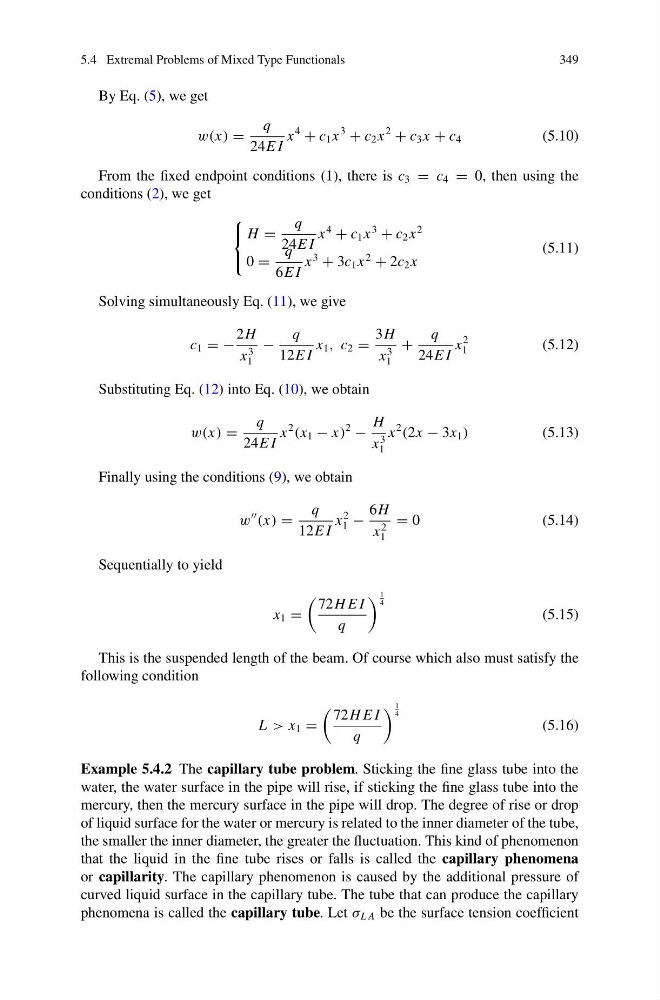
By Eq. (5), we get
w(x) =
q
24E I
x
4
+ c 1 x
3
+ c 2 x
2
+ c 3 x + c 4
(5.10)
From the fixed endpoint conditions (1), there is c 3 = c 4 = 0, then using the
conditions (2), we get
⎧
⎨
⎩
H =
q
24E I
x
4
+ c 1 x
3
+ c 2 x
2
0 =
q
6E I
x
3
+ 3c 1 x
2
+ 2c 2 x
(5.11)
Solving simultaneously Eq. (11), we give
c 1 = −
2H
x
3
1
−
q
12E I
x 1 , c 2 =
3H
x
3
1
+
q
24E I
x
2
1
(5.12)
Substituting Eq. (12) into Eq. (10), we obtain
w(x) =
q
24E I
x
2
(x 1 − x)
2
−
H
x
3
1
x
2
(2x − 3x 1 )
(5.13)
Finally using the conditions (9), we obtain
w
(x) =
q
12E I
x
2
1 −
6H
x
2
1
= 0
(5.14)
Sequentially to yield
x 1 =
72H E I
q
1
4
(5.15)
This is the suspended length of the beam. Of course which also must satisfy the
following condition
L > x 1 =
72H E I
q
1
4
(5.16)
Example 5.4.2 The capillary tube problem. Sticking the fine glass tube into the
water, the water surface in the pipe will rise, if sticking the fine glass tube into the
mercury, then the mercury surface in the pipe will drop. The degree of rise or drop
of liquid surface for the water or mercury is related to the inner diameter of the tube,
the smaller the inner diameter, the greater the fluctuation. This kind of phenomenon
that the liquid in the fine tube rises or falls is called the capillary phenomena
or capillarity. The capillary phenomenon is caused by the additional pressure of
curved liquid surface in the capillary tube. The tube that can produce the capillary
phenomena is called the capillary tube. Let σ L A be the surface tension coefficient
349
By Eq. (5), we get
w(x) =
q
24E I
x
4
+ c 1 x
3
+ c 2 x
2
+ c 3 x + c 4
(5.10)
From the fixed endpoint conditions (1), there is c 3 = c 4 = 0, then using the
conditions (2), we get
⎧
⎨
⎩
H =
q
24E I
x
4
+ c 1 x
3
+ c 2 x
2
0 =
q
6E I
x
3
+ 3c 1 x
2
+ 2c 2 x
(5.11)
Solving simultaneously Eq. (11), we give
c 1 = −
2H
x
3
1
−
q
12E I
x 1 , c 2 =
3H
x
3
1
+
q
24E I
x
2
1
(5.12)
Substituting Eq. (12) into Eq. (10), we obtain
w(x) =
q
24E I
x
2
(x 1 − x)
2
−
H
x
3
1
x
2
(2x − 3x 1 )
(5.13)
Finally using the conditions (9), we obtain
w
(x) =
q
12E I
x
2
1 −
6H
x
2
1
= 0
(5.14)
Sequentially to yield
x 1 =
72H E I
q
1
4
(5.15)
This is the suspended length of the beam. Of course which also must satisfy the
following condition
L > x 1 =
72H E I
q
1
4
(5.16)
Example 5.4.2 The capillary tube problem. Sticking the fine glass tube into the
water, the water surface in the pipe will rise, if sticking the fine glass tube into the
mercury, then the mercury surface in the pipe will drop. The degree of rise or drop
of liquid surface for the water or mercury is related to the inner diameter of the tube,
the smaller the inner diameter, the greater the fluctuation. This kind of phenomenon
that the liquid in the fine tube rises or falls is called the capillary phenomena
or capillarity. The capillary phenomenon is caused by the additional pressure of
curved liquid surface in the capillary tube. The tube that can produce the capillary
phenomena is called the capillary tube. Let σ L A be the surface tension coefficient