

5.4 Extremal Problems of Mixed Type Functionals
347
If δx 0 , δy 0 , δy
0 , δx 1 , δy 1 and δy
1 are all arbitrary, then, the coefficients of them
should be zero, namely
⎧
⎪ ⎪ ⎪ ⎪ ⎪ ⎨
⎪ ⎪ ⎪ ⎪ ⎪ ⎩
F − y
F y −
d
dx
F y
− y
F y + Φ x 1
x=x 1
= 0
F y −
d
dx
F y + Φ y 1
x=x 1
= 0
F y
x=x 1
= 0
(5.4.11)
and
⎧
⎪ ⎪ ⎪ ⎪ ⎪ ⎨
⎪ ⎪ ⎪ ⎪ ⎪ ⎩
F − y
F y −
d
dx
F y
− y
F y − Φ x 0
x=x 0
= 0
F y −
d
dx
F y − Φ y 0
x=x 0
= 0
F y
x=x 0
= 0
(5.4.12)
If there are some relations among x 0 , y 0 , y
0 , x 1 , y 1 and y
1 , then the relations
among the endpoint conditions can further be analyzed.
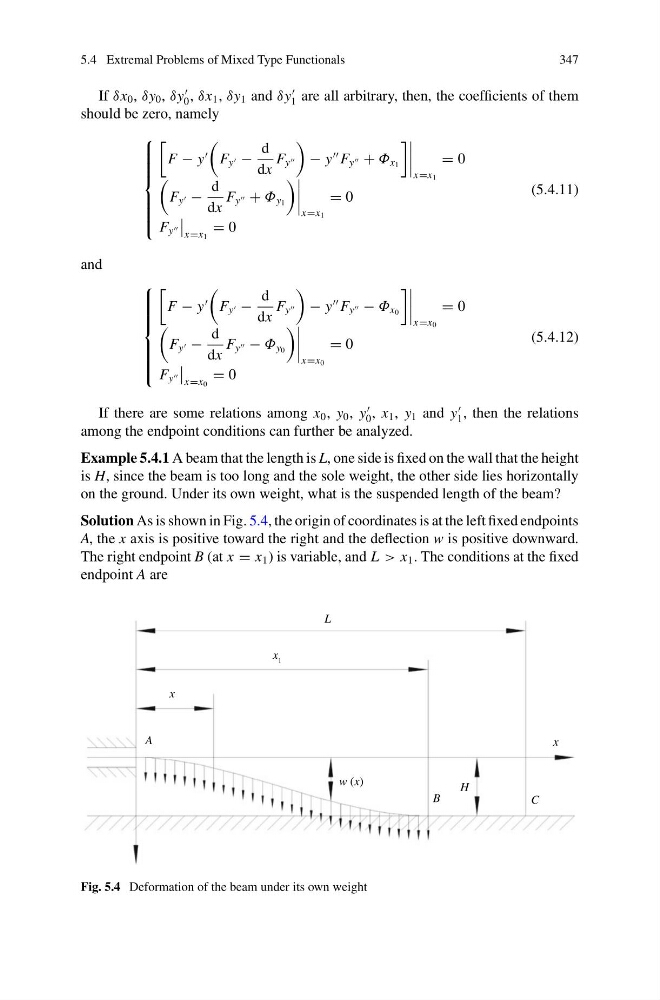
Example 5.4.1 A beam that the length is L, one side is fixed on the wall that the height
is H, since the beam is too long and the sole weight, the other side lies horizontally
on the ground. Under its own weight, what is the suspended length of the beam?
Solution As is shown in Fig. 5.4, the origin of coordinates is at the left fixed endpoints
A, the x axis is positive toward the right and the deflection w is positive downward.
The right endpoint B (at x = x 1 ) is variable, and L > x 1 . The conditions at the fixed
endpoint A are
L
B
H
C
x
x 1
x
A
w (x)
Fig. 5.4 Deformation of the beam under its own weight
347
If δx 0 , δy 0 , δy
0 , δx 1 , δy 1 and δy
1 are all arbitrary, then, the coefficients of them
should be zero, namely
⎧
⎪ ⎪ ⎪ ⎪ ⎪ ⎨
⎪ ⎪ ⎪ ⎪ ⎪ ⎩
F − y
F y −
d
dx
F y
− y
F y + Φ x 1
x=x 1
= 0
F y −
d
dx
F y + Φ y 1
x=x 1
= 0
F y
x=x 1
= 0
(5.4.11)
and
⎧
⎪ ⎪ ⎪ ⎪ ⎪ ⎨
⎪ ⎪ ⎪ ⎪ ⎪ ⎩
F − y
F y −
d
dx
F y
− y
F y − Φ x 0
x=x 0
= 0
F y −
d
dx
F y − Φ y 0
x=x 0
= 0
F y
x=x 0
= 0
(5.4.12)
If there are some relations among x 0 , y 0 , y
0 , x 1 , y 1 and y
1 , then the relations
among the endpoint conditions can further be analyzed.
Example 5.4.1 A beam that the length is L, one side is fixed on the wall that the height
is H, since the beam is too long and the sole weight, the other side lies horizontally
on the ground. Under its own weight, what is the suspended length of the beam?
Solution As is shown in Fig. 5.4, the origin of coordinates is at the left fixed endpoints
A, the x axis is positive toward the right and the deflection w is positive downward.
The right endpoint B (at x = x 1 ) is variable, and L > x 1 . The conditions at the fixed
endpoint A are
L
B
H
C
x
x 1
x
A
w (x)
Fig. 5.4 Deformation of the beam under its own weight