

1.3 Fundamentals of the Theory of Field
19
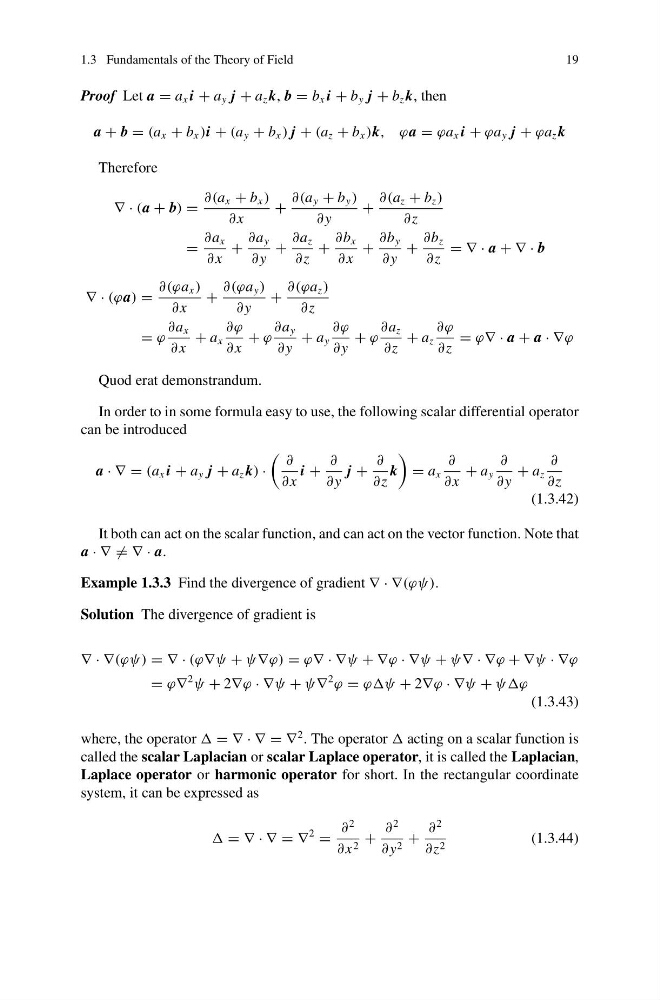
Proof Let a = a x i + a y j + a z k, b = b x i + b y j + b z k, then
a + b = (a x + b x )i + (a y + b x ) j + (a z + b x )k, ϕa = ϕa x i + ϕa y j + ϕa z k
Therefore
∇ · (a + b) =
∂(a x + b x )
∂ x
+
∂(a y + b y )
∂ y
+
∂(a z + b z )
∂z
=
∂a x
∂ x
+
∂a y
∂ y
+
∂a z
∂z
+
∂b x
∂ x
+
∂b y
∂ y
+
∂b z
∂z
= ∇ · a + ∇ · b
∇ · (ϕa) =
∂(ϕa x )
∂ x
+
∂(ϕa y )
∂ y
+
∂(ϕa z )
∂z
= ϕ
∂a x
∂ x
+ a x
∂ϕ
∂ x
+ ϕ
∂a y
∂ y
+ a y
∂ϕ
∂ y
+ ϕ
∂a z
∂z
+ a z
∂ϕ
∂z
= ϕ∇ · a + a · ∇ϕ
Quod erat demonstrandum.
In order to in some formula easy to use, the following scalar differential operator
can be introduced
a · ∇ = (a x i + a y j + a z k) ·
∂
∂ x
i +
∂
∂ y
j +
∂
∂z
k
= a x
∂
∂ x
+ a y
∂
∂ y
+ a z
∂
∂z
(1.3.42)
It both can act on the scalar function, and can act on the vector function. Note that
a · ∇ = ∇ · a.
Example 1.3.3 Find the divergence of gradient ∇ · ∇(ϕψ).
Solution The divergence of gradient is
∇ · ∇(ϕψ) = ∇ · (ϕ∇ψ + ψ∇ϕ) = ϕ∇ · ∇ψ + ∇ϕ · ∇ψ + ψ∇ · ∇ϕ + ∇ψ · ∇ϕ
= ϕ∇
2
ψ + 2∇ϕ · ∇ψ + ψ∇
2
ϕ = ϕϕψ + 2∇ϕ · ∇ψ + ψψϕ
(1.3.43)
where, the operator = ∇ · ∇ = ∇
2 . The operator acting on a scalar function is
called the scalar Laplacian or scalar Laplace operator, it is called the Laplacian,
Laplace operator or harmonic operator for short. In the rectangular coordinate
system, it can be expressed as
= ∇ · ∇ = ∇
2
=
∂
2
∂ x 2 +
∂
2
∂ y 2 +
∂
2
∂z 2
(1.3.44)
19
Proof Let a = a x i + a y j + a z k, b = b x i + b y j + b z k, then
a + b = (a x + b x )i + (a y + b x ) j + (a z + b x )k, ϕa = ϕa x i + ϕa y j + ϕa z k
Therefore
∇ · (a + b) =
∂(a x + b x )
∂ x
+
∂(a y + b y )
∂ y
+
∂(a z + b z )
∂z
=
∂a x
∂ x
+
∂a y
∂ y
+
∂a z
∂z
+
∂b x
∂ x
+
∂b y
∂ y
+
∂b z
∂z
= ∇ · a + ∇ · b
∇ · (ϕa) =
∂(ϕa x )
∂ x
+
∂(ϕa y )
∂ y
+
∂(ϕa z )
∂z
= ϕ
∂a x
∂ x
+ a x
∂ϕ
∂ x
+ ϕ
∂a y
∂ y
+ a y
∂ϕ
∂ y
+ ϕ
∂a z
∂z
+ a z
∂ϕ
∂z
= ϕ∇ · a + a · ∇ϕ
Quod erat demonstrandum.
In order to in some formula easy to use, the following scalar differential operator
can be introduced
a · ∇ = (a x i + a y j + a z k) ·
∂
∂ x
i +
∂
∂ y
j +
∂
∂z
k
= a x
∂
∂ x
+ a y
∂
∂ y
+ a z
∂
∂z
(1.3.42)
It both can act on the scalar function, and can act on the vector function. Note that
a · ∇ = ∇ · a.
Example 1.3.3 Find the divergence of gradient ∇ · ∇(ϕψ).
Solution The divergence of gradient is
∇ · ∇(ϕψ) = ∇ · (ϕ∇ψ + ψ∇ϕ) = ϕ∇ · ∇ψ + ∇ϕ · ∇ψ + ψ∇ · ∇ϕ + ∇ψ · ∇ϕ
= ϕ∇
2
ψ + 2∇ϕ · ∇ψ + ψ∇
2
ϕ = ϕϕψ + 2∇ϕ · ∇ψ + ψψϕ
(1.3.43)
where, the operator = ∇ · ∇ = ∇
2 . The operator acting on a scalar function is
called the scalar Laplacian or scalar Laplace operator, it is called the Laplacian,
Laplace operator or harmonic operator for short. In the rectangular coordinate
system, it can be expressed as
= ∇ · ∇ = ∇
2
=
∂
2
∂ x 2 +
∂
2
∂ y 2 +
∂
2
∂z 2
(1.3.44)