

4.7 Introduction to the Famous Scientists
317
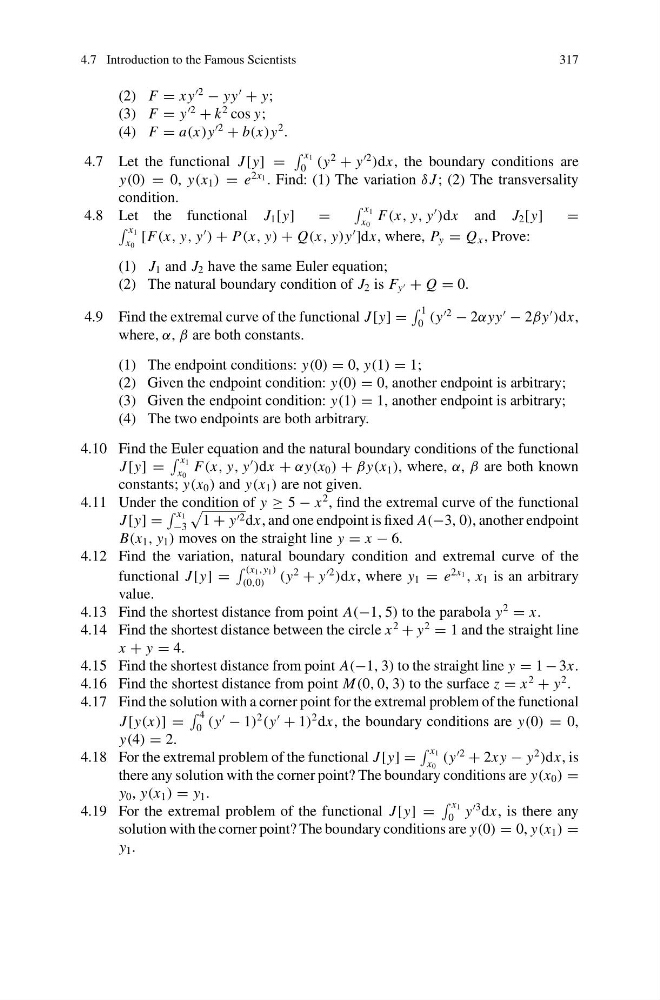
(2) F = x y
2
− yy
+ y;
(3) F = y
2
+ k
2 cos y;
(4) F = a(x)y
2
+ b(x)y
2 .
4.7 Let the functional J [y] =
x 1
0 (y
2
+ y
2
)dx, the boundary conditions are
y(0) = 0, y(x 1 ) = e
2x 1 . Find: (1) The variation δ J ; (2) The transversality
condition.
4.8 Let the functional J 1 [y]
=
x 1
x 0
F(x, y, y
)dx and J 2 [y]
=
x 1
x 0
[F(x, y, y
) + P(x, y) + Q(x, y)y
]dx, where, P y = Q x , Prove:
(1) J 1 and J 2 have the same Euler equation;
(2) The natural boundary condition of J 2 is F y + Q = 0.
4.9 Find the extremal curve of the functional J [y] =
1
0 (y
2
− 2αyy
− 2βy
)dx,
where, α, β are both constants.
(1) The endpoint conditions: y(0) = 0, y(1) = 1;
(2) Given the endpoint condition: y(0) = 0, another endpoint is arbitrary;
(3) Given the endpoint condition: y(1) = 1, another endpoint is arbitrary;
(4) The two endpoints are both arbitrary.
4.10 Find the Euler equation and the natural boundary conditions of the functional
J [y] =
x 1
x 0
F(x, y, y
)dx + αy(x 0 ) + βy(x 1 ), where, α, β are both known
constants; y(x 0 ) and y(x 1 ) are not given.
4.11 Under the condition of y ≥ 5 − x
2 , find the extremal curve of the functional
J [y] =
x 1
−3
1 + y 2 dx, and one endpoint is fixed A(−3, 0), another endpoint
B(x 1 , y 1 ) moves on the straight line y = x − 6.
4.12 Find the variation, natural boundary condition and extremal curve of the
functional J [y] =
(x 1 ,y 1 )
(0,0) (y
2
+ y
2
)dx, where y 1 = e
2x 1 , x 1 is an arbitrary
value.
4.13 Find the shortest distance from point A(−1, 5) to the parabola y
2
= x.
4.14 Find the shortest distance between the circle x
2
+ y
2
= 1 and the straight line
x + y = 4.
4.15 Find the shortest distance from point A(−1, 3) to the straight line y = 1 − 3x.
4.16 Find the shortest distance from point M(0, 0, 3) to the surface z = x
2
+ y
2 .
4.17 Find the solution with a corner point for the extremal problem of the functional
J [y(x)] =
4
0 (y
− 1)
2
(y
+ 1)
2 dx, the boundary conditions are y(0) = 0,
y(4) = 2.
4.18 For the extremal problem of the functional J [y] =
x 1
x 0
(y
2
+ 2x y − y
2
)dx, is
there any solution with the corner point? The boundary conditions are y(x 0 ) =
y 0 , y(x 1 ) = y 1 .
4.19 For the extremal problem of the functional J [y] =
x 1
0 y
3 dx, is there any
solution with the corner point? The boundary conditions are y(0) = 0, y(x 1 ) =
y 1 .
317
(2) F = x y
2
− yy
+ y;
(3) F = y
2
+ k
2 cos y;
(4) F = a(x)y
2
+ b(x)y
2 .
4.7 Let the functional J [y] =
x 1
0 (y
2
+ y
2
)dx, the boundary conditions are
y(0) = 0, y(x 1 ) = e
2x 1 . Find: (1) The variation δ J ; (2) The transversality
condition.
4.8 Let the functional J 1 [y]
=
x 1
x 0
F(x, y, y
)dx and J 2 [y]
=
x 1
x 0
[F(x, y, y
) + P(x, y) + Q(x, y)y
]dx, where, P y = Q x , Prove:
(1) J 1 and J 2 have the same Euler equation;
(2) The natural boundary condition of J 2 is F y + Q = 0.
4.9 Find the extremal curve of the functional J [y] =
1
0 (y
2
− 2αyy
− 2βy
)dx,
where, α, β are both constants.
(1) The endpoint conditions: y(0) = 0, y(1) = 1;
(2) Given the endpoint condition: y(0) = 0, another endpoint is arbitrary;
(3) Given the endpoint condition: y(1) = 1, another endpoint is arbitrary;
(4) The two endpoints are both arbitrary.
4.10 Find the Euler equation and the natural boundary conditions of the functional
J [y] =
x 1
x 0
F(x, y, y
)dx + αy(x 0 ) + βy(x 1 ), where, α, β are both known
constants; y(x 0 ) and y(x 1 ) are not given.
4.11 Under the condition of y ≥ 5 − x
2 , find the extremal curve of the functional
J [y] =
x 1
−3
1 + y 2 dx, and one endpoint is fixed A(−3, 0), another endpoint
B(x 1 , y 1 ) moves on the straight line y = x − 6.
4.12 Find the variation, natural boundary condition and extremal curve of the
functional J [y] =
(x 1 ,y 1 )
(0,0) (y
2
+ y
2
)dx, where y 1 = e
2x 1 , x 1 is an arbitrary
value.
4.13 Find the shortest distance from point A(−1, 5) to the parabola y
2
= x.
4.14 Find the shortest distance between the circle x
2
+ y
2
= 1 and the straight line
x + y = 4.
4.15 Find the shortest distance from point A(−1, 3) to the straight line y = 1 − 3x.
4.16 Find the shortest distance from point M(0, 0, 3) to the surface z = x
2
+ y
2 .
4.17 Find the solution with a corner point for the extremal problem of the functional
J [y(x)] =
4
0 (y
− 1)
2
(y
+ 1)
2 dx, the boundary conditions are y(0) = 0,
y(4) = 2.
4.18 For the extremal problem of the functional J [y] =
x 1
x 0
(y
2
+ 2x y − y
2
)dx, is
there any solution with the corner point? The boundary conditions are y(x 0 ) =
y 0 , y(x 1 ) = y 1 .
4.19 For the extremal problem of the functional J [y] =
x 1
0 y
3 dx, is there any
solution with the corner point? The boundary conditions are y(0) = 0, y(x 1 ) =
y 1 .