

4.6 One-Sided Variational Problems
315
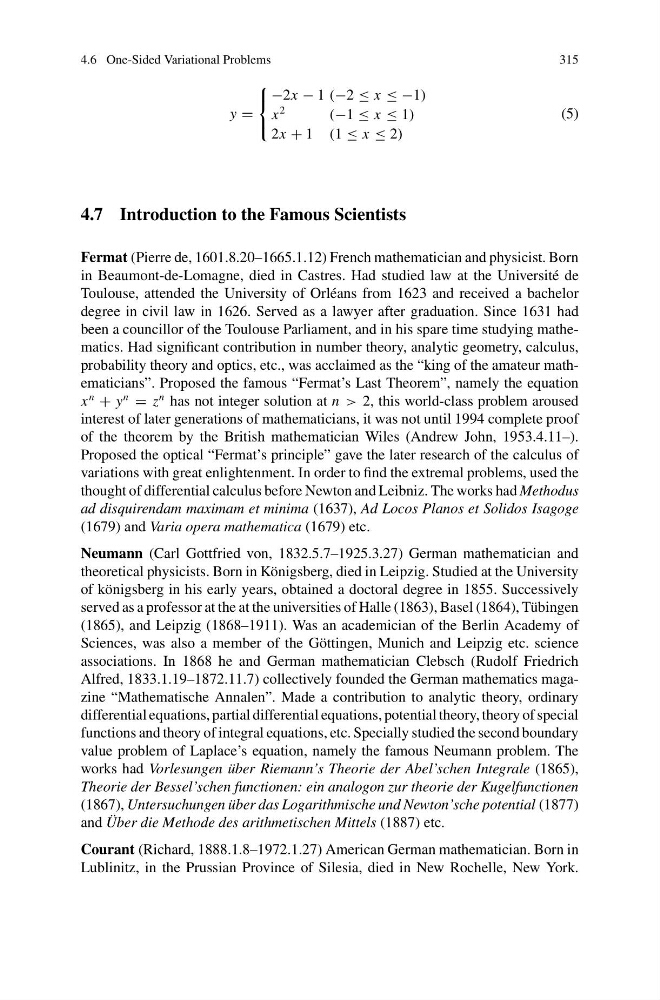
y =
⎧
⎨
⎩
−2x − 1 (−2 ≤ x ≤ −1)
x
2
(−1 ≤ x ≤ 1)
2x + 1 (1 ≤ x ≤ 2)
(5)
4.7 Introduction to the Famous Scientists
Fermat (Pierre de, 1601.8.20–1665.1.12) French mathematician and physicist. Born
in Beaumont-de-Lomagne, died in Castres. Had studied law at the Université de
Toulouse, attended the University of Orléans from 1623 and received a bachelor
degree in civil law in 1626. Served as a lawyer after graduation. Since 1631 had
been a councillor of the Toulouse Parliament, and in his spare time studying mathematics. Had significant contribution in number theory, analytic geometry, calculus,
probability theory and optics, etc., was acclaimed as the “king of the amateur mathematicians”. Proposed the famous “Fermat’s Last Theorem”, namely the equation
x
n
+ y
n
= z
n has not integer solution at n > 2, this world-class problem aroused
interest of later generations of mathematicians, it was not until 1994 complete proof
of the theorem by the British mathematician Wiles (Andrew John, 1953.4.11–).
Proposed the optical “Fermat’s principle” gave the later research of the calculus of
variations with great enlightenment. In order to find the extremal problems, used the
thought of differential calculus before Newton and Leibniz. The works had Methodus
ad disquirendam maximam et minima (1637), Ad Locos Planos et Solidos Isagoge
(1679) and Varia opera mathematica (1679) etc.
Neumann (Carl Gottfried von, 1832.5.7–1925.3.27) German mathematician and
theoretical physicists. Born in Königsberg, died in Leipzig. Studied at the University
of königsberg in his early years, obtained a doctoral degree in 1855. Successively
served as a professor at the at the universities of Halle (1863), Basel (1864), Tübingen
(1865), and Leipzig (1868–1911). Was an academician of the Berlin Academy of
Sciences, was also a member of the Göttingen, Munich and Leipzig etc. science
associations. In 1868 he and German mathematician Clebsch (Rudolf Friedrich
Alfred, 1833.1.19–1872.11.7) collectively founded the German mathematics magazine “Mathematische Annalen”. Made a contribution to analytic theory, ordinary
differential equations, partial differential equations, potential theory, theory of special
functions and theory of integral equations, etc. Specially studied the second boundary
value problem of Laplace’s equation, namely the famous Neumann problem. The
works had Vorlesungen über Riemann’s Theorie der Abel’schen Integrale (1865),
Theorie der Bessel’schen functionen: ein analogon zur theorie der Kugelfunctionen
(1867), Untersuchungen über das Logarithmische und Newton’sche potential (1877)
and Über die Methode des arithmetischen Mittels (1887) etc.
Courant (Richard, 1888.1.8–1972.1.27) American German mathematician. Born in
Lublinitz, in the Prussian Province of Silesia, died in New Rochelle, New York.
315
y =
⎧
⎨
⎩
−2x − 1 (−2 ≤ x ≤ −1)
x
2
(−1 ≤ x ≤ 1)
2x + 1 (1 ≤ x ≤ 2)
(5)
4.7 Introduction to the Famous Scientists
Fermat (Pierre de, 1601.8.20–1665.1.12) French mathematician and physicist. Born
in Beaumont-de-Lomagne, died in Castres. Had studied law at the Université de
Toulouse, attended the University of Orléans from 1623 and received a bachelor
degree in civil law in 1626. Served as a lawyer after graduation. Since 1631 had
been a councillor of the Toulouse Parliament, and in his spare time studying mathematics. Had significant contribution in number theory, analytic geometry, calculus,
probability theory and optics, etc., was acclaimed as the “king of the amateur mathematicians”. Proposed the famous “Fermat’s Last Theorem”, namely the equation
x
n
+ y
n
= z
n has not integer solution at n > 2, this world-class problem aroused
interest of later generations of mathematicians, it was not until 1994 complete proof
of the theorem by the British mathematician Wiles (Andrew John, 1953.4.11–).
Proposed the optical “Fermat’s principle” gave the later research of the calculus of
variations with great enlightenment. In order to find the extremal problems, used the
thought of differential calculus before Newton and Leibniz. The works had Methodus
ad disquirendam maximam et minima (1637), Ad Locos Planos et Solidos Isagoge
(1679) and Varia opera mathematica (1679) etc.
Neumann (Carl Gottfried von, 1832.5.7–1925.3.27) German mathematician and
theoretical physicists. Born in Königsberg, died in Leipzig. Studied at the University
of königsberg in his early years, obtained a doctoral degree in 1855. Successively
served as a professor at the at the universities of Halle (1863), Basel (1864), Tübingen
(1865), and Leipzig (1868–1911). Was an academician of the Berlin Academy of
Sciences, was also a member of the Göttingen, Munich and Leipzig etc. science
associations. In 1868 he and German mathematician Clebsch (Rudolf Friedrich
Alfred, 1833.1.19–1872.11.7) collectively founded the German mathematics magazine “Mathematische Annalen”. Made a contribution to analytic theory, ordinary
differential equations, partial differential equations, potential theory, theory of special
functions and theory of integral equations, etc. Specially studied the second boundary
value problem of Laplace’s equation, namely the famous Neumann problem. The
works had Vorlesungen über Riemann’s Theorie der Abel’schen Integrale (1865),
Theorie der Bessel’schen functionen: ein analogon zur theorie der Kugelfunctionen
(1867), Untersuchungen über das Logarithmische und Newton’sche potential (1877)
and Über die Methode des arithmetischen Mittels (1887) etc.
Courant (Richard, 1888.1.8–1972.1.27) American German mathematician. Born in
Lublinitz, in the Prussian Province of Silesia, died in New Rochelle, New York.