

4.6 One-Sided Variational Problems
311
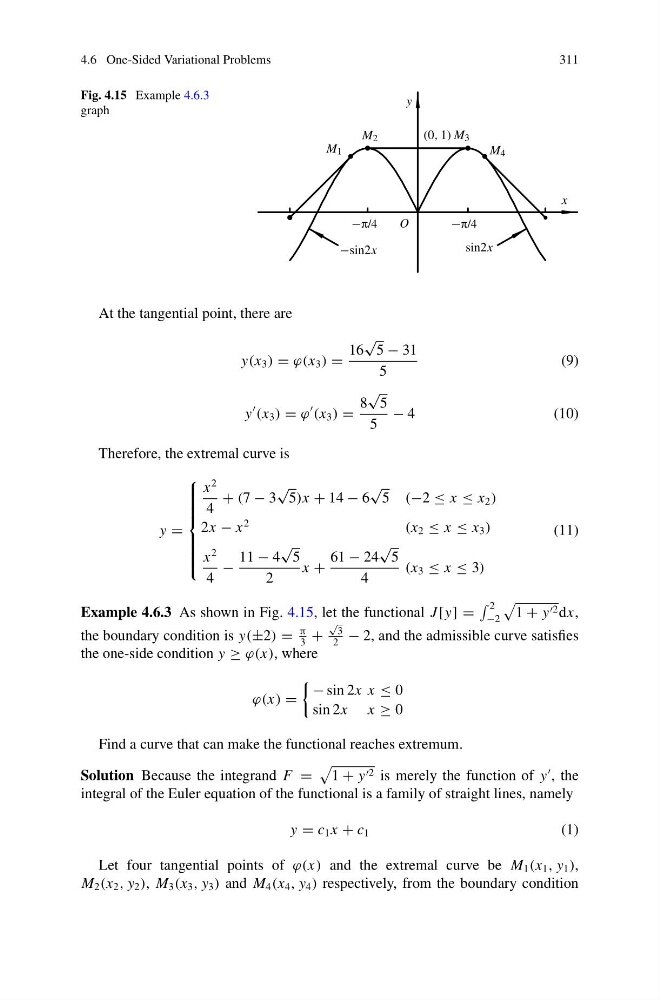
Fig. 4.15 Example 4.6.3
graph
O
x
y
(0, 1)
M 1
M 2
M 3
M 4
−π/4
−π/4
−sin2x
sin2x
At the tangential point, there are
y(x 3 ) = ϕ(x 3 ) =
16
√
5 − 31
5
(9)
y
(x 3 ) = ϕ
(x 3 ) =
8
√
5
5
− 4
( 1 0 )
Therefore, the extremal curve is
y =
⎧
⎪ ⎪ ⎪ ⎪ ⎪ ⎨
⎪ ⎪ ⎪ ⎪ ⎪ ⎩
x
2
4
+ (7 − 3
√
5)x + 14 − 6
√
5 (−2 ≤ x ≤ x 2 )
2x − x
2
(x 2 ≤ x ≤ x 3 )
x
2
4
−
11 − 4
√
5
2
x +
61 − 24
√
5
4
(x 3 ≤ x ≤ 3)
(11)
Example 4.6.3 As shown in Fig. 4.15, let the functional J [y] =
2
−2
1 + y dx,
the boundary condition is y(±2) =
π
3
+
√
3
2
− 2, and the admissible curve satisfies
the one-side condition y ≥ ϕ(x), where
ϕ(x) =
− sin 2x x ≤ 0
sin 2x x ≥ 0
Find a curve that can make the functional reaches extremum.
Solution Because the integrand F =
1 + y is merely the function of y
, the
integral of the Euler equation of the functional is a family of straight lines, namely
y = c 1 x + c 1
(1)
Let four tangential points of ϕ(x) and the extremal curve be M 1 (x 1 , y 1 ),
M 2 (x 2 , y 2 ), M 3 (x 3 , y 3 ) and M 4 (x 4 , y 4 ) respectively, from the boundary condition
311
Fig. 4.15 Example 4.6.3
graph
O
x
y
(0, 1)
M 1
M 2
M 3
M 4
−π/4
−π/4
−sin2x
sin2x
At the tangential point, there are
y(x 3 ) = ϕ(x 3 ) =
16
√
5 − 31
5
(9)
y
(x 3 ) = ϕ
(x 3 ) =
8
√
5
5
− 4
( 1 0 )
Therefore, the extremal curve is
y =
⎧
⎪ ⎪ ⎪ ⎪ ⎪ ⎨
⎪ ⎪ ⎪ ⎪ ⎪ ⎩
x
2
4
+ (7 − 3
√
5)x + 14 − 6
√
5 (−2 ≤ x ≤ x 2 )
2x − x
2
(x 2 ≤ x ≤ x 3 )
x
2
4
−
11 − 4
√
5
2
x +
61 − 24
√
5
4
(x 3 ≤ x ≤ 3)
(11)
Example 4.6.3 As shown in Fig. 4.15, let the functional J [y] =
2
−2
1 + y dx,
the boundary condition is y(±2) =
π
3
+
√
3
2
− 2, and the admissible curve satisfies
the one-side condition y ≥ ϕ(x), where
ϕ(x) =
− sin 2x x ≤ 0
sin 2x x ≥ 0
Find a curve that can make the functional reaches extremum.
Solution Because the integrand F =
1 + y is merely the function of y
, the
integral of the Euler equation of the functional is a family of straight lines, namely
y = c 1 x + c 1
(1)
Let four tangential points of ϕ(x) and the extremal curve be M 1 (x 1 , y 1 ),
M 2 (x 2 , y 2 ), M 3 (x 3 , y 3 ) and M 4 (x 4 , y 4 ) respectively, from the boundary condition