

1.3 Fundamentals of the Theory of Field
15
(a − ∇ϕ) · dr = 0
Since dr is any vector, therefore there is a = ∇ϕ, Quod erat demonstrandum.
Suppose that there is the vector field a, if there exists a single-valued function
ϕ satisfying a = ∇ϕ, then the vector a is called the potential field. ϕ is called the
scalar potential. If the function ψ = −ϕ, then ψ is called the potential function
of the potential field a. It can be seen that the relationship of the potential a and the
potential function ψ is
a = −∇ψ
(1.3.29)
The potential field is a gradient field, it has infinite potential functions, only there
exists a constant difference between them.
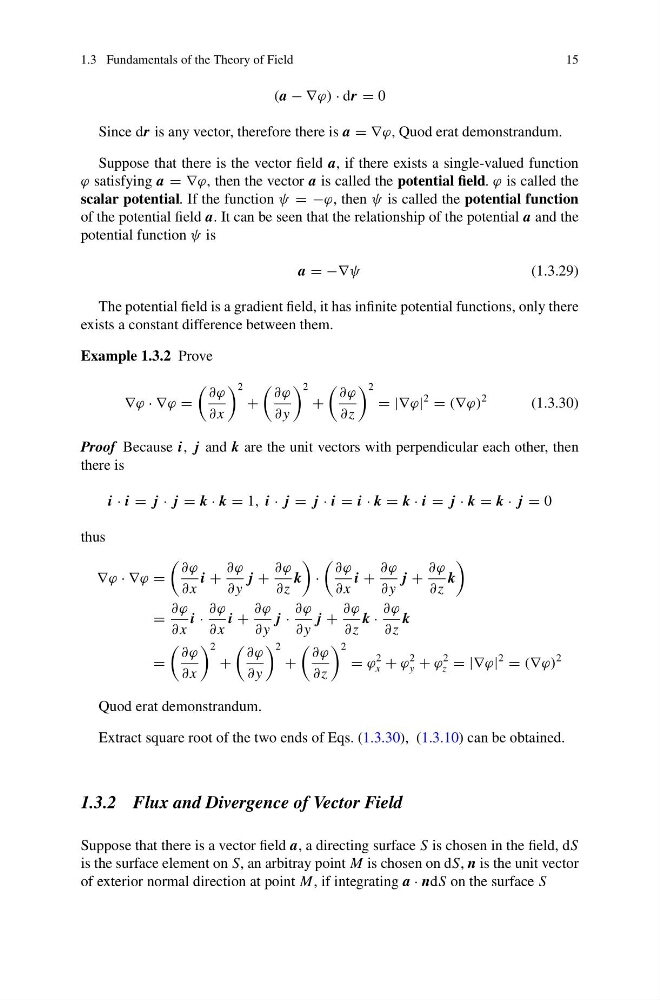
Example 1.3.2 Prove
∇ϕ · ∇ϕ =
∂ϕ
∂ x
2
+
∂ϕ
∂ y
2
+
∂ϕ
∂z
2
= |∇ϕ|
2
= (∇ϕ)
2
(1.3.30)
Proof Because i, j and k are the unit vectors with perpendicular each other, then
there is
i · i = j · j = k · k = 1, i · j = j · i = i · k = k · i = j · k = k · j = 0
thus
∇ϕ · ∇ϕ =
∂ϕ
∂ x
i +
∂ϕ
∂ y
j +
∂ϕ
∂z
k
·
∂ϕ
∂ x
i +
∂ϕ
∂ y
j +
∂ϕ
∂z
k
=
∂ϕ
∂ x
i ·
∂ϕ
∂ x
i +
∂ϕ
∂ y
j ·
∂ϕ
∂ y
j +
∂ϕ
∂z
k ·
∂ϕ
∂z
k
=
∂ϕ
∂ x
2
+
∂ϕ
∂ y
2
+
∂ϕ
∂z
2
= ϕ
2
x + ϕ
2
y + ϕ
2
z = |∇ϕ|
2
= (∇ϕ)
2
Quod erat demonstrandum.
Extract square root of the two ends of Eqs. (1.3.30), (1.3.10) can be obtained.
1.3.2 Flux and Divergence of Vector Field
Suppose that there is a vector field a, a directing surface S is chosen in the field, dS
is the surface element on S, an arbitray point M is chosen on dS, n is the unit vector
of exterior normal direction at point M, if integrating a · ndS on the surface S
15
(a − ∇ϕ) · dr = 0
Since dr is any vector, therefore there is a = ∇ϕ, Quod erat demonstrandum.
Suppose that there is the vector field a, if there exists a single-valued function
ϕ satisfying a = ∇ϕ, then the vector a is called the potential field. ϕ is called the
scalar potential. If the function ψ = −ϕ, then ψ is called the potential function
of the potential field a. It can be seen that the relationship of the potential a and the
potential function ψ is
a = −∇ψ
(1.3.29)
The potential field is a gradient field, it has infinite potential functions, only there
exists a constant difference between them.
Example 1.3.2 Prove
∇ϕ · ∇ϕ =
∂ϕ
∂ x
2
+
∂ϕ
∂ y
2
+
∂ϕ
∂z
2
= |∇ϕ|
2
= (∇ϕ)
2
(1.3.30)
Proof Because i, j and k are the unit vectors with perpendicular each other, then
there is
i · i = j · j = k · k = 1, i · j = j · i = i · k = k · i = j · k = k · j = 0
thus
∇ϕ · ∇ϕ =
∂ϕ
∂ x
i +
∂ϕ
∂ y
j +
∂ϕ
∂z
k
·
∂ϕ
∂ x
i +
∂ϕ
∂ y
j +
∂ϕ
∂z
k
=
∂ϕ
∂ x
i ·
∂ϕ
∂ x
i +
∂ϕ
∂ y
j ·
∂ϕ
∂ y
j +
∂ϕ
∂z
k ·
∂ϕ
∂z
k
=
∂ϕ
∂ x
2
+
∂ϕ
∂ y
2
+
∂ϕ
∂z
2
= ϕ
2
x + ϕ
2
y + ϕ
2
z = |∇ϕ|
2
= (∇ϕ)
2
Quod erat demonstrandum.
Extract square root of the two ends of Eqs. (1.3.30), (1.3.10) can be obtained.
1.3.2 Flux and Divergence of Vector Field
Suppose that there is a vector field a, a directing surface S is chosen in the field, dS
is the surface element on S, an arbitray point M is chosen on dS, n is the unit vector
of exterior normal direction at point M, if integrating a · ndS on the surface S