

292
4 Problems with Variable Boundaries
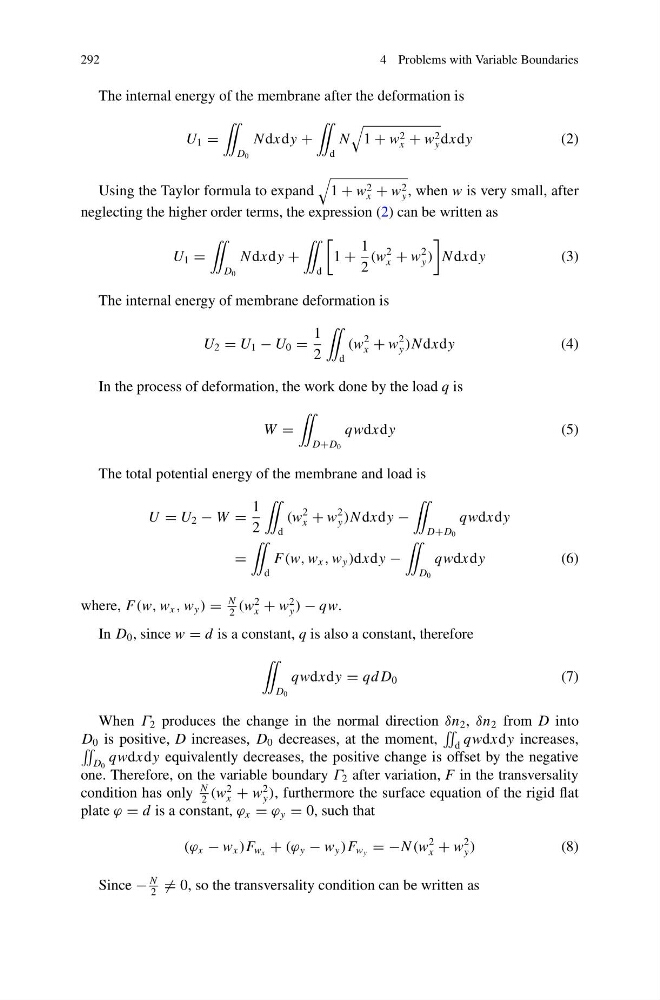
The internal energy of the membrane after the deformation is
U 1 =
¨
D 0
N dxdy +
¨
d
N
1 + w 2
x + w 2
y dxdy
(2)
Using the Taylor formula to expand
1 + w 2
x + w 2
y , when w is very small, after
neglecting the higher order terms, the expression (2) can be written as
U 1 =
¨
D 0
N dxdy +
¨
d
1 +
1
2
(w
2
x + w
2
y )
N dxdy
(3)
The internal energy of membrane deformation is
U 2 = U 1 − U 0 =
1
2
¨
d
(w
2
x + w
2
y )N dxdy
(4)
In the process of deformation, the work done by the load q is
W =
¨
D+D 0
qwdxdy
(5)
The total potential energy of the membrane and load is
U = U 2 − W =
1
2
¨
d
(w
2
x + w
2
y )N dxdy −
¨
D+D 0
qwdxdy
=
¨
d
F(w, w x , w y )dxdy −
¨
D 0
qwdxdy
(6)
where, F(w, w x , w y ) =
N
2
(w
2
x + w
2
y ) − qw.
In D 0 , since w = d is a constant, q is also a constant, therefore
¨
D 0
qwdxdy = qd D 0
(7)
When Γ 2 produces the change in the normal direction δn 2 , δn 2 from D into
D 0 is positive, D increases, D 0 decreases, at the moment,
˜
d qwdxdy increases,
˜
D 0
qwdxdy equivalently decreases, the positive change is offset by the negative
one. Therefore, on the variable boundary Γ 2 after variation, F in the transversality
condition has only
N
2
(w
2
x + w
2
y ), furthermore the surface equation of the rigid flat
plate ϕ = d is a constant, ϕ x = ϕ y = 0, such that
(ϕ x − w x )F w x + (ϕ y − w y )F w y = −N (w
2
x + w
2
y )
(8)
Since −
N
2
= 0, so the transversality condition can be written as
4 Problems with Variable Boundaries
The internal energy of the membrane after the deformation is
U 1 =
¨
D 0
N dxdy +
¨
d
N
1 + w 2
x + w 2
y dxdy
(2)
Using the Taylor formula to expand
1 + w 2
x + w 2
y , when w is very small, after
neglecting the higher order terms, the expression (2) can be written as
U 1 =
¨
D 0
N dxdy +
¨
d
1 +
1
2
(w
2
x + w
2
y )
N dxdy
(3)
The internal energy of membrane deformation is
U 2 = U 1 − U 0 =
1
2
¨
d
(w
2
x + w
2
y )N dxdy
(4)
In the process of deformation, the work done by the load q is
W =
¨
D+D 0
qwdxdy
(5)
The total potential energy of the membrane and load is
U = U 2 − W =
1
2
¨
d
(w
2
x + w
2
y )N dxdy −
¨
D+D 0
qwdxdy
=
¨
d
F(w, w x , w y )dxdy −
¨
D 0
qwdxdy
(6)
where, F(w, w x , w y ) =
N
2
(w
2
x + w
2
y ) − qw.
In D 0 , since w = d is a constant, q is also a constant, therefore
¨
D 0
qwdxdy = qd D 0
(7)
When Γ 2 produces the change in the normal direction δn 2 , δn 2 from D into
D 0 is positive, D increases, D 0 decreases, at the moment,
˜
d qwdxdy increases,
˜
D 0
qwdxdy equivalently decreases, the positive change is offset by the negative
one. Therefore, on the variable boundary Γ 2 after variation, F in the transversality
condition has only
N
2
(w
2
x + w
2
y ), furthermore the surface equation of the rigid flat
plate ϕ = d is a constant, ϕ x = ϕ y = 0, such that
(ϕ x − w x )F w x + (ϕ y − w y )F w y = −N (w
2
x + w
2
y )
(8)
Since −
N
2
= 0, so the transversality condition can be written as