

290
4 Problems with Variable Boundaries
G u η = F J 1u η + F u η J 1 = 0 − J 1 F p ×
y ξ
J 1
+ F q ×
x ξ
J 1
= −y ξ F p + x ξ F q (9)
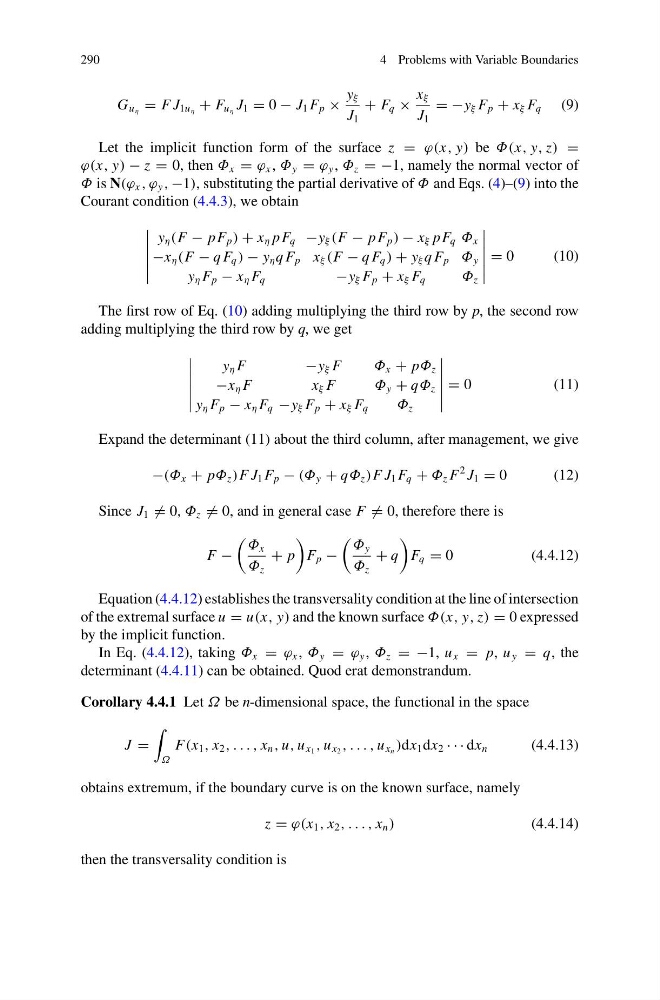
Let the implicit function form of the surface z = ϕ(x, y) be Φ(x, y, z) =
ϕ(x, y) − z = 0, then Φ x = ϕ x , Φ y = ϕ y , Φ z = −1, namely the normal vector of
Φ is N(ϕ x , ϕ y , −1), substituting the partial derivative of Φ and Eqs. (4)–(9) into the
Courant condition (4.4.3), we obtain
y η (F − pF p ) + x η pF q −y ξ (F − pF p ) − x ξ pF q Φ x
−x η (F − q F q ) − y η q F p x ξ (F − q F q ) + y ξ q F p Φ y
y η F p − x η F q
−y ξ F p + x ξ F q
Φ z
= 0
(10)
The first row of Eq. (10) adding multiplying the third row by p, the second row
adding multiplying the third row by q, we get
y η F
−y ξ F
Φ x + pΦ z
−x η F
x ξ F
Φ y + qΦ z
y η F p − x η F q −y ξ F p + x ξ F q
Φ z
= 0
(11)
Expand the determinant (11) about the third column, after management, we give
−(Φ x + pΦ z )F J 1 F p − (Φ y + qΦ z )F J 1 F q + Φ z F
2 J 1 = 0
( 1 2 )
Since J 1 = 0, Φ z = 0, and in general case F = 0, therefore there is
F −
Φ x
Φ z
+ p
F p −
Φ y
Φ z
+ q
F q = 0
(4.4.12)
Equation (4.4.12) establishes the transversality condition at the line of intersection
of the extremal surface u = u(x, y) and the known surface Φ(x, y, z) = 0 expressed
by the implicit function.
In Eq. (4.4.12), taking Φ x = ϕ x , Φ y = ϕ y , Φ z = −1, u x = p, u y = q, the
determinant (4.4.11) can be obtained. Quod erat demonstrandum.
Corollary 4.4.1 Let Ω be n-dimensional space, the functional in the space
J =
Ω
F(x 1 , x 2 , . . . , x n , u, u x 1 , u x 2 , . . . , u x n )dx 1 dx 2 · · · dx n
(4.4.13)
obtains extremum, if the boundary curve is on the known surface, namely
z = ϕ(x 1 , x 2 , . . . , x n )
(4.4.14)
then the transversality condition is
4 Problems with Variable Boundaries
G u η = F J 1u η + F u η J 1 = 0 − J 1 F p ×
y ξ
J 1
+ F q ×
x ξ
J 1
= −y ξ F p + x ξ F q (9)
Let the implicit function form of the surface z = ϕ(x, y) be Φ(x, y, z) =
ϕ(x, y) − z = 0, then Φ x = ϕ x , Φ y = ϕ y , Φ z = −1, namely the normal vector of
Φ is N(ϕ x , ϕ y , −1), substituting the partial derivative of Φ and Eqs. (4)–(9) into the
Courant condition (4.4.3), we obtain
y η (F − pF p ) + x η pF q −y ξ (F − pF p ) − x ξ pF q Φ x
−x η (F − q F q ) − y η q F p x ξ (F − q F q ) + y ξ q F p Φ y
y η F p − x η F q
−y ξ F p + x ξ F q
Φ z
= 0
(10)
The first row of Eq. (10) adding multiplying the third row by p, the second row
adding multiplying the third row by q, we get
y η F
−y ξ F
Φ x + pΦ z
−x η F
x ξ F
Φ y + qΦ z
y η F p − x η F q −y ξ F p + x ξ F q
Φ z
= 0
(11)
Expand the determinant (11) about the third column, after management, we give
−(Φ x + pΦ z )F J 1 F p − (Φ y + qΦ z )F J 1 F q + Φ z F
2 J 1 = 0
( 1 2 )
Since J 1 = 0, Φ z = 0, and in general case F = 0, therefore there is
F −
Φ x
Φ z
+ p
F p −
Φ y
Φ z
+ q
F q = 0
(4.4.12)
Equation (4.4.12) establishes the transversality condition at the line of intersection
of the extremal surface u = u(x, y) and the known surface Φ(x, y, z) = 0 expressed
by the implicit function.
In Eq. (4.4.12), taking Φ x = ϕ x , Φ y = ϕ y , Φ z = −1, u x = p, u y = q, the
determinant (4.4.11) can be obtained. Quod erat demonstrandum.
Corollary 4.4.1 Let Ω be n-dimensional space, the functional in the space
J =
Ω
F(x 1 , x 2 , . . . , x n , u, u x 1 , u x 2 , . . . , u x n )dx 1 dx 2 · · · dx n
(4.4.13)
obtains extremum, if the boundary curve is on the known surface, namely
z = ϕ(x 1 , x 2 , . . . , x n )
(4.4.14)
then the transversality condition is