

1.3 Fundamentals of the Theory of Field
13
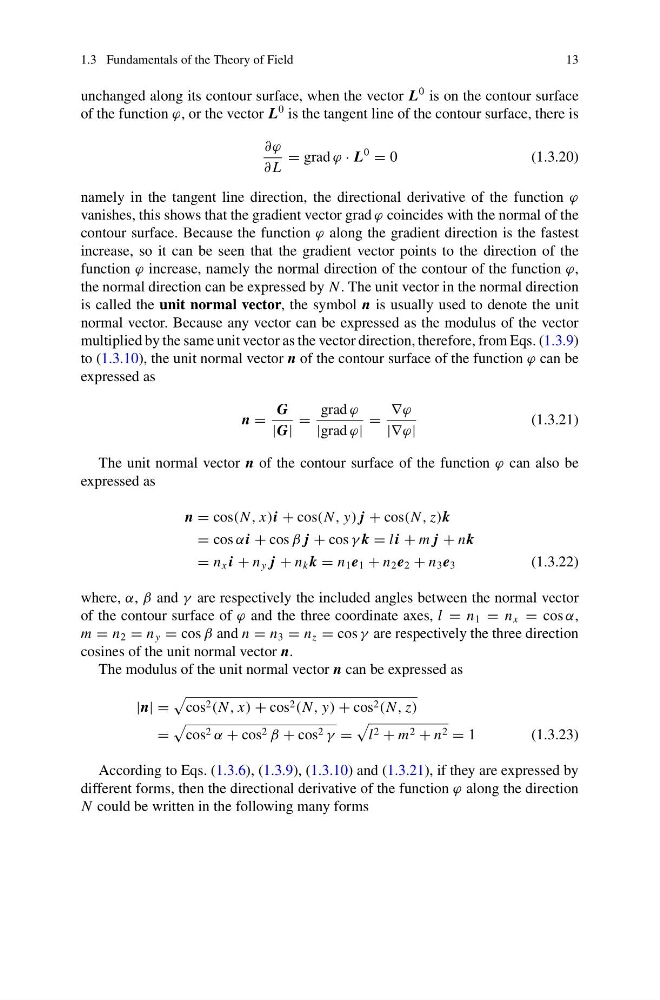
unchanged along its contour surface, when the vector L
0 is on the contour surface
of the function ϕ, or the vector L
0 is the tangent line of the contour surface, there is
∂ϕ
∂ L
= grad ϕ · L
0
= 0
(1.3.20)
namely in the tangent line direction, the directional derivative of the function ϕ
vanishes, this shows that the gradient vector grad ϕ coincides with the normal of the
contour surface. Because the function ϕ along the gradient direction is the fastest
increase, so it can be seen that the gradient vector points to the direction of the
function ϕ increase, namely the normal direction of the contour of the function ϕ,
the normal direction can be expressed by N . The unit vector in the normal direction
is called the unit normal vector, the symbol n is usually used to denote the unit
normal vector. Because any vector can be expressed as the modulus of the vector
multiplied by the same unit vector as the vector direction, therefore, from Eqs. (1.3.9)
to (1.3.10), the unit normal vector n of the contour surface of the function ϕ can be
expressed as
n =
G
|G|
=
grad ϕ
|grad ϕ|
=
∇ϕ
|∇ϕ|
(1.3.21)
The unit normal vector n of the contour surface of the function ϕ can also be
expressed as
n = cos(N , x)i + cos(N , y) j + cos(N , z)k
= cos αi + cos β j + cos γ k = l i + m j + nk
= n x i + n y j + n k k = n 1 e 1 + n 2 e 2 + n 3 e 3
(1.3.22)
where, α, β and γ are respectively the included angles between the normal vector
of the contour surface of ϕ and the three coordinate axes, l = n 1 = n x = cos α,
m = n 2 = n y = cos β and n = n 3 = n z = cos γ are respectively the three direction
cosines of the unit normal vector n.
The modulus of the unit normal vector n can be expressed as
|n| =
cos 2 (N , x) + cos 2 (N , y) + cos 2 (N , z)
=
cos 2 α + cos 2 β + cos 2 γ =
l 2 + m 2 + n 2 = 1
(1.3.23)
According to Eqs. (1.3.6), (1.3.9), (1.3.10) and (1.3.21), if they are expressed by
different forms, then the directional derivative of the function ϕ along the direction
N could be written in the following many forms
13
unchanged along its contour surface, when the vector L
0 is on the contour surface
of the function ϕ, or the vector L
0 is the tangent line of the contour surface, there is
∂ϕ
∂ L
= grad ϕ · L
0
= 0
(1.3.20)
namely in the tangent line direction, the directional derivative of the function ϕ
vanishes, this shows that the gradient vector grad ϕ coincides with the normal of the
contour surface. Because the function ϕ along the gradient direction is the fastest
increase, so it can be seen that the gradient vector points to the direction of the
function ϕ increase, namely the normal direction of the contour of the function ϕ,
the normal direction can be expressed by N . The unit vector in the normal direction
is called the unit normal vector, the symbol n is usually used to denote the unit
normal vector. Because any vector can be expressed as the modulus of the vector
multiplied by the same unit vector as the vector direction, therefore, from Eqs. (1.3.9)
to (1.3.10), the unit normal vector n of the contour surface of the function ϕ can be
expressed as
n =
G
|G|
=
grad ϕ
|grad ϕ|
=
∇ϕ
|∇ϕ|
(1.3.21)
The unit normal vector n of the contour surface of the function ϕ can also be
expressed as
n = cos(N , x)i + cos(N , y) j + cos(N , z)k
= cos αi + cos β j + cos γ k = l i + m j + nk
= n x i + n y j + n k k = n 1 e 1 + n 2 e 2 + n 3 e 3
(1.3.22)
where, α, β and γ are respectively the included angles between the normal vector
of the contour surface of ϕ and the three coordinate axes, l = n 1 = n x = cos α,
m = n 2 = n y = cos β and n = n 3 = n z = cos γ are respectively the three direction
cosines of the unit normal vector n.
The modulus of the unit normal vector n can be expressed as
|n| =
cos 2 (N , x) + cos 2 (N , y) + cos 2 (N , z)
=
cos 2 α + cos 2 β + cos 2 γ =
l 2 + m 2 + n 2 = 1
(1.3.23)
According to Eqs. (1.3.6), (1.3.9), (1.3.10) and (1.3.21), if they are expressed by
different forms, then the directional derivative of the function ϕ along the direction
N could be written in the following many forms