

266
4 Problems with Variable Boundaries
1 + y 2 + z 2 + (m − y
)
y
1 + y 2 + z 2
+ (n − z
)
z
1 + y 2 + z 2
x=x 1
= 0
(5)
By y
= c 1 , z
= c 3 , we get
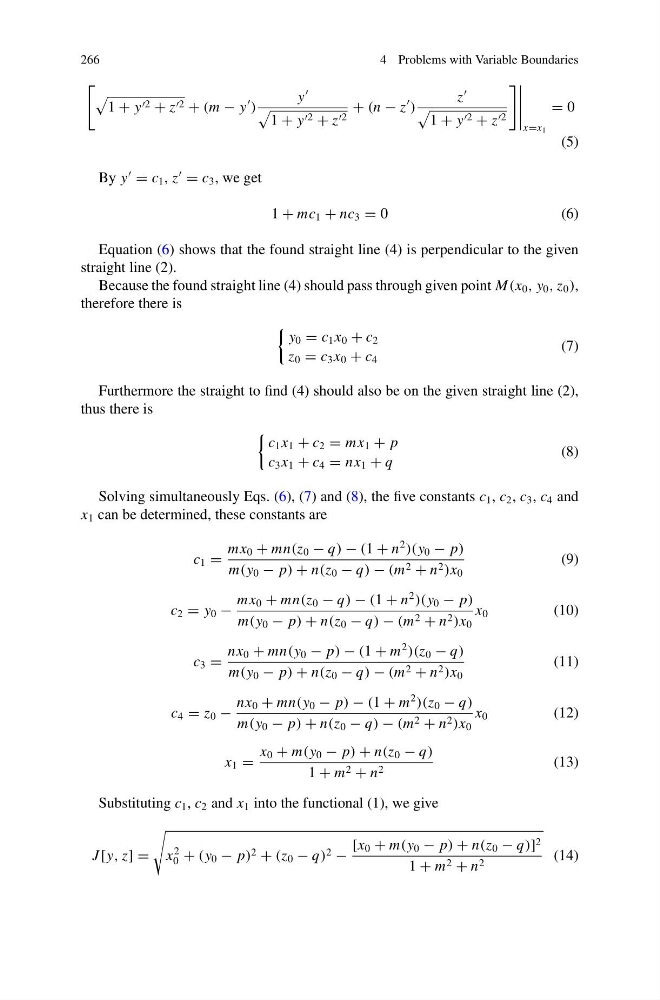
1 + mc 1 + nc 3 = 0
( 6 )
Equation (6) shows that the found straight line (4) is perpendicular to the given
straight line (2).
Because the found straight line (4) should pass through given point M(x 0 , y 0 , z 0 ),
therefore there is
y 0 = c 1 x 0 + c 2
z 0 = c 3 x 0 + c 4
(7)
Furthermore the straight to find (4) should also be on the given straight line (2),
thus there is
c 1 x 1 + c 2 = mx 1 + p
c 3 x 1 + c 4 = nx 1 + q
(8)
Solving simultaneously Eqs. (6), (7) and (8), the five constants c 1 , c 2 , c 3 , c 4 and
x 1 can be determined, these constants are
c 1 =
mx 0 + mn(z 0 − q) − (1 + n
2
)(y 0 − p)
m(y 0 − p) + n(z 0 − q) − (m 2 + n 2 )x 0
(9)
c 2 = y 0 −
mx 0 + mn(z 0 − q) − (1 + n
2
)(y 0 − p)
m(y 0 − p) + n(z 0 − q) − (m 2 + n 2 )x 0
x 0
(10)
c 3 =
nx 0 + mn(y 0 − p) − (1 + m
2
)(z 0 − q)
m(y 0 − p) + n(z 0 − q) − (m 2 + n 2 )x 0
(11)
c 4 = z 0 −
nx 0 + mn(y 0 − p) − (1 + m
2
)(z 0 − q)
m(y 0 − p) + n(z 0 − q) − (m 2 + n 2 )x 0
x 0
(12)
x 1 =
x 0 + m(y 0 − p) + n(z 0 − q)
1 + m 2 + n 2
(13)
Substituting c 1 , c 2 and x 1 into the functional (1), we give
J [y, z] =
x
2
0 + (y 0 − p) 2 + (z 0 − q) 2 −
[x 0 + m(y 0 − p) + n(z 0 − q)] 2
1 + m 2 + n 2
(14)
4 Problems with Variable Boundaries
1 + y 2 + z 2 + (m − y
)
y
1 + y 2 + z 2
+ (n − z
)
z
1 + y 2 + z 2
x=x 1
= 0
(5)
By y
= c 1 , z
= c 3 , we get
1 + mc 1 + nc 3 = 0
( 6 )
Equation (6) shows that the found straight line (4) is perpendicular to the given
straight line (2).
Because the found straight line (4) should pass through given point M(x 0 , y 0 , z 0 ),
therefore there is
y 0 = c 1 x 0 + c 2
z 0 = c 3 x 0 + c 4
(7)
Furthermore the straight to find (4) should also be on the given straight line (2),
thus there is
c 1 x 1 + c 2 = mx 1 + p
c 3 x 1 + c 4 = nx 1 + q
(8)
Solving simultaneously Eqs. (6), (7) and (8), the five constants c 1 , c 2 , c 3 , c 4 and
x 1 can be determined, these constants are
c 1 =
mx 0 + mn(z 0 − q) − (1 + n
2
)(y 0 − p)
m(y 0 − p) + n(z 0 − q) − (m 2 + n 2 )x 0
(9)
c 2 = y 0 −
mx 0 + mn(z 0 − q) − (1 + n
2
)(y 0 − p)
m(y 0 − p) + n(z 0 − q) − (m 2 + n 2 )x 0
x 0
(10)
c 3 =
nx 0 + mn(y 0 − p) − (1 + m
2
)(z 0 − q)
m(y 0 − p) + n(z 0 − q) − (m 2 + n 2 )x 0
(11)
c 4 = z 0 −
nx 0 + mn(y 0 − p) − (1 + m
2
)(z 0 − q)
m(y 0 − p) + n(z 0 − q) − (m 2 + n 2 )x 0
x 0
(12)
x 1 =
x 0 + m(y 0 − p) + n(z 0 − q)
1 + m 2 + n 2
(13)
Substituting c 1 , c 2 and x 1 into the functional (1), we give
J [y, z] =
x
2
0 + (y 0 − p) 2 + (z 0 − q) 2 −
[x 0 + m(y 0 − p) + n(z 0 − q)] 2
1 + m 2 + n 2
(14)