

264
4 Problems with Variable Boundaries
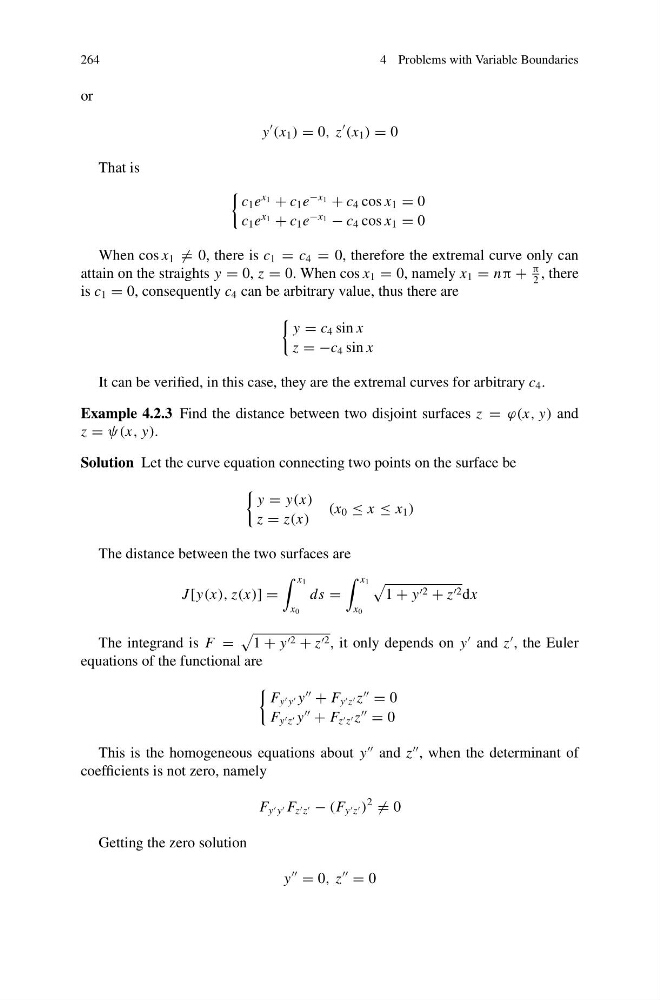
or
y
(x 1 ) = 0, z
(x 1 ) = 0
That is
c 1 e
x 1 + c 1 e
−x 1 + c 4 cos x 1 = 0
c 1 e
x 1 + c 1 e
−x 1 − c 4 cos x 1 = 0
When cos x 1 = 0, there is c 1 = c 4 = 0, therefore the extremal curve only can
attain on the straights y = 0, z = 0. When cos x 1 = 0, namely x 1 = nπ +
π
2
, there
is c 1 = 0, consequently c 4 can be arbitrary value, thus there are
y = c 4 sin x
z = −c 4 sin x
It can be verified, in this case, they are the extremal curves for arbitrary c 4 .
Example 4.2.3 Find the distance between two disjoint surfaces z = ϕ(x, y) and
z = ψ(x, y).
Solution Let the curve equation connecting two points on the surface be
y = y(x)
z = z(x)
(x 0 ≤ x ≤ x 1 )
The distance between the two surfaces are
J [y(x), z(x)] =
x 1
x 0
ds =
x 1
x 0
1 + y 2 + z 2 dx
The integrand is F =
1 + y 2 + z 2 , it only depends on y
and z
, the Euler
equations of the functional are
F y y y
+ F y z z
= 0
F y z y
+ F z z z
= 0
This is the homogeneous equations about y
and z
, when the determinant of
coefficients is not zero, namely
F y y F z z − (F y z )
2
= 0
Getting the zero solution
y
= 0, z
= 0
4 Problems with Variable Boundaries
or
y
(x 1 ) = 0, z
(x 1 ) = 0
That is
c 1 e
x 1 + c 1 e
−x 1 + c 4 cos x 1 = 0
c 1 e
x 1 + c 1 e
−x 1 − c 4 cos x 1 = 0
When cos x 1 = 0, there is c 1 = c 4 = 0, therefore the extremal curve only can
attain on the straights y = 0, z = 0. When cos x 1 = 0, namely x 1 = nπ +
π
2
, there
is c 1 = 0, consequently c 4 can be arbitrary value, thus there are
y = c 4 sin x
z = −c 4 sin x
It can be verified, in this case, they are the extremal curves for arbitrary c 4 .
Example 4.2.3 Find the distance between two disjoint surfaces z = ϕ(x, y) and
z = ψ(x, y).
Solution Let the curve equation connecting two points on the surface be
y = y(x)
z = z(x)
(x 0 ≤ x ≤ x 1 )
The distance between the two surfaces are
J [y(x), z(x)] =
x 1
x 0
ds =
x 1
x 0
1 + y 2 + z 2 dx
The integrand is F =
1 + y 2 + z 2 , it only depends on y
and z
, the Euler
equations of the functional are
F y y y
+ F y z z
= 0
F y z y
+ F z z z
= 0
This is the homogeneous equations about y
and z
, when the determinant of
coefficients is not zero, namely
F y y F z z − (F y z )
2
= 0
Getting the zero solution
y
= 0, z
= 0