

260
4 Problems with Variable Boundaries
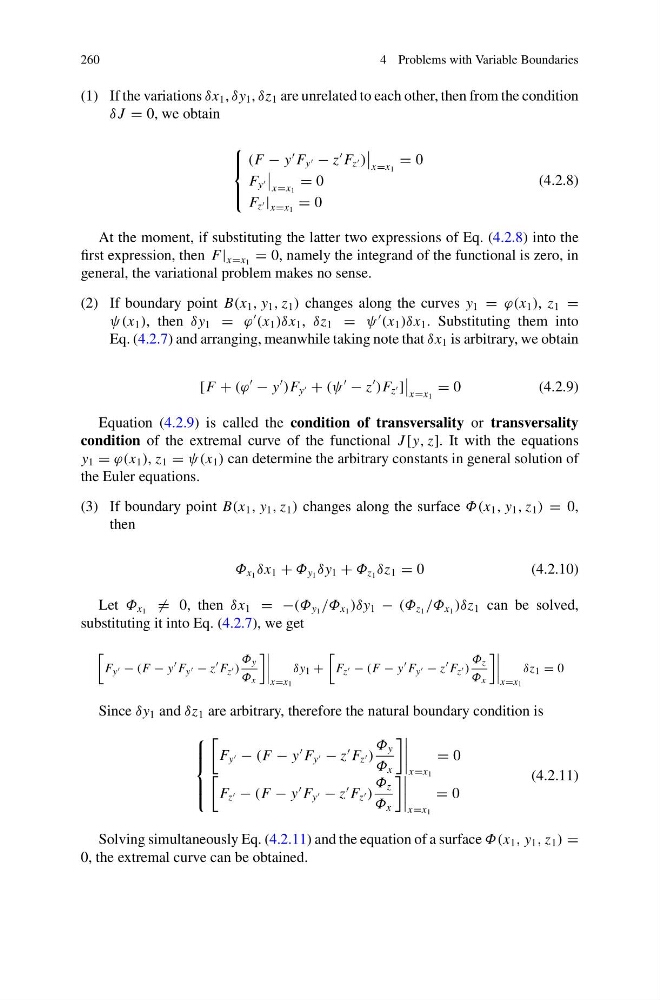
(1) If the variations δx 1 , δy 1 , δz 1 are unrelated to each other, then from the condition
δ J = 0, we obtain
⎧
⎪ ⎨
⎪ ⎩
(F − y
F y − z
F z )
x=x 1
= 0
F y
x=x 1
= 0
F z | x=x 1 = 0
(4.2.8)
At the moment, if substituting the latter two expressions of Eq. (4.2.8) into the
first expression, then F| x=x 1 = 0, namely the integrand of the functional is zero, in
general, the variational problem makes no sense.
(2) If boundary point B(x 1 , y 1 , z 1 ) changes along the curves y 1 = ϕ(x 1 ), z 1 =
ψ(x 1 ), then δy 1 = ϕ
(x 1 )δx 1 , δz 1 = ψ
(x 1 )δx 1 . Substituting them into
Eq. (4.2.7) and arranging, meanwhile taking note that δx 1 is arbitrary, we obtain
[F + (ϕ
− y
)F y + (ψ
− z
)F z ]
x=x 1
= 0
(4.2.9)
Equation (4.2.9) is called the condition of transversality or transversality
condition of the extremal curve of the functional J [y, z]. It with the equations
y 1 = ϕ(x 1 ), z 1 = ψ(x 1 ) can determine the arbitrary constants in general solution of
the Euler equations.
(3) If boundary point B(x 1 , y 1 , z 1 ) changes along the surface Φ(x 1 , y 1 , z 1 ) = 0,
then
Φ x 1 δx 1 + Φ y 1 δy 1 + Φ z 1 δz 1 = 0
(4.2.10)
Let Φ x 1 = 0, then δx 1 = −(Φ y 1 /Φ x 1 )δy 1 − (Φ z 1 /Φ x 1 )δz 1 can be solved,
substituting it into Eq. (4.2.7), we get
F y − (F − y
F y − z
F z )
Φ y
Φ x
x=x1
δy 1 +
F z − (F − y
F y − z
F z )
Φ z
Φ x
x=x1
δz 1 = 0
Since δy 1 and δz 1 are arbitrary, therefore the natural boundary condition is
⎧
⎪ ⎪ ⎨
⎪ ⎪ ⎩
F y − (F − y
F y − z
F z )
Φ y
Φ x
x=x 1
= 0
F z − (F − y
F y − z
F z )
Φ z
Φ x
x=x 1
= 0
(4.2.11)
Solving simultaneously Eq. (4.2.11) and the equation of a surface Φ(x 1 , y 1 , z 1 ) =
0, the extremal curve can be obtained.
4 Problems with Variable Boundaries
(1) If the variations δx 1 , δy 1 , δz 1 are unrelated to each other, then from the condition
δ J = 0, we obtain
⎧
⎪ ⎨
⎪ ⎩
(F − y
F y − z
F z )
x=x 1
= 0
F y
x=x 1
= 0
F z | x=x 1 = 0
(4.2.8)
At the moment, if substituting the latter two expressions of Eq. (4.2.8) into the
first expression, then F| x=x 1 = 0, namely the integrand of the functional is zero, in
general, the variational problem makes no sense.
(2) If boundary point B(x 1 , y 1 , z 1 ) changes along the curves y 1 = ϕ(x 1 ), z 1 =
ψ(x 1 ), then δy 1 = ϕ
(x 1 )δx 1 , δz 1 = ψ
(x 1 )δx 1 . Substituting them into
Eq. (4.2.7) and arranging, meanwhile taking note that δx 1 is arbitrary, we obtain
[F + (ϕ
− y
)F y + (ψ
− z
)F z ]
x=x 1
= 0
(4.2.9)
Equation (4.2.9) is called the condition of transversality or transversality
condition of the extremal curve of the functional J [y, z]. It with the equations
y 1 = ϕ(x 1 ), z 1 = ψ(x 1 ) can determine the arbitrary constants in general solution of
the Euler equations.
(3) If boundary point B(x 1 , y 1 , z 1 ) changes along the surface Φ(x 1 , y 1 , z 1 ) = 0,
then
Φ x 1 δx 1 + Φ y 1 δy 1 + Φ z 1 δz 1 = 0
(4.2.10)
Let Φ x 1 = 0, then δx 1 = −(Φ y 1 /Φ x 1 )δy 1 − (Φ z 1 /Φ x 1 )δz 1 can be solved,
substituting it into Eq. (4.2.7), we get
F y − (F − y
F y − z
F z )
Φ y
Φ x
x=x1
δy 1 +
F z − (F − y
F y − z
F z )
Φ z
Φ x
x=x1
δz 1 = 0
Since δy 1 and δz 1 are arbitrary, therefore the natural boundary condition is
⎧
⎪ ⎪ ⎨
⎪ ⎪ ⎩
F y − (F − y
F y − z
F z )
Φ y
Φ x
x=x 1
= 0
F z − (F − y
F y − z
F z )
Φ z
Φ x
x=x 1
= 0
(4.2.11)
Solving simultaneously Eq. (4.2.11) and the equation of a surface Φ(x 1 , y 1 , z 1 ) =
0, the extremal curve can be obtained.