

10
1 Preliminaries
Let L
0 be the unit vector of L
L
0
= cos αi + cos β j + cos γ k
(1.3.4)
and let the vector G be
G =
∂ϕ
∂ x
i +
∂ϕ
∂ y
j +
∂ϕ
∂z
k
(1.3.5)
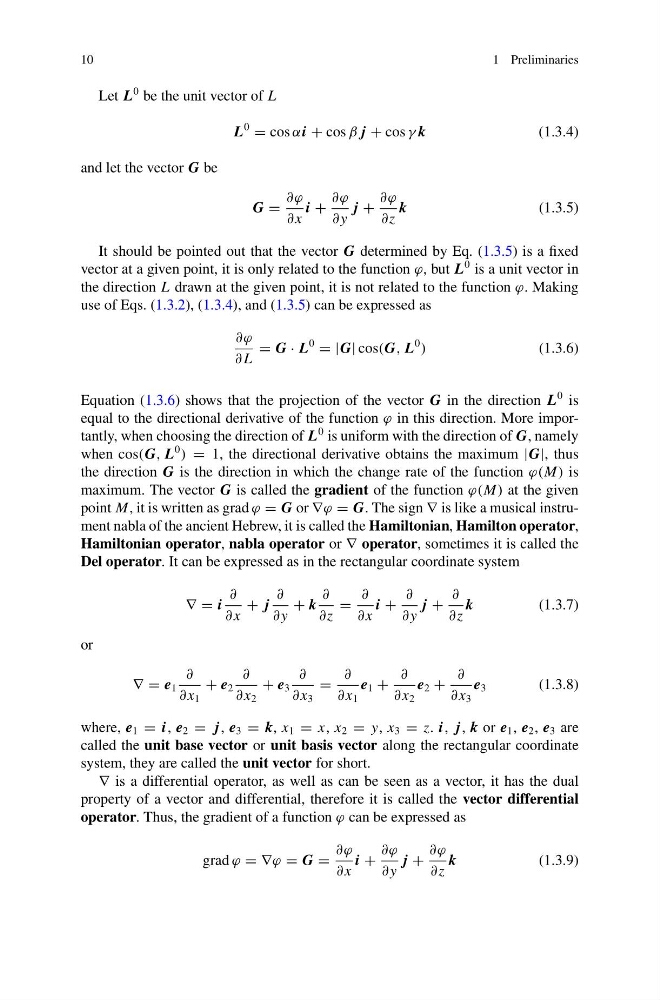
It should be pointed out that the vector G determined by Eq. (1.3.5) is a fixed
vector at a given point, it is only related to the function ϕ, but L
0 is a unit vector in
the direction L drawn at the given point, it is not related to the function ϕ. Making
use of Eqs. (1.3.2), (1.3.4), and (1.3.5) can be expressed as
∂ϕ
∂ L
= G · L
0
= |G| cos(G, L
0
)
(1.3.6)
Equation (1.3.6) shows that the projection of the vector G in the direction L
0 is
equal to the directional derivative of the function ϕ in this direction. More importantly, when choosing the direction of L
0 is uniform with the direction of G, namely
when cos(G, L
0
) = 1, the directional derivative obtains the maximum |G|, thus
the direction G is the direction in which the change rate of the function ϕ(M) is
maximum. The vector G is called the gradient of the function ϕ(M) at the given
point M, it is written as grad ϕ = G or ∇ϕ = G. The sign ∇ is like a musical instrument nabla of the ancient Hebrew, it is called the Hamiltonian, Hamilton operator,
Hamiltonian operator, nabla operator or ∇ operator, sometimes it is called the
Del operator. It can be expressed as in the rectangular coordinate system
∇ = i
∂
∂ x
+ j
∂
∂ y
+ k
∂
∂z
=
∂
∂ x
i +
∂
∂ y
j +
∂
∂z
k
(1.3.7)
or
∇ = e 1
∂
∂ x 1
+ e 2
∂
∂ x 2
+ e 3
∂
∂ x 3
=
∂
∂ x 1
e 1 +
∂
∂ x 2
e 2 +
∂
∂ x 3
e 3
(1.3.8)
where, e 1 = i, e 2 = j , e 3 = k, x 1 = x, x 2 = y, x 3 = z. i, j , k or e 1 , e 2 , e 3 are
called the unit base vector or unit basis vector along the rectangular coordinate
system, they are called the unit vector for short.
∇ is a differential operator, as well as can be seen as a vector, it has the dual
property of a vector and differential, therefore it is called the vector differential
operator. Thus, the gradient of a function ϕ can be expressed as
grad ϕ = ∇ϕ = G =
∂ϕ
∂ x
i +
∂ϕ
∂ y
j +
∂ϕ
∂z
k
(1.3.9)
1 Preliminaries
Let L
0 be the unit vector of L
L
0
= cos αi + cos β j + cos γ k
(1.3.4)
and let the vector G be
G =
∂ϕ
∂ x
i +
∂ϕ
∂ y
j +
∂ϕ
∂z
k
(1.3.5)
It should be pointed out that the vector G determined by Eq. (1.3.5) is a fixed
vector at a given point, it is only related to the function ϕ, but L
0 is a unit vector in
the direction L drawn at the given point, it is not related to the function ϕ. Making
use of Eqs. (1.3.2), (1.3.4), and (1.3.5) can be expressed as
∂ϕ
∂ L
= G · L
0
= |G| cos(G, L
0
)
(1.3.6)
Equation (1.3.6) shows that the projection of the vector G in the direction L
0 is
equal to the directional derivative of the function ϕ in this direction. More importantly, when choosing the direction of L
0 is uniform with the direction of G, namely
when cos(G, L
0
) = 1, the directional derivative obtains the maximum |G|, thus
the direction G is the direction in which the change rate of the function ϕ(M) is
maximum. The vector G is called the gradient of the function ϕ(M) at the given
point M, it is written as grad ϕ = G or ∇ϕ = G. The sign ∇ is like a musical instrument nabla of the ancient Hebrew, it is called the Hamiltonian, Hamilton operator,
Hamiltonian operator, nabla operator or ∇ operator, sometimes it is called the
Del operator. It can be expressed as in the rectangular coordinate system
∇ = i
∂
∂ x
+ j
∂
∂ y
+ k
∂
∂z
=
∂
∂ x
i +
∂
∂ y
j +
∂
∂z
k
(1.3.7)
or
∇ = e 1
∂
∂ x 1
+ e 2
∂
∂ x 2
+ e 3
∂
∂ x 3
=
∂
∂ x 1
e 1 +
∂
∂ x 2
e 2 +
∂
∂ x 3
e 3
(1.3.8)
where, e 1 = i, e 2 = j , e 3 = k, x 1 = x, x 2 = y, x 3 = z. i, j , k or e 1 , e 2 , e 3 are
called the unit base vector or unit basis vector along the rectangular coordinate
system, they are called the unit vector for short.
∇ is a differential operator, as well as can be seen as a vector, it has the dual
property of a vector and differential, therefore it is called the vector differential
operator. Thus, the gradient of a function ϕ can be expressed as
grad ϕ = ∇ϕ = G =
∂ϕ
∂ x
i +
∂ϕ
∂ y
j +
∂ϕ
∂z
k
(1.3.9)