

252
4 Problems with Variable Boundaries
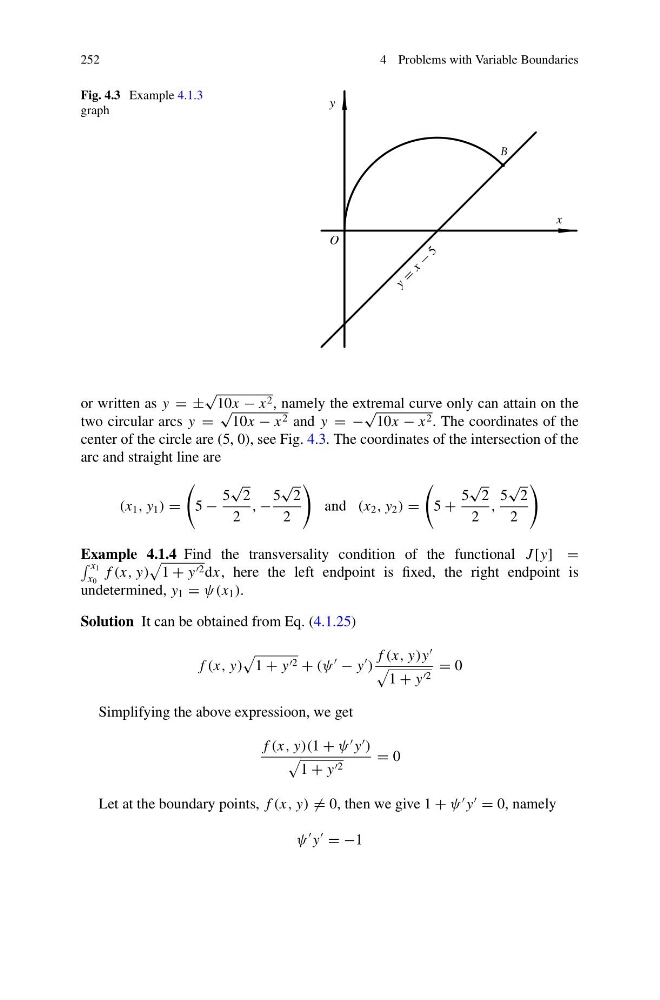
Fig. 4.3 Example 4.1.3
graph
B
O
x
y
y
=
x
−
5
or written as y = ±
√
10x − x 2 , namely the extremal curve only can attain on the
two circular arcs y =
√
10x − x 2 and y = −
√
10x − x 2 . The coordinates of the
center of the circle are (5, 0), see Fig. 4.3. The coordinates of the intersection of the
arc and straight line are
(x 1 , y 1 ) =
5 −
5
√
2
2
, −
5
√
2
2
and (x 2 , y 2 ) =
5 +
5
√
2
2
,
5
√
2
2
Example 4.1.4 Find the transversality condition of the functional J [y] =
x 1
x 0
f (x, y)
1 + y dx, here the left endpoint is fixed, the right endpoint is
undetermined, y 1 = ψ(x 1 ).
Solution It can be obtained from Eq. (4.1.25)
f (x, y)
1 + y + (ψ
− y
)
f (x, y)y
1 + y
= 0
Simplifying the above expressioon, we get
f (x, y)(1 + ψ
y
)
1 + y
= 0
Let at the boundary points, f (x, y) = 0, then we give 1 + ψ
y
= 0, namely
ψ
y
= −1
4 Problems with Variable Boundaries
Fig. 4.3 Example 4.1.3
graph
B
O
x
y
y
=
x
−
5
or written as y = ±
√
10x − x 2 , namely the extremal curve only can attain on the
two circular arcs y =
√
10x − x 2 and y = −
√
10x − x 2 . The coordinates of the
center of the circle are (5, 0), see Fig. 4.3. The coordinates of the intersection of the
arc and straight line are
(x 1 , y 1 ) =
5 −
5
√
2
2
, −
5
√
2
2
and (x 2 , y 2 ) =
5 +
5
√
2
2
,
5
√
2
2
Example 4.1.4 Find the transversality condition of the functional J [y] =
x 1
x 0
f (x, y)
1 + y dx, here the left endpoint is fixed, the right endpoint is
undetermined, y 1 = ψ(x 1 ).
Solution It can be obtained from Eq. (4.1.25)
f (x, y)
1 + y + (ψ
− y
)
f (x, y)y
1 + y
= 0
Simplifying the above expressioon, we get
f (x, y)(1 + ψ
y
)
1 + y
= 0
Let at the boundary points, f (x, y) = 0, then we give 1 + ψ
y
= 0, namely
ψ
y
= −1