

250
4 Problems with Variable Boundaries
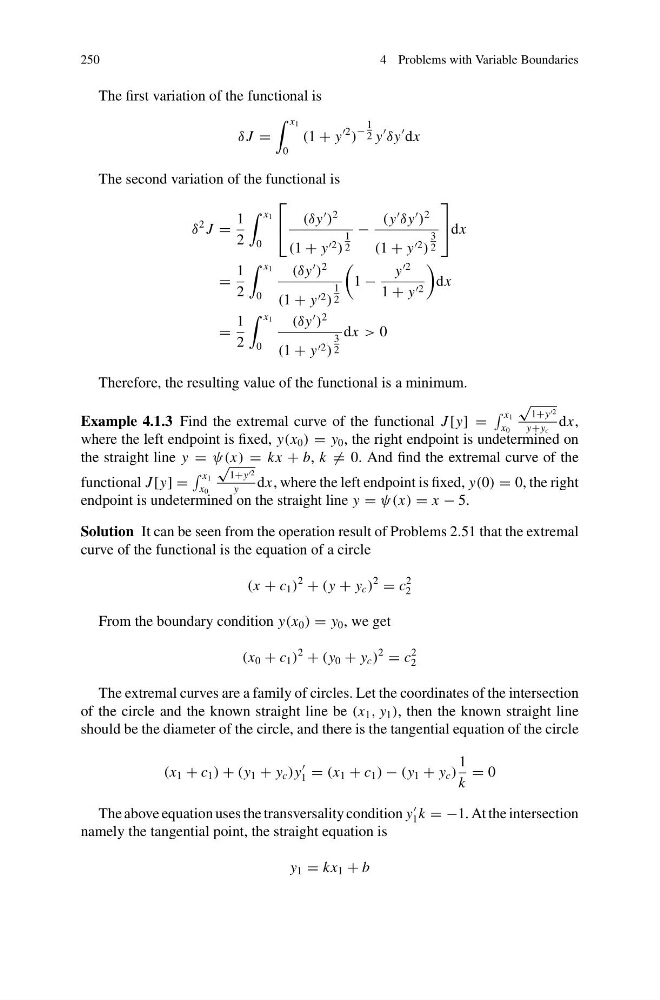
The first variation of the functional is
δ J =
x 1
0
(1 + y
2
)
−
1
2 y
δy
dx
The second variation of the functional is
δ
2 J =
1
2
x 1
0
⎡
⎣ (δy
)
2
(1 + y 2 )
1
2
−
(y
δy
)
2
(1 + y 2 )
3
2
⎤
⎦ dx
=
1
2
x 1
0
(δy
)
2
(1 + y 2 )
1
2
1 −
y
2
1 + y 2
dx
=
1
2
x 1
0
(δy
)
2
(1 + y 2 )
3
2
dx > 0
Therefore, the resulting value of the functional is a minimum.
Example 4.1.3 Find the extremal curve of the functional J [y] =
x 1
x 0
√
1+y 2
y+y c
dx,
where the left endpoint is fixed, y(x 0 ) = y 0 , the right endpoint is undetermined on
the straight line y = ψ(x) = kx + b, k = 0. And find the extremal curve of the
functional J [y] =
x 1
x 0
√
1+y 2
y
dx, where the left endpoint is fixed, y(0) = 0, the right
endpoint is undetermined on the straight line y = ψ(x) = x − 5.
Solution It can be seen from the operation result of Problems 2.51 that the extremal
curve of the functional is the equation of a circle
(x + c 1 )
2
+ (y + y c )
2
= c
2
2
From the boundary condition y(x 0 ) = y 0 , we get
(x 0 + c 1 )
2
+ (y 0 + y c )
2
= c
2
2
The extremal curves are a family of circles. Let the coordinates of the intersection
of the circle and the known straight line be (x 1 , y 1 ), then the known straight line
should be the diameter of the circle, and there is the tangential equation of the circle
(x 1 + c 1 ) + (y 1 + y c )y
1 = (x 1 + c 1 ) − (y 1 + y c )
1
k
= 0
The above equation uses the transversality condition y
1 k = −1. At the intersection
namely the tangential point, the straight equation is
y 1 = kx 1 + b
4 Problems with Variable Boundaries
The first variation of the functional is
δ J =
x 1
0
(1 + y
2
)
−
1
2 y
δy
dx
The second variation of the functional is
δ
2 J =
1
2
x 1
0
⎡
⎣ (δy
)
2
(1 + y 2 )
1
2
−
(y
δy
)
2
(1 + y 2 )
3
2
⎤
⎦ dx
=
1
2
x 1
0
(δy
)
2
(1 + y 2 )
1
2
1 −
y
2
1 + y 2
dx
=
1
2
x 1
0
(δy
)
2
(1 + y 2 )
3
2
dx > 0
Therefore, the resulting value of the functional is a minimum.
Example 4.1.3 Find the extremal curve of the functional J [y] =
x 1
x 0
√
1+y 2
y+y c
dx,
where the left endpoint is fixed, y(x 0 ) = y 0 , the right endpoint is undetermined on
the straight line y = ψ(x) = kx + b, k = 0. And find the extremal curve of the
functional J [y] =
x 1
x 0
√
1+y 2
y
dx, where the left endpoint is fixed, y(0) = 0, the right
endpoint is undetermined on the straight line y = ψ(x) = x − 5.
Solution It can be seen from the operation result of Problems 2.51 that the extremal
curve of the functional is the equation of a circle
(x + c 1 )
2
+ (y + y c )
2
= c
2
2
From the boundary condition y(x 0 ) = y 0 , we get
(x 0 + c 1 )
2
+ (y 0 + y c )
2
= c
2
2
The extremal curves are a family of circles. Let the coordinates of the intersection
of the circle and the known straight line be (x 1 , y 1 ), then the known straight line
should be the diameter of the circle, and there is the tangential equation of the circle
(x 1 + c 1 ) + (y 1 + y c )y
1 = (x 1 + c 1 ) − (y 1 + y c )
1
k
= 0
The above equation uses the transversality condition y
1 k = −1. At the intersection
namely the tangential point, the straight equation is
y 1 = kx 1 + b