

246
4 Problems with Variable Boundaries
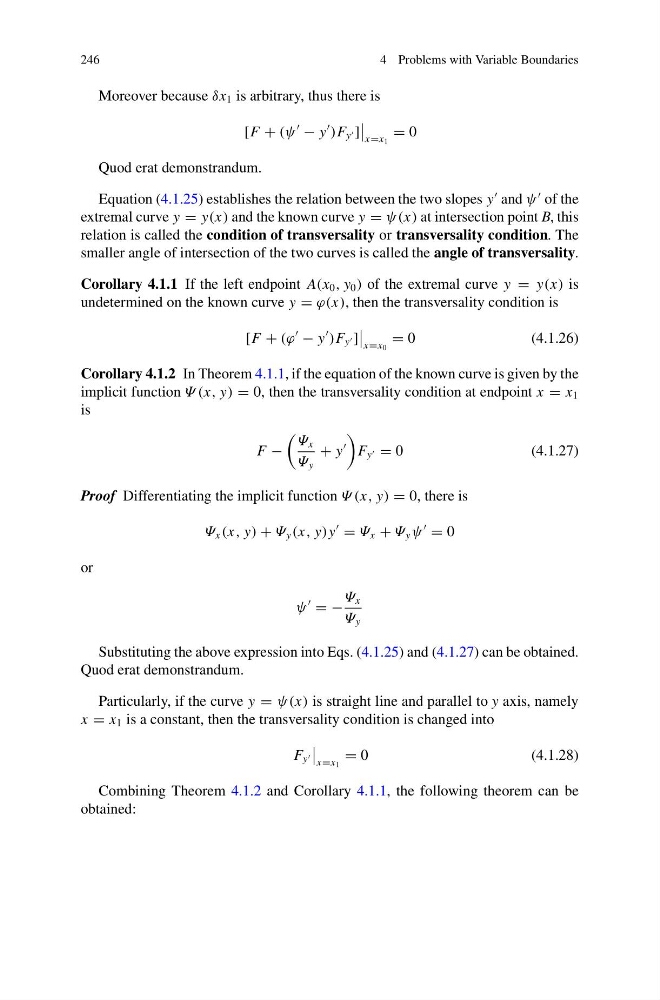
Moreover because δx 1 is arbitrary, thus there is
[F + (ψ
− y
)F y ]
x=x 1
= 0
Quod erat demonstrandum.
Equation (4.1.25) establishes the relation between the two slopes y
and ψ
of the
extremal curve y = y(x) and the known curve y = ψ(x) at intersection point B, this
relation is called the condition of transversality or transversality condition. The
smaller angle of intersection of the two curves is called the angle of transversality.
Corollary 4.1.1 If the left endpoint A(x 0 , y 0 ) of the extremal curve y = y(x) is
undetermined on the known curve y = ϕ(x), then the transversality condition is
[F + (ϕ
− y
)F y ]
x=x 0
= 0
(4.1.26)
Corollary 4.1.2 In Theorem 4.1.1, if the equation of the known curve is given by the
implicit function Ψ (x, y) = 0, then the transversality condition at endpoint x = x 1
is
F −
Ψ x
Ψ y
+ y
F y = 0
(4.1.27)
Proof Differentiating the implicit function Ψ (x, y) = 0, there is
Ψ x (x, y) + Ψ y (x, y)y
= Ψ x + Ψ y ψ
= 0
or
ψ
= −
Ψ x
Ψ y
Substituting the above expression into Eqs. (4.1.25) and (4.1.27) can be obtained.
Quod erat demonstrandum.
Particularly, if the curve y = ψ(x) is straight line and parallel to y axis, namely
x = x 1 is a constant, then the transversality condition is changed into
F y
x=x 1
= 0
(4.1.28)
Combining Theorem 4.1.2 and Corollary 4.1.1, the following theorem can be
obtained:
4 Problems with Variable Boundaries
Moreover because δx 1 is arbitrary, thus there is
[F + (ψ
− y
)F y ]
x=x 1
= 0
Quod erat demonstrandum.
Equation (4.1.25) establishes the relation between the two slopes y
and ψ
of the
extremal curve y = y(x) and the known curve y = ψ(x) at intersection point B, this
relation is called the condition of transversality or transversality condition. The
smaller angle of intersection of the two curves is called the angle of transversality.
Corollary 4.1.1 If the left endpoint A(x 0 , y 0 ) of the extremal curve y = y(x) is
undetermined on the known curve y = ϕ(x), then the transversality condition is
[F + (ϕ
− y
)F y ]
x=x 0
= 0
(4.1.26)
Corollary 4.1.2 In Theorem 4.1.1, if the equation of the known curve is given by the
implicit function Ψ (x, y) = 0, then the transversality condition at endpoint x = x 1
is
F −
Ψ x
Ψ y
+ y
F y = 0
(4.1.27)
Proof Differentiating the implicit function Ψ (x, y) = 0, there is
Ψ x (x, y) + Ψ y (x, y)y
= Ψ x + Ψ y ψ
= 0
or
ψ
= −
Ψ x
Ψ y
Substituting the above expression into Eqs. (4.1.25) and (4.1.27) can be obtained.
Quod erat demonstrandum.
Particularly, if the curve y = ψ(x) is straight line and parallel to y axis, namely
x = x 1 is a constant, then the transversality condition is changed into
F y
x=x 1
= 0
(4.1.28)
Combining Theorem 4.1.2 and Corollary 4.1.1, the following theorem can be
obtained: