

234
3 Sufficient Conditions of Extrema of Functionals
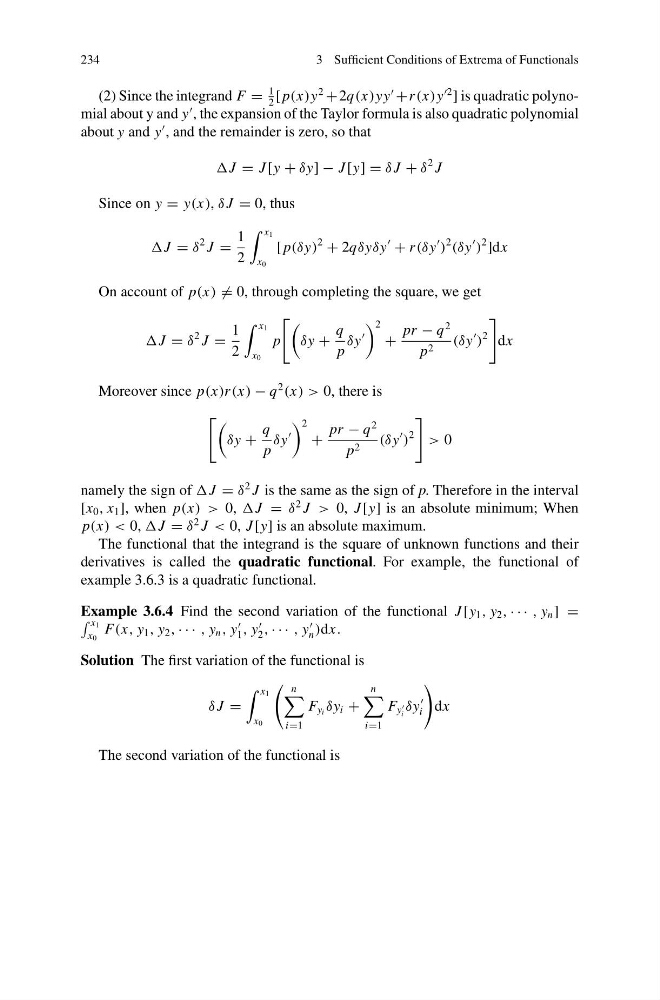
(2) Since the integrand F =
1
2
[ p(x)y
2
+ 2q(x)yy
+r (x)y
2
] is quadratic polynomial about y and y
, the expansion of the Taylor formula is also quadratic polynomial
about y and y
, and the remainder is zero, so that
J = J [y + δy] − J [y] = δ J + δ
2 J
Since on y = y(x), δ J = 0, thus
J = δ
2 J =
1
2
x 1
x 0
[ p(δy)
2
+ 2qδyδy
+ r (δy
)
2
(δy
)
2
]dx
On account of p(x) = 0, through completing the square, we get
J = δ
2 J =
1
2
x 1
x 0
p
δy +
q
p
δy
2
+
pr − q
2
p 2 (δy
)
2
dx
Moreover since p(x)r (x) − q
2
(x) > 0, there is
δy +
q
p
δy
2
+
pr − q
2
p 2 (δy
)
2
> 0
namely the sign of J = δ
2 J is the same as the sign of p. Therefore in the interval
[x 0 , x 1 ], when p(x) > 0, J = δ
2 J > 0, J [y] is an absolute minimum; When
p(x) < 0, J = δ
2 J < 0, J [y] is an absolute maximum.
The functional that the integrand is the square of unknown functions and their
derivatives is called the quadratic functional. For example, the functional of
example 3.6.3 is a quadratic functional.
Example 3.6.4 Find the second variation of the functional J [y 1 , y 2 , · · · , y n ] =
x 1
x 0
F(x, y 1 , y 2 , · · · , y n , y
1 , y
2 , · · · , y
n )dx.
Solution The first variation of the functional is
δ J =
x 1
x 0
n
i=1
F y i δy i +
n
i=1
F y
i
δy
i
dx
The second variation of the functional is
3 Sufficient Conditions of Extrema of Functionals
(2) Since the integrand F =
1
2
[ p(x)y
2
+ 2q(x)yy
+r (x)y
2
] is quadratic polynomial about y and y
, the expansion of the Taylor formula is also quadratic polynomial
about y and y
, and the remainder is zero, so that
J = J [y + δy] − J [y] = δ J + δ
2 J
Since on y = y(x), δ J = 0, thus
J = δ
2 J =
1
2
x 1
x 0
[ p(δy)
2
+ 2qδyδy
+ r (δy
)
2
(δy
)
2
]dx
On account of p(x) = 0, through completing the square, we get
J = δ
2 J =
1
2
x 1
x 0
p
δy +
q
p
δy
2
+
pr − q
2
p 2 (δy
)
2
dx
Moreover since p(x)r (x) − q
2
(x) > 0, there is
δy +
q
p
δy
2
+
pr − q
2
p 2 (δy
)
2
> 0
namely the sign of J = δ
2 J is the same as the sign of p. Therefore in the interval
[x 0 , x 1 ], when p(x) > 0, J = δ
2 J > 0, J [y] is an absolute minimum; When
p(x) < 0, J = δ
2 J < 0, J [y] is an absolute maximum.
The functional that the integrand is the square of unknown functions and their
derivatives is called the quadratic functional. For example, the functional of
example 3.6.3 is a quadratic functional.
Example 3.6.4 Find the second variation of the functional J [y 1 , y 2 , · · · , y n ] =
x 1
x 0
F(x, y 1 , y 2 , · · · , y n , y
1 , y
2 , · · · , y
n )dx.
Solution The first variation of the functional is
δ J =
x 1
x 0
n
i=1
F y i δy i +
n
i=1
F y
i
δy
i
dx
The second variation of the functional is